
AMC Goes from Economy Cars to Muscle Cars: Ep2. The Last Independent Automaker
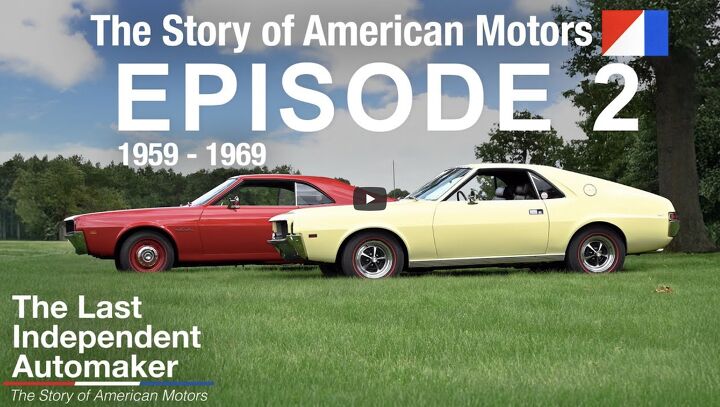
After surviving the 1950s, AMC goes upmarket, but struggles to capture young baby boomers who want faster, sportier “muscle cars.” In response, the company makes big changes to its products and public image.
The Last Independent Automaker is a six-part documentary series, produced by Joe Ligo, Jimm Needle, and Patrick Foster. It details the dramatic rise and fall of American Motors Corp., told through over 35 exclusive interviews, hundreds of rare photographs, and hours of historical and new automobile footage.
The TTAC Creators Series tells stories and amplifies creators from all corners of the car world, including culture, dealerships, collections, modified builds and more.
An AI-generated transcript edited by a human staffer is below.
[Image: YouTube Screenshot]
Become a TTAC insider. Get the latest news, features, TTAC takes, and everything else that gets to the truth about cars first by subscribing to our newsletter.
This transcript is from a documentary episode about the rise, transformation, and struggles of American Motors Corporation (AMC) during the late 1950s through the late 1960s, focusing heavily on George Romney, AMC’s leadership changes, and the company’s attempt to compete with Detroit’s “Big Three.”
Key Themes & Timeline
George Romney’s Success at AMC
- By 1959, George Romney had turned AMC from a struggling automaker into a profitable company through the success of the fuel-efficient Rambler compact cars.
- Romney positioned AMC against the large, gas-hungry cars made by GM, Ford, and Chrysler.
- His leadership made AMC briefly the third-best-selling car brand in America, a remarkable achievement for an independent automaker.
AMC’s Design and Manufacturing Challenges
- AMC operated with limited resources and relied on creative, low-cost engineering and styling solutions.
- Designer Richard Teague emerged as a key figure, known for innovative styling done on tight budgets.
- The company constantly struggled with balancing attractive redesigns against the enormous cost of retooling vehicles.
Labor Relations and Profit Sharing
- Romney worked closely with Walter Reuther to create one of the first UAW contracts featuring worker profit-sharing.
- Romney believed employees should share in the company’s success, though critics called him a socialist.
Leadership Conflict and Romney’s Exit
- Tensions developed between Romney and AMC styling chief Edmund Anderson over the use of outside design consultants.
- Romney eventually forced Anderson out and promoted Richard Teague.
- In 1962, Romney left AMC to run for governor of Michigan, eventually winning office.
Roy Abernathy Changes AMC’s Direction
- New CEO Roy Abernathy abandoned Romney’s economy-car philosophy.
- Abernathy pushed AMC upscale with larger, flashier, more luxurious cars in an effort to compete directly with the Big Three.
- He also tried to eliminate AMC’s “practical but boring” image.
The Mustang Changes the Industry
- The launch of the Ford Mustang transformed the auto market almost overnight.
- AMC lacked a direct competitor and rushed to develop sporty “pony cars.”
- The Rambler Tarpon evolved into the larger but less successful Marlin after executive interference altered its design.
Sales Decline and Identity Crisis
- AMC’s upscale strategy failed:
- Younger buyers preferred muscle cars like the Mustang, GTO, and Camaro.
- Traditional Rambler customers were alienated.
- Rambler sales fell sharply, and AMC suffered its first yearly loss in a decade.
The Javelin and AMX Revival
- AMC regrouped under new leadership led by Roy Chapin Jr..
- Designer Richard Teague helped create the sporty AMC Javelin and AMC AMX.
- AMC hired the groundbreaking advertising agency Wells Rich Greene, led by Mary Wells Lawrence.
- Aggressive “unfair comparison” ads directly attacked competitors like the Mustang and Volkswagen.
- The strategy successfully modernized AMC’s image and attracted younger buyers.
Racing and Brand Reinvention
- AMC entered motorsports and used racing success to build credibility.
- The Javelin became a commercial success and helped revive excitement around AMC.
- The company moved far away from Romney-era practicality toward performance and youth marketing.
Overall Message
The documentary portrays AMC as a creative underdog constantly fighting for survival against much larger rivals. It highlights:
- George Romney’s visionary but disciplined leadership,
- the dangers of chasing trends without enough resources,
- the importance of branding and product identity,
- and AMC’s repeated reinvention attempts during a rapidly changing American car market.
The episode ends setting up AMC’s next chapter with the introduction of the Gremlin and further changes under Roy Chapin Jr.

Joe Ligo is an Emmy Award-winning TV producer and the director of The Last Independent Automaker, a six-part documentary on the history of American Motors Corporation. He's also the creator of the webseries AutoMoments, which features reviews and stories of classic cars. Previously he's worked with Hagerty, The Drive, The Autopian and MotorWeek. He owns a 1972 AMC Ambassador Brougham sedan.
More by AutoMoments | TTAC Creator






Comments
Join the conversation
Scrunched into VW Beetles at the time, I thought the "Wide Small Car" Pacer looked dreamy. Couldn't ask for a better greenhouse. Never got to try one.
AMC would still be around had they consulted with the Geoff's