


Tales From the Beat Episode 136: Journalist-Author David Bernknopf
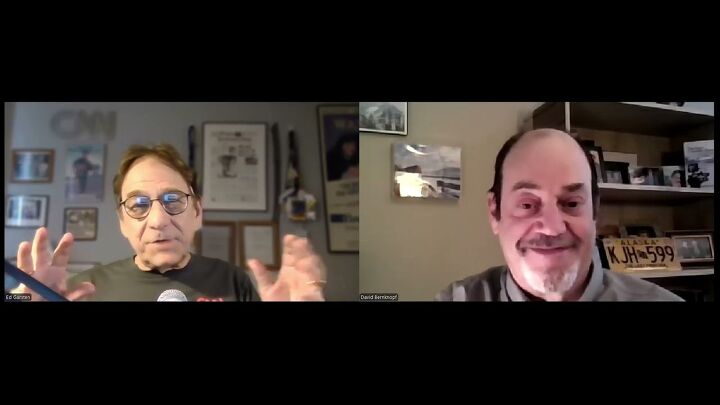
After a career that spanned more than two decades at CNN and years as an independent producer, David Bernknopf found himself looking for work and found it running an investigative unit at a TV operation in Alaska.
He wrote a novel informed by his experiences in the 49th state that's humorous but also takes on serious journalistic issues. He discusses "Two Years on Another Planet...or is it Alaska," the issues he encountered, plus the state of journalism and CNN with former CNN colleague and podcast host Ed Garsten.
TTAC Creator Ed Garsten hosts " Tales from the Beat," a podcast about the automotive and media worlds. A veteran reporter and public relations operative, Garsten worked for CNN, The Associated Press, The Detroit News, Chrysler's PR department and Franco Public Relations. He is currently a senior contributor for Forbes.
The TTAC Creators Series tells stories and amplifies creators from all corners of the car world, including culture, dealerships, collections, modified builds and more.
A transcript, cleaned up via AI and edited by a staffer, is below.
[Image: YouTube Screenshot]
Become a TTAC insider. Get the latest news, features, TTAC takes, and everything else that gets to the truth about cars first by subscribing to our newsletter.
Transcript:
Tales from the Beat: Episode 136
Host: Ed Garsten
Guest: David Bernoff
Ed Garsten: Hi everyone, I'm Ed Garsten and welcome to episode 136 of Tales from the Beat, where we look at news and PR from both sides of the scrimmage line. I’m thrilled to have as my guest on this episode an old colleague of mine from back in the day at CNN, Mr. David Bernoff. David, you’ve been a writer, editor, producer, documentarian... what else do you do?
David Bernoff: What else did I do? I traveled the world and covered political conventions. I had a great 21-plus years. My last story—you probably don’t know this—was 9/11.
Ed: Is that right?
David: Yeah. I was the site producer at the United 93 crash in Pennsylvania. The reason they chose me was that one of the assignment editors said, "Well, you're from Pittsburgh, right?" I said, "Yeah, that's where I grew up." She asked, "Do you know where Shanksville is?" I said, "No." She said, "It's near Somerset." I said, "I know where Somerset is." She said, "Get in your car and start driving."
Ed: Wow. And how long were you out there?
David: About a week. In fact, weren't you out there with us?
Ed: No, actually, it was my crew. I was part of that great layoff in January of '01 with that fabulous merger with AOL and Time Warner. My bureau in Detroit was left with just a crew and no reporter, and they were the closest crew. We went everywhere—even though we were in Detroit, we frequently went all around the country for breaking stories. They worked 9/11, and then when they came home, the company laid them off too and closed the bureau.
David: Here’s a funny bit that says a lot about the business: I had already left CNN. I had taken a buyout and was sitting at home when I called the desk and said, "I know you guys need help." I had only been gone a few weeks. They said, "Head out. Do you know where Shanksville is? Find it and get going."
Because I was getting money from my departure agreement and then freelancer money on top of it, about a year later I got a call from CNN accounting. They said, "We’ve made a terrible mistake; we discovered we were paying you twice for the same amount of time." I said, "No, that’s not a mistake! I agree with that! You owe me the money." We eventually agreed, and they did pay.
Ed: That’s funny. Well, along with all those other things you’ve done, we want to talk about your new aspiration as an author. Let’s see—is it too shiny? Can you see this? Two Years on Another Planet: Or Is It Alaska? You must have been told by people, "Oh, you have a book in you."
David: Yeah, I certainly was told that, especially regarding my time at CNN and covering politics. But I always felt that nobody cares about the producer; they care about the big-name correspondents you work for. I never felt a book was "in me" until I was in Alaska. It was so different in every way—culturally and environmentally. It was a lonely place for me because I moved there with no friends or family.
I was also given unprecedented freedom. To be honest, they were so happy to have an experienced network-type producer up there that it was just, "Whatever you want to do, do it." That’s unheard of.
Ed: I can't imagine. How did you end up there?
David: I had left a job working for a syndicated investigative news program in Washington called Full Measure. The program was becoming more political and less investigative, and I didn't want to do that, so I quit. I was sitting at home and got a cold call from a big TV station group. They asked, "Would you consider a job in Alaska?"
I didn't stifle a laugh because it seemed so bizarre. I told them, "You guys couldn't afford me in Alaska," but they told me to think about it. I was just consulting on some podcasts at the time, and I thought, "What a great adventure this could be." It took four weeks to get my stuff to Anchorage. Not only does it have to travel across the country, but it has to wait for a freighter in Tacoma. Everything in Alaska comes in by freighter except a few Amazon Prime packages and mail.
Ed: So you were just up there waiting for your stuff?
David: I lived in a hotel for a while. When I got my townhouse, the only thing I bought was a mattress so I could sleep. For three weeks, I lived in an empty place.
Ed: That reminds me of when I was hired at CNN for the launch team of Headline News. I moved from Tucson to Atlanta, and the only furniture I had in a 2,000-square-foot apartment was a cardboard box from a 20-inch color TV and a webbed lawn chair. I lived like that for two months until my wife sold our house and brought the rest of our stuff. So, you got this job running an investigative unit?
David: Yes. The group had two stations in Anchorage, two in Fairbanks, and several repeater stations. It was a statewide operation. Even so, the whole state doesn't even have 800,000 people.
What I came to realize is that while it looks big on a map, about 15-20% of the people live in "off-the-road" towns—meaning there is literally no road that goes there. Most of them are Alaskan Natives living a subsistence life. Last year, two towns were wiped out in a typhoon and people had to be airlifted by military cargo flights. They are living in hotels in Anchorage now, and it’s a real culture shock for the kids. Those communities just voted to move their entire towns to higher ground so they can move back. Those are the kinds of stories you get to cover—things people in the "Lower 48" don't even believe.
Ed: You were there for two years. Was that predetermined?
David: I agreed to stay for two years. There were times I thought I wouldn't make it. Many people are bothered by the short days in winter or long days in summer, but for me, it was the length of the winter. For almost six months of the year, you don't see a roof—you just see snow on the roof because it never gets warm enough to melt. There’s a joke in the book that when things finally melt, you don't even know what you're going to find under those piles of snow.
Ed: In the book, you take on some salient journalistic issues regarding government accountability. Could you talk about those issues—both in real life and how you translated them into fiction?
David: The book is fiction, not a memoir. The characters are conglomerations. The main antagonist is based on things that happened to me at CNN and people I worked with there.
There is one story in the book that is told almost truthfully: we had been trying for months to get the Mayor of Anchorage to do an interview about how COVID relief funds were being spent. The Mayor avoided us at every turn. One day, we heard he was having his first news conference in months. When we arrived, the Mayor's press person told us, "He's not going to talk to you. This is a news conference to talk about what the Mayor wants to talk about, not what you want to talk about."
I said, "I can't make him answer, but the definition of a news conference is that we ask questions and you answer." This person actually said to me, "I don't know how you do things in New York, but that's not how we do things in Anchorage." Then, the assistant put his hand on my reporter’s shoulder. That’s a step too far for me. I told him, "Do not touch us. If the Mayor doesn't want to answer, fine, but don't touch us." He tried to claim I touched him first. Luckily, I had asked our camera person to start rolling the minute we walked into the building.
It gets to the issue of accountability. Do leaders feel any responsibility to answer questions from the media anymore? Increasingly, they don't, because they have their own ways to communicate without us.
Ed: It's true. I worked in corporate communications for Chrysler for 11 years. During the bankruptcy in 2009, we had a CEO who didn't care for the press. He asked me, "Should I do news conferences?" I said, "Yes, of course." He asked why, and I explained that it allows you to espouse your views in a true context so people hear it directly from you rather than interpreted by outside sources. He looked at me and said, "I'm not going to do them. They're just going to ask hard questions and it's just going to piss me off."
David: That is more and more common. We have a fictionalized version of this in the book. We were trying to interview the head of the Alaska state prison system because an inordinate number of people were dying in custody. They had come up with an ill-defined category called "expected deaths" to avoid responsibility. We wanted a definition of what an "expected death" was. Finally, the head of communications sent a note saying the department head would be "busy for the foreseeable future." I wanted to write back asking, "Can you define 'the foreseeable future'? Is that forever?"
Ed: Looking at the totality of your experience, how do you see the relationship between the audience and journalism now in terms of trust?
David: It’s depressing. There is a decline in trust, some of which we have to accept responsibility for, but it’s more about how people get information now. In Alaska, it was a throwback—people didn't yell "fake news" at me. But at the New York Times or CNN, you start off with half your audience hating you and 25% finding you irrelevant.
I worry that as this continues, it becomes harder to run a civil society based on responsive government and compromise. I’m glad I’m not doing it on a daily basis anymore because it's so hard to reach a broad audience.
Ed: I freelance for Forbes now, and I have to find stories based on what people are asking for on AI. Even a headline has to intimate that I’m answering a specific question the user already asked. That’s not news; that’s searching.
David: Too much of it is chasing what’s hot rather than coming up with your own stuff. We worked for a guy who said the mix of a newscast is "what people ought to know" versus "what people want to know." Today, it's almost all "want to know."
In the old days, a station in Philadelphia and a station in Pittsburgh would share a full-time state house reporter. Those days are gone. In Alaska, we hired someone to cover Juneau—which is an "off-road" town—and after two weeks, the station said they couldn't afford the hotel anymore, so she had to cover it by phone. You can't cover a city hall by phone. You cover it by being in the building and bumping into people.
Ed: Exactly. One of the best interviews I ever got was with a former policeman in a men’s room. I handed him my card while he had a hand free, and I ended up getting an interview with him in prison that nobody else got. You have to be there.
David: And you have to build relationships. Every journalist today is so busy on social media or writing multiple web versions of a story that they have less time to build sources.
Most people don't know this, but police departments are moving to digital encrypted communications. Scanners don't work anymore. As a journalist, you no longer know if there’s a big fire or a homicide in real-time. You have to wait for them to call you. That’s a huge blow to "meat and potatoes" journalism.
Ed: David, before we go, let's talk about the book one more time. Two Years on Another Planet: Or Is It Alaska? How can people get it?
David: It’ll be out in a few days and is available for pre-order at Barnes & Noble, Books-A-Million, and Amazon. Since it’s an independent publication, I urge people to review it—even if you don't like it, a star rating helps the algorithms. My website is www.2yearbook.com.
Ed: It’s a really cool book. We’ll have to come back and talk about the old CNN days another time. We want the best for our old employer, but there are difficult times ahead.
David: I look at it as a life’s privilege to have been part of that organization for 20 years.
Ed: We were there for the best years—that sense of building something that hadn't been done before. I remember worrying, "Can we really fill 24 hours of news?" It seems silly now.
David: The logo you see behind me is from the original anchor set on Techwood Drive in Atlanta. My career has been fantastic, and I loved Alaska for all its insanity and challenges.
Ed: I felt that truth through the book. David Bernoff, it was great to catch up. Good luck with the book. And for all of you who tuned in, thanks for being with us for Tales from the Beat. I'm Ed Garsten, and I’ll be back soon.

TTAC Creator Ed Garsten hosts " Tales from the Beat," a podcast about the automotive and media worlds. A veteran reporter and public relations operative, Garsten worked for CNN, The Associated Press, The Detroit News, Chrysler's PR department and Franco Public Relations. He is currently a senior contributor for Forbes.
More by Ed Garsten, TTAC Creator







Comments
Join the conversation
I've sold numerous trucks in Alaska. costs $4,000 between trucking to Redmond and barge to Anchorage, still save buyers $2-3,000 as inventory there is limited.
So...all very interesting stuff here, but I don't think this journalist ever covered the automotive beat.