Rare Rides Icons: The Jeep Wagoneer, The First Luxury SUV Ever (Part VI)

In our last Wagoneer installment of Rare Rides Icons, we began the journey through the frequent and sometimes confusing updates Jeep made to its flagship utility wagon. Edits to the SJ Wagoneer began in 1964 and continued through the end of its life at the 1991 model year. However, the most important change to the Wagoneer occurred as a side-effect of Jeep’s ownership. We pick up in early 1970.
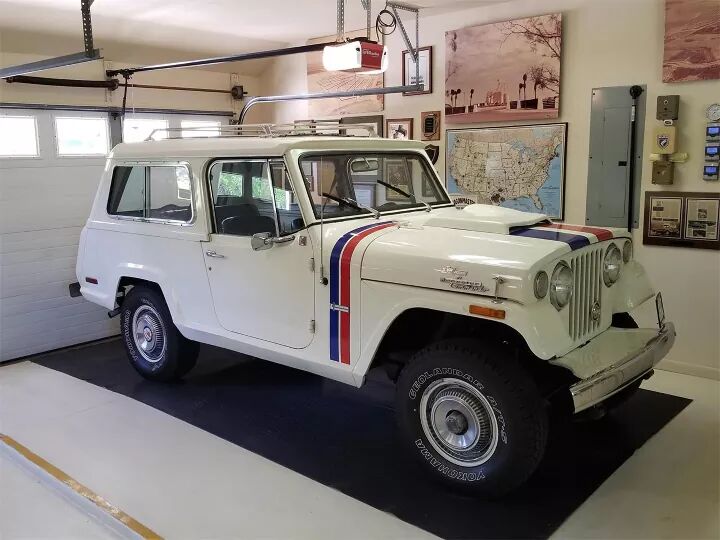
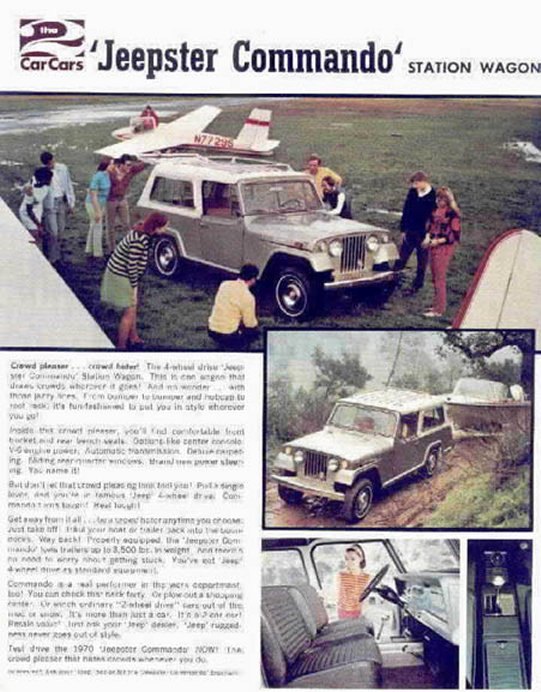
Kaiser Jeep had a narrow product line, and limited funds with which to develop new models. The company’s only new product in the second half of the Sixties was the new Jeepster Commando, a rework of the basic idea behind the 1940s Jeepster. The market was changing, and the light duty recreational utility vehicle was becoming popular. Vehicles like the Jeepster, IH Scout, and Ford Bronco offered more compact dimensions than traditional utility wagons.
Kenosha, Wisconsin based American Motors Corporation showed some interest in Kaiser Jeep throughout the Sixties, and talks advanced to negotiations as the decade drew to a close. AMC saw the value in the Jeep brand, and the opportunity the recreational vehicle market presented for additional breadth in passenger-oriented utility vehicles. Jeep vehicles were already on sale, key to a company like AMC which had never built utility vehicles. And unusually for AMC, they were flush with cash from the success of their smaller, fuel efficient vehicles.
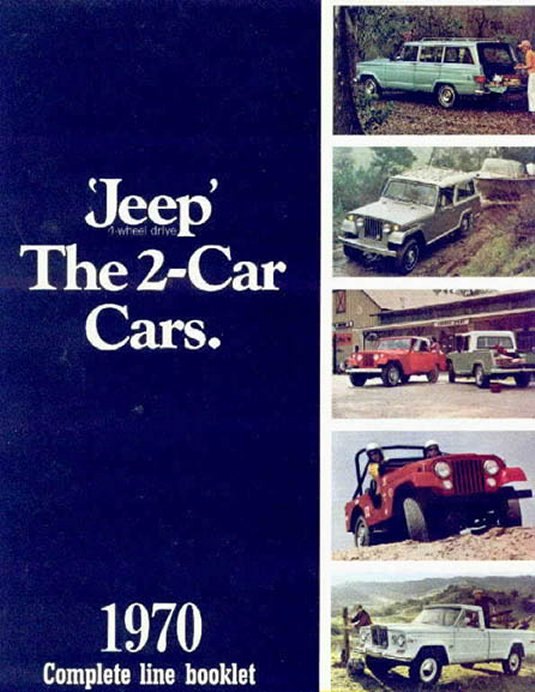
The company purchased Kaiser Jeep Corporation in February of 1970, for roughly $70 million ($601.9m adj.). Jeep was then renamed to Jeep Corporation. AMC would focus immediately on the expansion of Jeep’s successful passenger utility vehicles. Given the ownership change, from 1972 until its conclusion the SJ Wagoneer used only AMC engines.
The change in Jeep’s ownership meant an altered direction for the Wagoneer. AMC had more resources to fund Jeep, but also focused on parts and engine consolidation for cost saving. The Kaiser Jeep years were always an amalgam of parts from different suppliers, like an AMC engine here and GM transmission there.
The 1970s would see multiple developments in the Wagoneer to improve its livability and make it more luxurious. Developing the existing platform, AMC’s engineers reduced NVH in the Wagoneer. They also made one visual change immediately, partway through the 1970 model year.
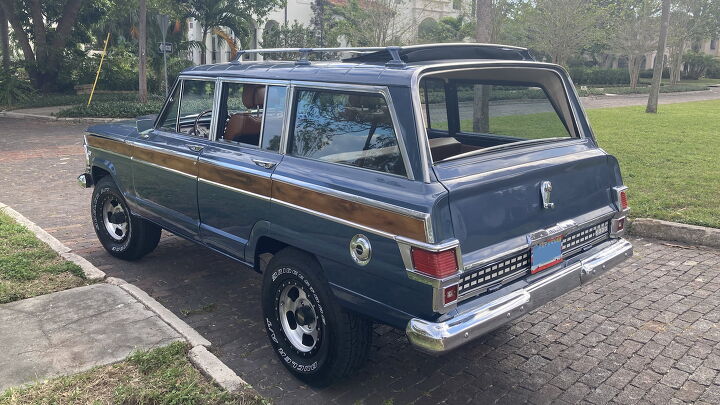
AMC put a new face on Jeep’s largest SUV: The metal grille with vertical bars was removed, and replaced by a plastic grille that wore an eggcrate design. The vertical bars were a Kaiser Jeep touch, and would not return through the rest of the Wagoneer’s run. The eggcrate design was also grafted onto the tailgate as a trim panel, outlined in black. New square indicator lamps appeared beneath the original tail lamps, surrounded in chrome.
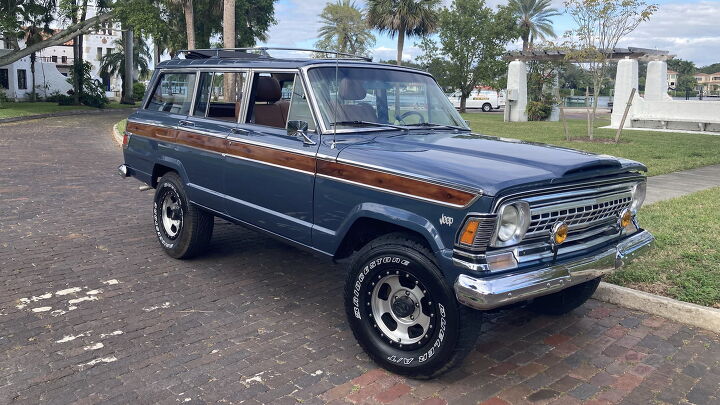
AMC also experimented with a luxury trim Wagoneer in 1971, as the Super Wagoneer was a thing of the past and discontinued after 1969. That year the so-called X-Code Wagoneer arrived. Examples were originally finished in a light green color called Golden Lime, and the model featured the first exterior wood grain on a Wagoneer. Available with a high level of standard features and power equipment, the X-Code could be identified by its color and a thick chrome strip that ran along the upper character line and wrapped around just under the door handles.
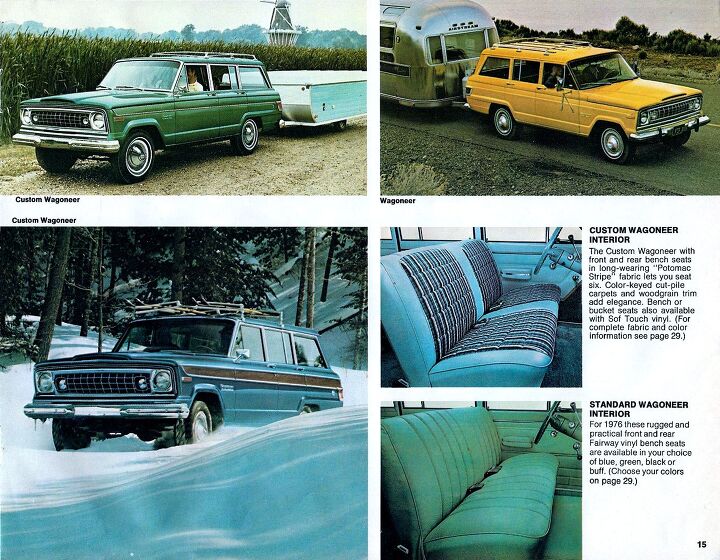
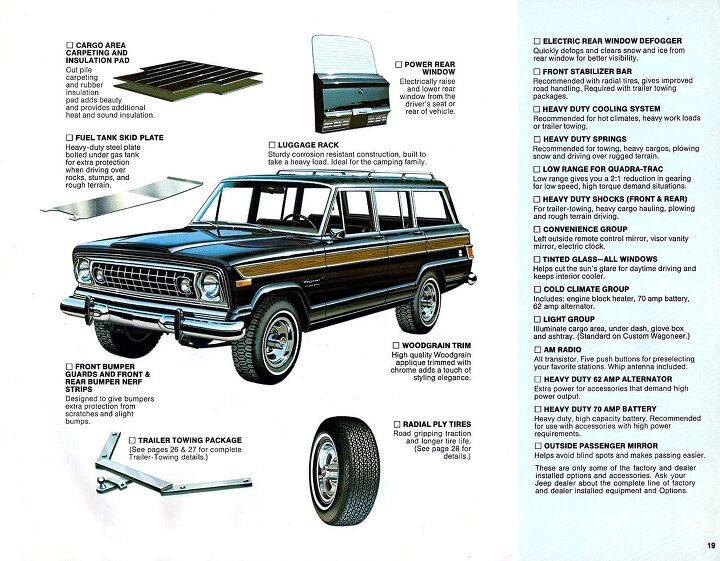
X-Code examples of today have largely been painted different colors, or do not maintain their faux wood trim as it would require custom fabrication. We can show you an X-Code example here repainted in blue. There was also a Golden Lime example sans wood on BaT last year. Priced a generous $1,000 ($8,210 adj.) above a standard Custom trim, the X-Code was a single-year Wagoneer. Wood exterior trim would become an option on the Wagoneer by 1973.
In 1972 and 1973 there were a couple notable mechanical changes for the Wagoneer. The Buick V8 went away as an option in 1972, and was replaced by the AMC 360 (5.9L) V8. AMC developed a new full-time four-wheel drive system the following year and debuted it on the Wagoneer.
Branded as Quadra-Trac, the system used a Borg-Warner transfer case (BW1339). A chain-drive system paired to GM’s THM400 automatic, Quadra-Trac had five different modes: 4WD Hi Locked, 4WD Hi Open, Neutral, 4WD Low Open, and 4WD Low Locked. The system broadened the consumer appeal of the Wagoneer and other Jeep products as it removed the manual 4WD transfer case, and eliminated the manual locking hubs.
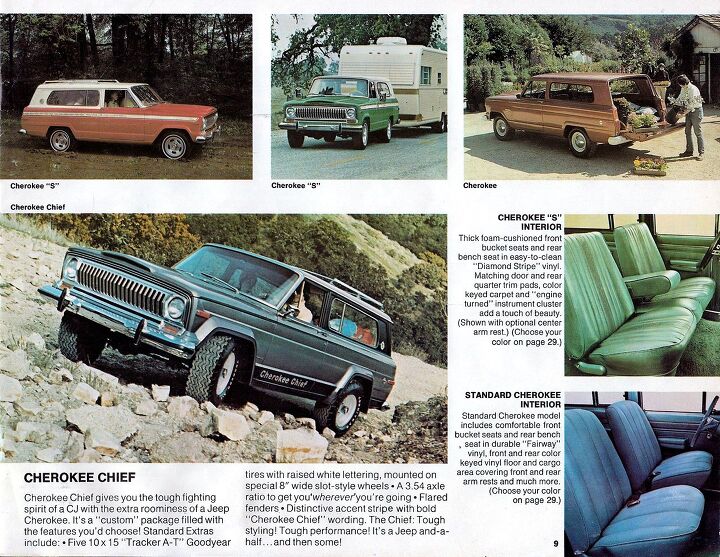
As the popularity of the utility vehicle grew, the SJ platform branched outward. With a revised two-door window line and fewer features, the Cherokee debuted in 1974 and coined the SUV moniker in its marketing. Its popularity caused Jeep to introduce the four-door Cherokee in 1977. Both models were differentiated from the more expensive Wagoneer by emphasis on their utility features. Cherokee was a replacement for the Jeepster commando, which proved to be too impractical to appeal to most consumers.
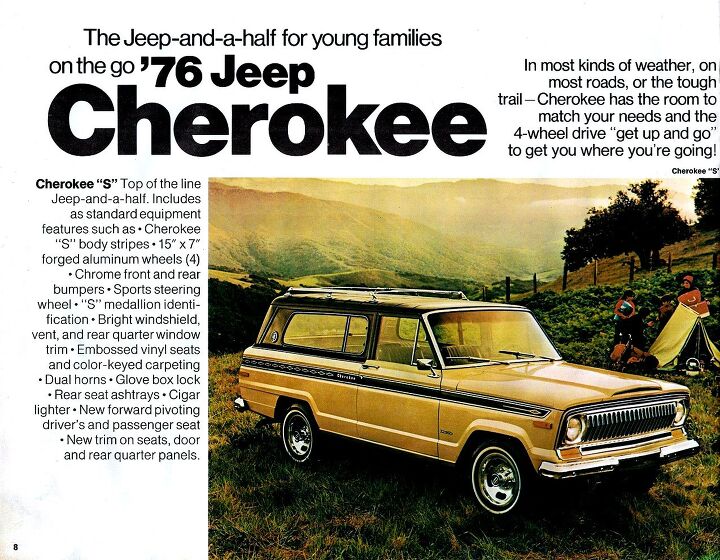
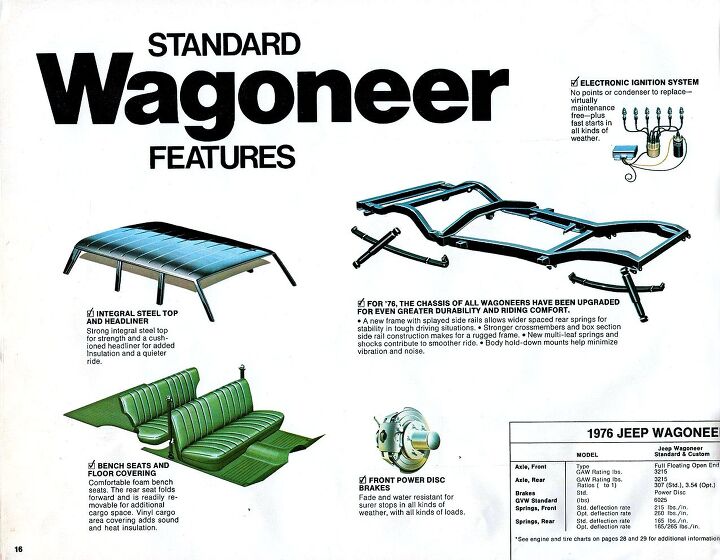
Wagoneer received front disc brakes as standard in 1974, which were granted to the Cherokee as an optional extra. Both models were upgraded in 1976 with strengthened frames that used upgraded cross members, and boxed side rail construction. Both the Wagoneer and Cherokee were built at Jeep’s Toledo Complex.
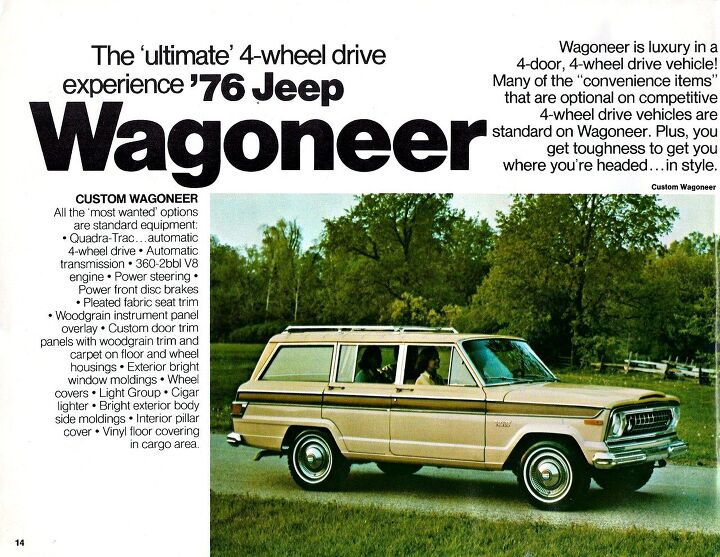
The development and success of the Cherokee as a standalone model with clear differentiation to the Wagoneer was important. Though the two shared a platform and major mechanical parts, the Cherokee’s arrival allowed the Wagoneer more freedom to move upmarket. With the debut of the four-door Cherokee in 1977, the last piece fell into place.
Beginning in 1978, Jeep would push the options and trims of the Wagoneer to ever more luxurious places. The first of which would include a trim level that persists as a Jeep staple today. We’ll pick up there in our next installment, with the introduction of Limited.
[Images: Jeep, seller, seller]
Become a TTAC insider. Get the latest news, features, TTAC takes, and everything else that gets to the truth about cars first by subscribing to our newsletter.
Interested in lots of cars and their various historical contexts. Started writing articles for TTAC in late 2016, when my first posts were QOTDs. From there I started a few new series like Rare Rides, Buy/Drive/Burn, Abandoned History, and most recently Rare Rides Icons. Operating from a home base in Cincinnati, Ohio, a relative auto journalist dead zone. Many of my articles are prompted by something I'll see on social media that sparks my interest and causes me to research. Finding articles and information from the early days of the internet and beyond that covers the little details lost to time: trim packages, color and wheel choices, interior fabrics. Beyond those, I'm fascinated by automotive industry experiments, both failures and successes. Find me on Twitter, @CoreyLewis86.
More by Corey Lewis








Comments
Join the conversation
For those who would enjoy some long-form Wagoneer video content, Vice Grip Garage has an installment on a 1967 model with an interesting combination: The Buick Dauntless V8 and a three-on-the-tree manual.
Derek incorrectly cites in the video that the Dauntless arrived in 1968, it was actually 1966 ( Directory Index: Jeep/1966_Jeep/1966_Jeep_Wagoneer_Brochure). Likely he looked at the Wiki, which is incorrect.
However, he is correct in saying the V8 would've been paired only to an automatic transmission. This three-speed manual Borg Warner with V8 was a hurried build with what was available, or some sort of special order at the time.
What surprised me was the incredible smoothness of the ancient Buick V8.
https://youtu.be/hXu4MS-IKsk?si=dVd-E8hHGtCiQW2Z
AMC was hardly flush with cash when they bought Jeep. Ramblers were profitable in the early 60's but the late 60's were pretty lean years for the company and they had to borrow money to buy Jeep. Paying off that debt reduced the funds available for updating the passenger cars and meeting federal air quality and safety mandates, which may have contributed to the company's downfall.
On the other hand, adding Jeep broadened the company's product portfolio and may have kept it going in those years when off roaders were selling better than economy cars.
AMC had a couple flush years selling economy cars in the 70's because of oil shocks but that was after buying Jeep, not before.