Abandoned History: America's 1970s Convertible Controversy, Who's to Blame?

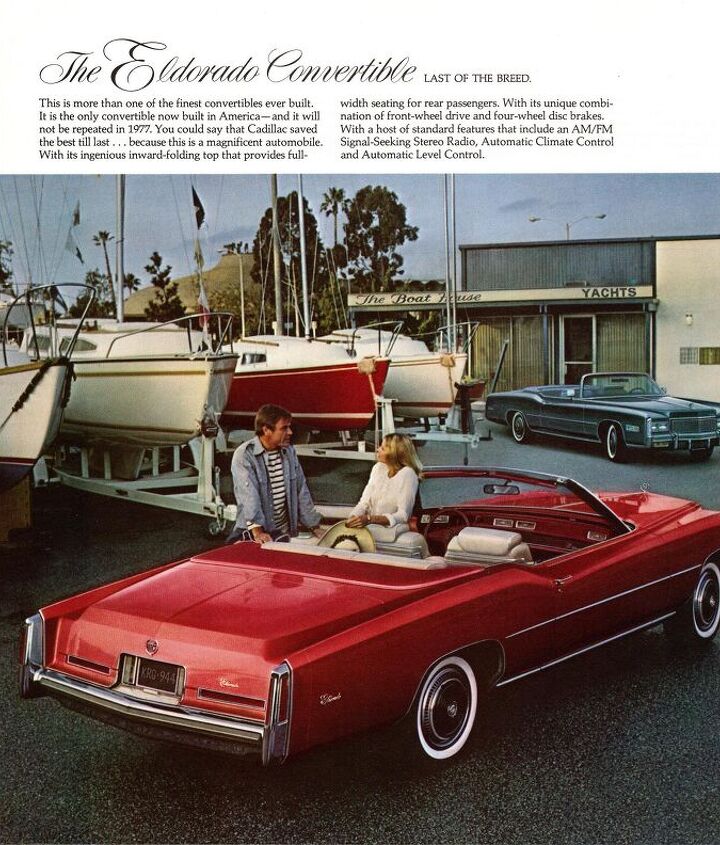
As our Rare Rides series on the Cadillac Eldorado continues through the Seventies, we’re on a collision course with a poignant moment in time: the death of the American convertible. The Eldorado convertible ended up the last man standing amongst domestic-branded vehicles when it bowed out in 1976. American-made convertibles would return years later, the first of which were the 1982 Dodge 400 and Chrysler LeBaron. But who was to blame for those years where there were no domestic convertibles at all, and other manufacturers offered far fewer true convertibles? The commonly held belief is that it was intense safety regulation from the US government that caused their demise, but that’s not the case.
The first whiff of additional safety regulation came in July 1965, when GM and Ford both testified to Congress about the importance of roof strength. Automotive safety was newly in the public eye, after Ralph Nader’s book Unsafe at Any Speed arrived in 1965 to skewer the domestic automobile industry. Nader asserted the Detroit automakers knew their cars weren’t safe and had flawed designs, and sold them to the unsuspecting public anyway. The book took down the Chevrolet Corvair in particular, and was responsible for the ultimate death of the model line.

Public outcry was sharp and immediate, and led to the aforementioned testimony. The book was also responsible for President Johnson’s swift movement in signing the National Traffic and Motor Vehicle Safety Act. The act created the National Traffic Safety Bureau (NTSB), shortly thereafter renamed to the National Highway Traffic Safety Administration (NHTSA). The NTSB/NHTSA were quick to issue a legal proposal regarding roof intrusion protection for all passenger cars. The proposed rule stated cars would have both corners of their roof statically tested at the same time.
The Detroit automakers were of course against such testing, and claimed, alongside the Automobile Manufacturers Association, that testing both sides of the roof was “unnecessary.” Secretly, GM performed the “two-corner” test on six of its vehicles, and only one passed. The new regulation was a huge financial risk for the Detroit automakers, all of whom would need to reengineer most or all their passenger models.

There was argument and debate about the regulation for some time, which caused uncertainty in product planning for the Detroit makers, and in particular smaller domestic automakers. The roof test, it seemed, would spell the end for the convertible: If a sedan with pillars and a fixed roof couldn’t pass the test, what hope was there for a soft top convertible?
Meanwhile multiple automotive safety regulations were being eyed by the Nixon Administration. In a series of memorandums and a closed-door meeting on April 27, 1971, Ford’s chairman Henry Ford II and company president Lee Iacocca sat down with President Nixon himself in the Oval Office. The topic at hand was the suggested passive restraint regulation, which was strongly supported by the Secretary of Transportation.

The passive restraint regulation would require either airbags or very thick dash padding on passenger cars, which would “guard against injury in a 30-mph perpendicular crash, whether or not seat belts were fastened. This initial regulation was set to go into effect by August 15, 1973. Its second phase was proposed to take effect on August 15, 1975, and said the passive systems “must protect against injury in all types of 30-mph accidents.”
In the 35-minute meeting that morning, Lee Iacocca did most of the talking. The message was fairly succinct. In essence, “These regulations are breaking our balls and going to bankrupt us, you need to lay off.” Compliance with the regulations (emissions, roof intrusion, passive restraints) would not be affordable, and Ford et. al. would be forced to pass that cost on to the consumers. The emissions regulations were finalized by that time, but with the other two still in discussion Henry Ford II stated Ford expected the cost of its cars to go up between $100 and $800 ($780 to $4,925 adj.) in the years between 1972 to 1975.

Based on this price increase, Ford asserted, consumers would simply drop domestic cars and buy foreign cars instead. Iacocca was flat out against the airbag development at the time, as he said in the meeting “The citizens of the U.S. must be protected from their own idiocy, so we will put in a sophisticated device that will blow up on impact and package him in an air bag and save their lives.” He was also against shoulder restraints and headrests: “... the shoulder harnesses, the headrests are complete wastes of money.”
Nixon stated he would look into the issue at the end of the meeting. He promised, “I want to see what the hell the department [NHTSA] is doing in the future.” Three days later, Nixon’s White House Counsel John Erlichman called John Volpe, the Secretary of Transportation. Erlichman had a simple message in his phone call with Volpe. “...the whole point here, as far as the scope of my instructions is concerned, is that I’m instructed to advise you that the President desires that the [NHTSA] order be suspended.”

And so it was. The passive restraint legislation was dropped, and would not return and be signed into law until the mid-1990s. Nixon meant what he said to Iacocca and Ford about monitoring the NHTSA more closely. The NHTSA was allowed to proceed with its roof intrusion regulation, with two large caveats.
One, that it applied to fixed roof passenger cars only, to the exclusion of convertibles and heavier-duty vehicles weighing over 6,000 pounds. It did not apply to any light trucks, or other multipurpose passenger vehicles. Secondly, what GM and the other Detroit automakers wanted came true: Only one side of the vehicle’s roof would be tested, not both.

The roof intrusion regulation would eventually be known as rollover protection, and remained a contentious issue throughout the 2000s as the SUV (a multipurpose vehicle, excluded) became the popular family mode of transport. The issue became much more heated after the Ford Explorer’s tire-related rollover fatalities circa 2000. Rollover standards were enhanced and adjusted by the Highway Funding Bill S.1072, from June 30, 2006 onward.
As Nixon folded quickly to pressures against safety regulation by the domestic automakers, regulation was not the death of the convertible. Though the uncertain period from 1965 to 1971 certainly hampered the development of convertibles and forced manufacturers to look for other solutions (like targa bars and removable roof panels), that wasn’t the main driving force behind the death of the domestic convertible and imported convertible options.

The main reason convertibles were popular in the early automotive days came down to one thing: fresh air. With the roof off, the sweltering summer heat wasn’t so bad. There wasn’t air conditioning, there was no powered ventilation, and there was no sunroof or targa option. The tides began to turn against the convertible in the early Sixties.
Air conditioning became a more widely available option across the market, where previously it was limited to very high-end vehicles and carried a hefty option surcharge. Air conditioning systems for cars were also honed and developed in the Sixties to be more effective than previously.

At the start of the Sixties, there was another development for a partial open-air experience, the sunroof. Ford’s Thunderbird debuted in 1960 with an optional sunroof and started the trend. The simple panel cut-out didn’t require extensive roof modification, and did not carry with it the inconveniences of the traditional convertible (aging canvas, water leaks, lack of sound insulation). A lesser seen compromise was the sporty targa roof, with its removable solid panel(s).

Throughout the Sixties and into the Seventies the number of convertible models on offer in the US slimmed down considerably. But manufacturers noticed there was not an increase in demand for the remaining models. On the contrary, sales continued to slip as customers chose a coupe or sedan with air conditioning and a sunroof, or went more exotic with a 911 or Mercedes-Benz SL. And as safety requirements increased, convertibles became more expensive to build, and required considerable additional engineering dollars.

As mentioned above, domestic convertibles and a broader convertible market did return en masse for a time, from 1982 to roughly 2005. New mid-price and economy nameplates arrived like the LeBaron, Sebring, Celica, and Paseo. They were joined by long-time convertibles like the SL and 911, and other new options in the Buick Reatta, Buick Riviera, BMW Z3, Nissan 350Z, Audi Cabriolet, Audi TT, Cadillac XLR, and so on.
But as before, the convertible faded from popularity as consumers flocked to the white or silver CUV of their wildest dreams. Domestic offerings for the true convertible are limited to two in 2025, the Ford Mustang and Chevy Corvette. But we can take solace as we know the real reason is the same now as in 1977: consumers don’t really want them.
[Images: PBS via US National Archives, seller, Nissan, AMC, Ford, GM]
Become a TTAC insider. the latest news, features, TTAC takes, and everything else that gets to the truth about cars first by subscribing to our newsletter.
Interested in lots of cars and their various historical contexts. Started writing articles for TTAC in late 2016, when my first posts were QOTDs. From there I started a few new series like Rare Rides, Buy/Drive/Burn, Abandoned History, and most recently Rare Rides Icons. Operating from a home base in Cincinnati, Ohio, a relative auto journalist dead zone. Many of my articles are prompted by something I'll see on social media that sparks my interest and causes me to research. Finding articles and information from the early days of the internet and beyond that covers the little details lost to time: trim packages, color and wheel choices, interior fabrics. Beyond those, I'm fascinated by automotive industry experiments, both failures and successes. Lately I've taken an interest in AI, and generating "what if" type images for car models long dead. Reincarnating a modern Toyota Paseo, Lincoln Mark IX, or Isuzu Trooper through a text prompt is fun. Fun to post them on Twitter too, and watch people overreact. To that end, the social media I use most is Twitter, @CoreyLewis86. I also contribute pieces for Forbes Wheels and Forbes Home.
More by Corey Lewis








Comments
Join the conversation
What about the 1989 Mazda Miata and it's impact on the convertible?
To correct some errors in the article and comments. Cadillac had optional "Sunshine Turrent Tops" sliding metal sunroofs from 1939 to 1941 on the Cadillac 60S and select LaSalles.
The 1966 Buick Riviera and Olds Tornado were the first with no vent windows and flow through ventilation.