


Maserati Boomerang: The Car World's Sharpest Angle
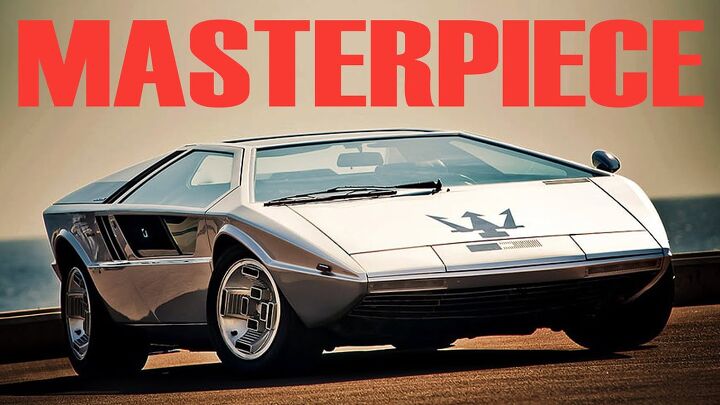
The early 1970s were a bizarre period for car design.
Manufacturers were still drunk on the success of the space age, safety legislation was starting to creep in, and designers had suddenly discovered that you could draw an entire car with a ruler instead of a French curve. Out of that madness came Giorgetto Giugiaro’s Maserati Boomerang—possibly the most unapologetically wedge-shaped car ever built, and one of those machines that straddled the line between sculpture and automobile.
The TTAC Creators Series tells stories and amplifies creators from all corners of the car world, including culture, dealerships, collections, modified builds and more.
A transcript, cleaned up via AI and edited by a staffer, is below.
[Image: YouTube Screenshot]
Become a TTAC insider. Get the latest news, features, TTAC takes, and everything else that gets to the truth about cars first by subscribing to our newsletter.
Transcript:
The early 1970s were a bizarre period for car design. Manufacturers were still drunk on the success of the Space Age. Safety legislation was starting to creep in, and designers had suddenly discovered that you could draw an entire car with a ruler instead of a French curve. Out of that madness came Giorgetto Giugiaro’s Maserati Boomerang, possibly the most unapologetically wedge-shaped car ever built, and one of those machines that straddled the line between sculpture and automobile.
First unveiled as a wooden mockup at the 1972 Turin Motor Show, and then as a fully functional one-off the following year in Geneva, the Boomerang was the wedge taken to its logical extreme. It wasn’t just a car; it was an essay on geometry, a rolling manifesto of Italdesign’s vision for the future. Where other concepts merely hinted at angularity, the Boomerang leaned into it with the subtlety of a chainsaw. And while it looked like something out of a Stanley Kubrick film, the Boomerang wasn’t an empty showpiece.
Italdesign built it on the chassis of the Maserati Bora, which meant this alien wedge had serious pedigree underneath. Launched in 1971, the Bora was Maserati’s first mid-engined road car, and it came with a level of engineering and performance that made Ferrari nervous. That meant the Boomerang carried a 4.7-liter Maserati V8 mounted midship. This quad-cam, 16-valve engine produced a muscular 310 horsepower, enough to push the Boomerang close to 300 kilometers per hour in the early 1970s. That was properly fast—faster than a Lamborghini Miura and quicker than many contemporary Ferraris.
Transmission duties were handled by a ZF five-speed manual sending power to the rear wheels. Suspension was fully independent, with double wishbones at each corner, and four-wheel disc brakes provided the stopping power. So while the bodywork might have looked like a modernist fever dream, the mechanical package was pure Maserati, built to go head-to-head with the Italian supercar hierarchy.
But of course, it’s the design that made the Boomerang legendary. Giugiaro didn’t just flirt with straight edges—he obsessed over them. Every surface of the Boomerang is taut, angular, and brutally geometric. The nose drops low into a razor-thin front end. The windscreen is raked back at an outrageous 13 degrees, and the roofline tapers into a rear deck that looks less like a trunk and more like a runway.
Giugiaro himself said the Boomerang was drawn almost exclusively with a ruler rather than curves, and it shows. Where most cars are shaped like organic beings—muscles, tendons, and skin—the Boomerang looks carved, as if someone took a block of aluminum and sliced into it. The influences are obvious: you can see the nose treatment of the Italdesign Iguana and hints of the Alfa Romeo Carabo. But the Boomerang exaggerated those ideas, pushing wedge design to its absolute extreme. It was less a car and more a prototype for an entirely new visual language.
Even the wheels were works of art. Designed specifically for the Boomerang, they looked more like sculptures than functional components. Giugiaro considered them his finest wheel design, and given that he designed everything from Volkswagens to the DeLorean, that’s saying something.
That design wasn’t without controversy. Glass manufacturers reportedly called the windscreen angle “stupid,” claiming it would ruin visibility and create endless issues with reflections and heat. Giugiaro ignored them. Three years later, he proved his point with the production Lotus Esprit, which borrowed heavily from the Boomerang’s visual DNA and carried it successfully into showrooms.
If the exterior looked alien, the interior was positively Martian. Giugiaro tore up the rulebook entirely. The steering wheel wasn’t really a wheel at all—only the rim was exposed, while the center housed a massive circular instrument cluster. The speedometer and tachometer were stacked in the upper half of the disc, with secondary gauges below.
Then there was the steering column. At the time, safety was becoming a serious concern in the automotive industry, with manufacturers under pressure to design cars that wouldn’t impale occupants in a crash. For the Boomerang, Italdesign engineered a split steering column connected by a chain—a complex but clever system designed to prevent the column from being driven backward into the driver during a frontal collision.
Calling the Boomerang irrational was part of the point. It was never meant to be a car you drove in everyday traffic. This was a dream car, a rolling provocation designed to challenge the industry—and it worked. The Boomerang influenced an entire generation of vehicles. You can see its DNA in the Lotus Esprit, the Maserati Khamsin, and countless Italdesign prototypes that followed. It proved that extreme wedge shapes could not only exist, but help define the future.
So what happened to it? After its Geneva debut in 1973, the Boomerang lived on as a showpiece, occasionally resurfacing at exhibitions and concours events. Thankfully, it has been carefully preserved over the decades. Today, the Boomerang is recognized as one of the most iconic concept cars ever built, representing not only Giugiaro at his boldest, but the 1970s at their most experimental.
And that’s it for this video. Let me know what you think of the Boomerang and its story. If you enjoyed the video, leave a like and subscribe to the channel. If you liked this, you’ll probably enjoy most of the other content on the channel as well. Take a look around, and I’ll see you in the next one. Cheers.

I am a proud owner of a single turbo 335i and a Ducati 999s. I make a lot of content on both, as well as just sharing my opinion on just about everything car and motorcycle related,
More by Chris VS Cars | TTAC Creator








Comments
Join the conversation
If I owned one of these, I would need some smaller luggage.
Stolen from Hyundai Pony Coupe of 1974 !