


Sea-Doo GTX 170 Review -- Novice-Friendly Personal Watercraft

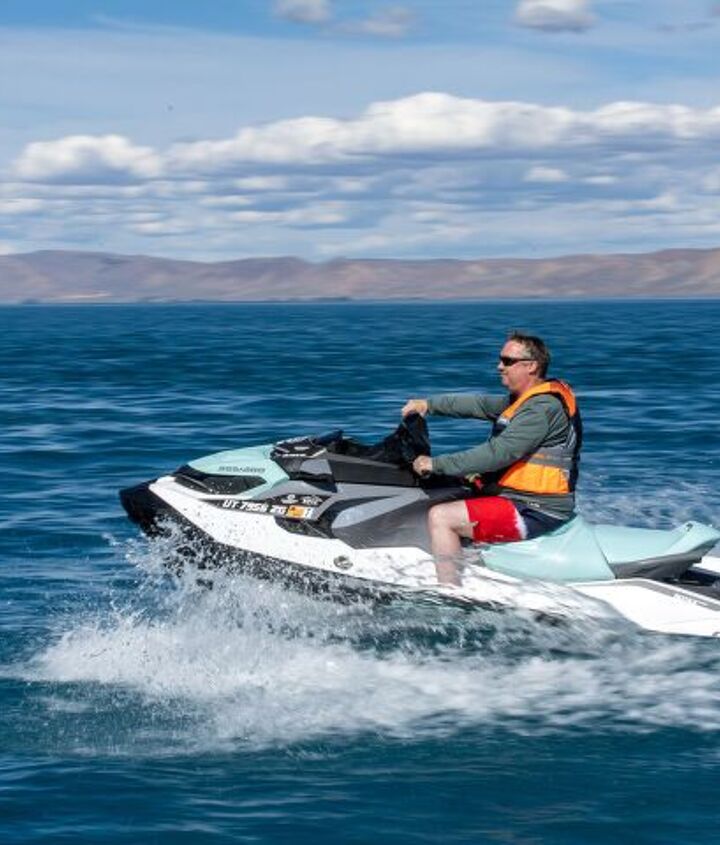
Your humble author's experience with helming water-based vehicles has been, heretofore, limited.
I've piloted a few boats on open water. I've kayaked shallow water in the Caribbean. Done some white-water rafting in the Pacific Northwest as part of a group. And that's about it.
Most of my boating experience has been as a passenger, it seems.
So when I was told I'd be piloting a Sea-Doo GTX personal watercraft as part of my trip to Utah to drive some Can-Am side-by-sides, I had questions.
For example, should I be ready to do some swimming?

A strong swimmer, I am not -- laps at the gym pool are one thing, treading water in a deep lake is another. But I was assured that I would not fall in the drink unless I was driving like an absolute jerk (the actual word used gets flagged by our content management system). In fact, I was told I'd probably not get wet at all, beyond wading into the water at the floating dock.
That dock, in this case, was at the end of a pier near a marina operated by Beaver Creek Lodge and Epic Recreations, which also provided us lodging, gear, and a guide. These two outfitters are part of the Uncharted Society, which uses BRP products as part of packaged experiences.

(Full disclosure: Can-Am and Sea-Doo invited me, via their parent company BRP, to Utah to test side-by-sides and the GTX. They paid for my flights, lodging, and meals, and sent me home with a few shirts and a hoodie.)
Although the other assembled media had previous PWC experience, we still needed a safety brief and feature walk-through before hitting the water.
We were told to give each other space and keep a lookout -- most accidents occur from collisions where someone didn't see someone else -- and to avoid water less than 3 feet deep, lest sand from the bottom gum up the impeller. We were also taught how to climb on and off, both when leaving from/returning to the dock and if we should fall into the lake.
In that latter scenario, a kill-switch key (aka safety lanyard) attached to our life vest would disengage, the GTX would coast to a stop, and we could swim up to it and clamber back on via a fold-down bar in the rear. Despite having never piloted a PWC myself, I knew about the kill switch -- I once worked in a harbor, running the refueling dock, and I remembered seeing the lanyards plugged in as the drivers pulled up.
The features of note involved a water-tight storage compartment for cell phones and other small items, and a not-so-water-tight larger storage area. We also then got some instruction on how to drive the dang thing. The handlebars had two levers, one on each side. On left, a brake (more on that later) and on the right, the throttle. In between lay the digital gauge cluster and a few related buttons, including one for drive modes.
To get, uh, rolling one must climb on, get situated, detach from any mooring, push out and float away from the shallow bottom, make sure your lanyard is engaged, and then press the start button.
At this point, the 130-horsepower, 1630-cc engine rumbles to life and you're ready to go.
Well, sort of -- the GTX starts in neutral. No need to use a shifter, though -- squeezing the throttle puts you in gear and moves you forward. Need to go back to neutral? Use the brake lever to come to a stop and then use the same lever to engage neutral. That lever also activates reverse.


Being a total newb, I started slow, getting comfortable with the turning before goosing the gas. I tried to remember my previous times boating -- since water is obviously different than land, you have to drive differently. With boats, turning usually takes a bit longer, and you need to be careful about cutting across someone else's wake. If a wake is unavoidable, best to hit it perpendicularly and power through it. Stopping/slowing down takes time.
A PWC changes the game a bit. The stuff about wakes remains the same, but turning is sharper. The lighter weight of a PWC means that the drag of the water will slow you pretty quickly, and, again, this one has a brake that makes stopping even more immediate.
Once I got comfortable, I found open water and gunned it -- the GTX will get moving with ease. Soon I was skipping across the small waves -- we had a nice day with very little chop -- and grinning like an idiot.
Top speed is around 40-50 mph, depending on one's weight, and I was somewhere in that neighborhood.
The GTX is very stable when it comes to cornering, allowing you to carve waves nicely, with speed mostly related to one's bravery. Being a PWC rookie, I sometimes backed off the throttle during a turn that had me leaning a lot -- I suspect I had more room to lean without having to get my swim trunks soaked.
As noted, a brake is offered, but as mentioned above, the drag from the water usually slowed me down enough to either make a turn or coast down to avoid crossing someone else's path. The brake seemed only necessary in terms of a real need for a RIGHT NOW stop.
The brake works by deflecting thrust forward to slow the Sea-Doo down. It did help in some cases, especially when trying to set up a tight turn after a high-speed run, and, again, it would be useful to slow quickly should a boat cross your path.
I mostly tried to use the throttle to adjust cornering speeds, but found it a little too much like a light-switch -- it was hard to ease off just a little and at times I dropped more speed than I wanted to. This may be a matter of practice, but it struck me as the GTX's biggest flaw.

The watertight compartment kept my phone dry for the 90 minutes we were on the water, and I never did have to find out how well my life vest worked. The only time I got anything other than my feet wet is when someone from another group of PWC users came across my path and splashed me as if I was in the front row at Sea World.
I also found the seat comfortable enough for an hour-and-a-half on the water -- never did I feel saddle-sore or uncomfortable.
As with the side-by-sides, I don't have enough frame of reference to compare the GTX 170 to competitors, but I can tell you that the GTX will be easy-to-use if you're a first-timer. Or if you're renting a unit from an outfitter -- indeed, the GTX I drove was a special rental-issue GTX 130, but it's basically the same as the GTX 170.
Pricing for one of these starts just under $16K. The GTX's ease of use and capability charmed me, but that's also because it made my first time easier. There are more powerful watercraft out there, including in Sea-Doo's lineup, and I am sure other PWCs maneuver better. But the GTX is pretty dang good for the price.
More to the point, it has a level of user-friendliness that makes it easy to jump on and go play.
And isn't that what we want from a personal watercraft?
[Images: Ben Dann, Sea-Doo]
Become a TTAC insider. Get the latest news, features, TTAC takes, and everything else that gets to the truth about cars first by subscribing to our newsletter.
Tim Healey grew up around the auto-parts business and has always had a love for cars — his parents joke his first word was “‘Vette”. Despite this, he wanted to pursue a career in sports writing but he ended up falling semi-accidentally into the automotive-journalism industry, first at Consumer Guide Automotive and later at Web2Carz.com. He also worked as an industry analyst at Mintel Group and freelanced for About.com, CarFax, Vehix.com, High Gear Media, Torque News, FutureCar.com, Cars.com, among others, and of course Vertical Scope sites such as AutoGuide.com, Off-Road.com, and HybridCars.com. He’s an urbanite and as such, doesn’t need a daily driver, but if he had one, it would be compact, sporty, and have a manual transmission.
More by Tim Healey








Comments
Join the conversation
I'm more of a fan of the stand-ups that actually take some skill to ride. A lot more fun IMHO. Bought a older Kawasaki 650SX last fall. I've ridden these sit downs and got bored pretty quickly.
By far so much more fun than any boat. I have an Explorer Pro 170 and the only limitation so far has been whitecaps if the wind really picks up. Then you get wet. Don't bother going Turbo-Charged. The 130/170's are fast enough. Plus more fuel efficient.