


2026 Polaris Slingshot Review -- Slow Change Makes Progress

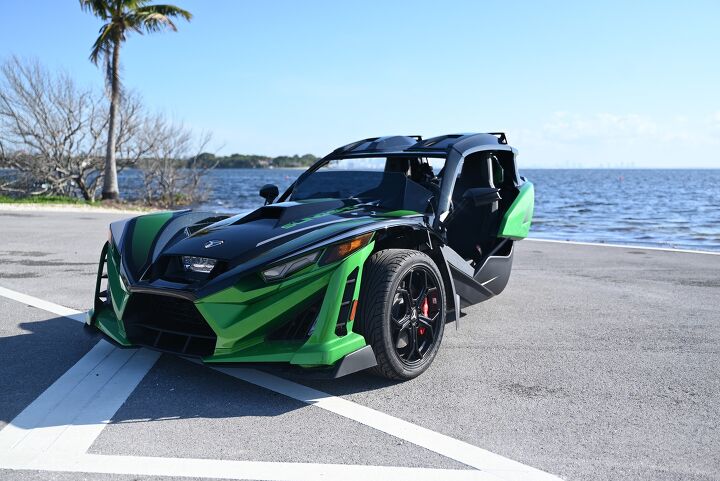
Last year was a busy year for the Polaris Slingshot. Fresh off a styling refresh, complete with interior refinements and software upgrades, 2026 is far from a rest year for America’s favorite three-wheeler. With two new trims in the top end of the lineup packed with features, it’s quite the opposite. This is the 2026 Slingshot Signature Edition and Slingshot Grand Touring, the new apex of a decade-old lineage.

Under the warm, sunny skies from Miami down to Key West in Florida, a group of journalists and influencers learned how the Slingshot makes the most out of its platform. On first impressions alone, the front end of a 2026 Slingshot looks markedly different than even a few years ago. It’s all courtesy of the above-mentioned facelift — one that takes formerly sharp, extremely angular styling lines and smoothes them into something almost dignified.
The chin front spoiler beneath the front grille loses its upward dip, transforming the front clip into something more automotive-adjacent. Not stopping at just the grille, the whole front end sports smoother lines, and the whole package looks more “put together” compared to the old guard. Knowing this, the 2025 update serves as a great foundation for the 2026 Slingshot’s two heavy hitters. One is an open-top sun-soaker, and the other, not so much.
Full disclosure: Polaris paid for flights, housing, and meals so we could drive the Slingshot.

Regardless of the particulars, the Slingshot Grand Touring and Signature Edition both use the pre-requisite R-trim that used to be the platform's flagship as its basis. It means you get goodies like app-controlled dynamic LED interior accent lights, turn-by-turn navigation with USB-loaded route import capability, sport seats, Brembo brakes, and a vented sport hood on top of trim-specific features.
Starting with the open-top Signature Edition, you may not have the eclectic choice of exterior colors like the R trim. But it compensates with an exclusive Golden Steel with Black Crystal two-tone color arrangement, its exact shade varying depending on the sun’s rays and the angle you’re viewing it from. The exterior badging and graphics package, plus the custom seats, reflect the special edition feel Polaris was aiming for — it helps the Signature Edition feel special in the way a low-production sports car trim ought to be.
The Signature Edition may be the ultimate evolution of the Slingshot's open-top philosophy, but its Grand Touring cousin is something altogether different. Built into the very spine of the GT is the Slingshade, a magnetic-latching fiberglass sun shade that gives a measure of sun exposure resistance over long road trips. Don’t get it twisted, it’s far from a proper roof. A jaunt around the rainy streets of Miami Beach the night before proved that in a hurry, it would’ve been a nightmare without rain gear.

Still, the extra protection makes a difference if you’re driving all the way down US-1 South in the Florida sun. To match the Signature Edition, the Grand Touring has its own exclusive iridescent Viper Black with Green Venom color combination. It’s certainly one of the loudest color combinations ever applied to a Slingshot — the biggest signifier that what you’re looking at in traffic is a GT, not something else.
Between them, both use Polaris’ seven-inch center touch screen, complete with proprietary Ride Command infotainment software that manages your BlueTooth, audio, and navigation settings. One of the most common criticisms levied at Slingshots of old was a distinct lack of power from the Stage 2 Rockford Fosgate audio system. It’s an issue addressed in both the GT and Signature Edition through an upgraded Stage 3 Max system, complete with Lightning + speakers in the roll hoops and eight-inch side panel speakers.

It all serves well towards making these new flagship Slingshots a profoundly more entertaining machine to drive. Not the least because what powers them isn’t remotely quiet. It’s the same naturally-aspirated two-liter ProStar four-cylinder engine you’d find in the RZR Pro R side-by-side. In this on-road configuration, it makes 204 horsepower and 149.8 lb-ft of torque, no small amount for just a single back wheel.
With a dry weight of just 1,692 lbs, there’s enough grunt to sprint to 60 mph in 4.9 seconds. It’s enough to roast the back tire under hard acceleration, and the choice of a five speed manual or the computer-controlled AutoDrive gearbox gives you the choice of how to do it. Most beginners are bound to opt for the AutoDrive; but with a light clutch and tall gearing, a Slingshot is remarkably approachable in manual form.
The double wishbone front suspension and rear swingarm with a single coilover is more than capable of handling corners with competence. Given the layout, oversteer and understeer depends even more on steering angles and the engine’s position in the rev range than normal. Even so, grip levels are generally enough to keep things level in the bends. It’s to the point you almost forget there aren’t two wheels behind your back sometimes.
Standard issue traction and stability control is a given for cars, but it’s especially welcome in this application. The former can be switched off entirely if you want to have even more fun, though you should do so at your own peril. Two driving modes, Comfort and “Slingshot,” provide even more control over throttle sensitivity and the aggressiveness of the traction control.
Given the sporty suspension, the ride quality was surprisingly comfortable. Speed bumps and small potholes are hardly an issue, and the Brembo brakes give solid feedback at low speeds as well as at the top-end. Along the drive, we stopped for fuel all of once between Miami and Key West, equating to roughly 25 MPG combined.
All the while, that Stage 3 Max Rockford Fosgate audio made a world of difference to the driving experience. Instead of hearing nothing but the wind at highway speeds, you can actually hear the music as the air rushes around your helmet. Better still, a comprehensive software update post-2025 renders the Ride Command infotainment software more snappy and intuitive. Along a long road trip, possibly wearing gloves all the while, that extra response is very welcome.
It’s all controllable via the Ride Command + companion app for iOS and Android. Though, licensing and certification issues means Android Auto isn’t officially supported on the platform while Apple Car Play is. It’s one of the more pressing flaws with the Slingshot platform, one that’s yet to be officially rectified. Lastly, Polaris’ Ride Command-equipped navigation might be improved, but it’s still not the most intuitive system out there. Granted, billion-dollar automotive OEMs also struggle to do what Apple and Google make easy. That said, you’ll probably want to use Google Maps on your phone, plus a RAM X-Grip dashboard attachment instead.


Despite the refinements, you’re still bound to be worn out after driving one of these long-distance. Of course, you’re barking up the wrong tree if you want an automotive-grade experience from a Slingshot. In truth, it’s more like an on-road side-by-side, and the two new flagship Slingshots take this to what looks like its zenith. But at $36,999 and $41,999 respectively for the manual Signature Series or GT, you’re spending legit sports car money for the privilege of owning the most desirable three-wheeler on American roads today.
[Images © 2026 Benny Kirk/TTAC.com]
Become a TTAC insider. Get the latest news, features, TTAC takes, and everything else that gets to the truth about cars first by subscribing to our newsletter.
As one of the youngest automotive/aerospace journalists in North America, Benny Kirk's writing prowess is rooted in the deepest pits of nerd and geek culture. Only after he acquired a degree in journalism did his penchant for scouring the Internet at two in the morning to learn cool facts about cars, airplanes, spaceships, and computers become remotely useful. His real-world experience includes live coverage at major North American and international auto shows, racing events, NASA space launches, and a portfolio of test drives and reviews from major OEMs in both the automotive and powersports sectors. Recently he's started covering nuclear energy news as a special beat project, just for the kick of it, so you know there's nothing Benny's afraid to write about. Still, he's more than happy to apply his craft to give some genuinely helpful consumer advice.
More by Benny Kirk









Comments
Join the conversation
Compared to a bike, it has all the disadvantages of a car.
Compared to a car, it has all the disadvantages of a bike.
What's not to love? (Other than the decades-out-of-date emissions tech.)
There exist 4 wheel conversion kits for this. Not that there's any point to any configuration.