


Rare Rides Icons: The Cadillac Eldorado, Distinctly Luxurious (Part LVII)

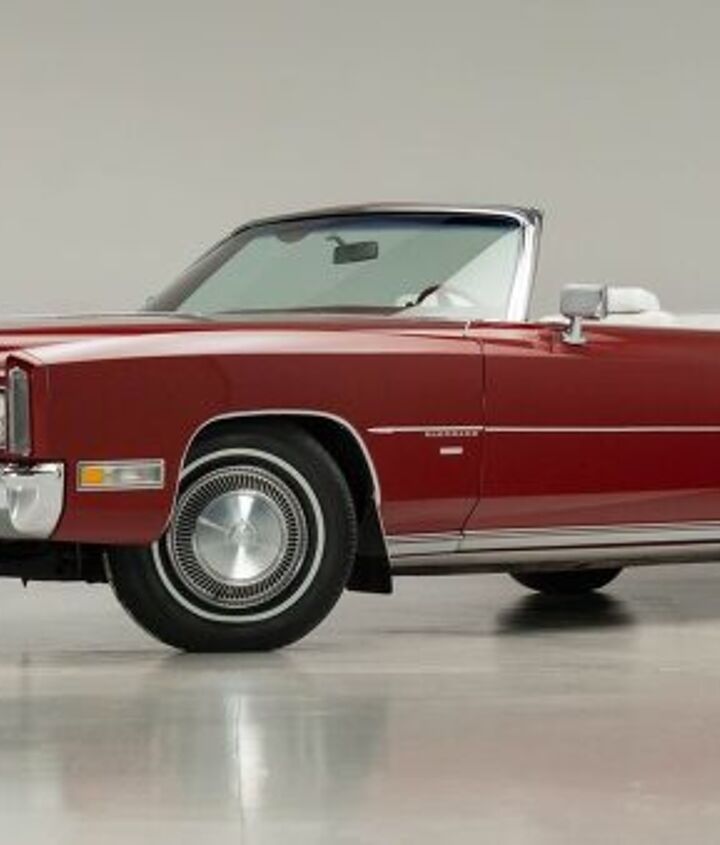
The Fleetwood Eldorado was all new for 1971, as the model stepped away from sporting pretensions and leaned into the burgeoning brougham and luxury tastes of American consumers. As we saw in our last installment, the angular late Sixties look of the Eldorado (lauded by almost everyone) was replaced with a curved and bloated shape which grew in all dimensions over its predecessor. Today we take a look at the lavish interior accommodations of the 1971 model and talk about cost cutting.
(Note: The silver car with a houndstooth interior is a 1970 Eldorado, while the red car with a black interior is the 1971.)
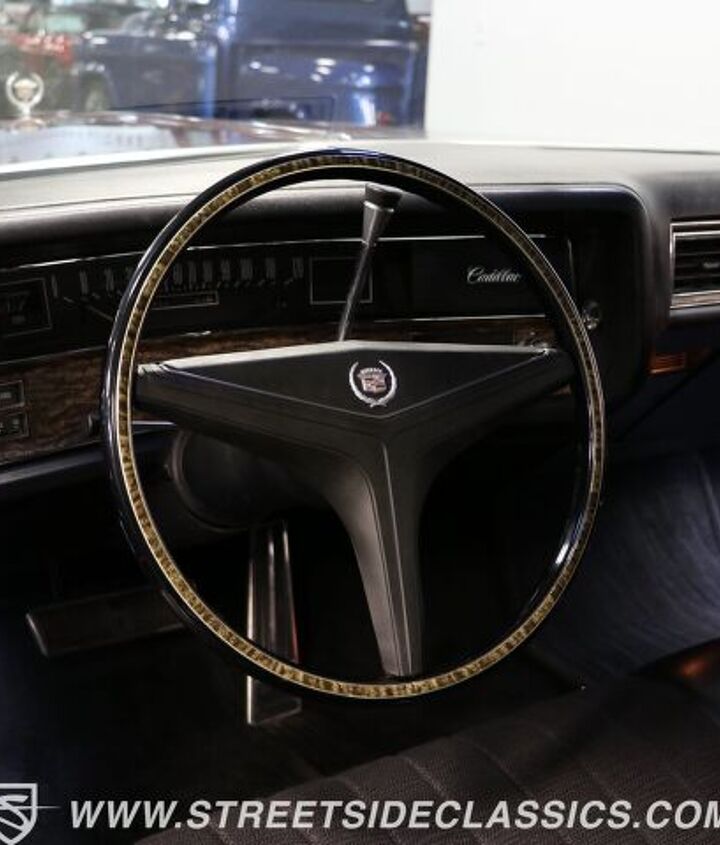
The new Eldorado was one of those instances where things appeared roughly the same on the surface, but revealed otherwise when the details were examined. The three-spoke wheel of 1970 was reworked with a larger center cover, and was a very light modification of the wheel cover in use by Buick that year. It no longer wore a stitched leather appearance, but luxury was implied via the wood tone around the rim. In time the wood of the wheel faded much faster than the dash given its greater UV exposure, as seen here.
Beyond the wheel was a similar gauge layout to 1970, but a bit worse. The horizontal speedometer remained intact but was compressed horizontally (apparently just for fun). The fuel gauge moved from the right of the speedometer to the left. And to its left there were two new vents for the driver, oddly contained within the confines of the gauge cluster.

The warning lights which previously resided below the speedometer were relocated again, to the right of the gauges. There, they were condensed and stacked into a layout that would become more familiar throughout the Seventies and Eighties. Their compression combined with the shrunken speedometer meant there was extra space to the right side in the instrument binnacle. This was filled with a textured black plastic plate that read Cadillac in the middle.
Climate controls and light switches stayed put for 1971, but the light switch lost its wood tone. The wood itself transitioned from a burled look in 1970 to a horizontal grained style in 1971, and was cooler in color (lighter brown). There was notably less wood in the instrument cluster: It was removed from the upper section entirely and replaced with black plastic. Only the lower portion of the gauge cluster had wood trim.

As previously, the dash was divided between driver and passenger sides by a binnacle that made the cockpit “driver focused.” But for 1971 the design was softened slightly, and the dash tucked inward toward the hood more. The instruments were also slightly U-shaped around the driver, curving where there was previously a straight horizontal line.

The dash in front of the passenger was notably edited and awkward looking in 1971. The silver Cadillac plaque between the set of four vents was removed and replaced with a black plastic indentation. There, a large analog clock was inserted into the recess. Why the clock would be presented only to the front passengers is a mystery; the driver would have a difficult time checking it quickly.

A minimal amount of editing was performed on the door panels for the 1971 Eldorado. The wood insert in the door was the exact same shape as before, as was its surround. Within it, the grab handle was extended a bit further and ran the full length of the wood trim.

The armrest lost its rear passenger ashtray compartment, replaced by nothing. Its interior door handle remained in place, but received additional chrome decoration and a rectangular handle shape instead of a square one. Buttons for the windows remained exactly where they were, as did the glued-on panel for the wiper controls. The door light and red marker were relocated directly under the handle, where they were probably more useful.

Seating types were standardized across Eldorado to one: a bench seat. The removal of the center console option was in keeping with the new personal luxury and comfort mission statement and offered seating for six adults (in theory). The seat shape was only vaguely revised in 1971.

Headrest design was carried over from 1970, while the upper portion of the seat back was reshaped lightly. It became a larger section with a button tufted appearance accomplished via two rectangular decor pieces. Stitching was removed on the upper seatback, but remained the same as 1970 on the lower portion and on the seat bottoms. Materials looked slightly more downmarket in some cases, with plain cloth available in place of previous houndstooth or brocade. For the decadence of the exterior, the Eldorado’s interior could come off drab in 1971.

Given the emphasis on passenger comfort and capability for the new Eldorado, there was an interesting update to the back seat quarters. The seat backs were more reclined in 1971, likely to give the feeling of more headroom and thus a more comfortable environment. The seat back also looked shorter, and no longer offered a separation between the rear outboard seats.

The ashtray formerly located in the door was moved to the arm rest at either side, which was certainly an easier reach for backseat smokers. The window button at either side was removed, as the coupe styling meant the rear side windows were no longer operational. Think of the plus side: It saved GM two window assemblies, two motors, and two switches on each car produced!

It all came together to feel a bit cynical with hindsight. The 1971 Eldorado lost styling unique to the model, its pillarless hardtop design, and carried an interior that was very similar to its predecessor but worse in most regards. The closeup of the detail on the radio, instrument panel, and that blanked off textured Cadillac filler piece says it all. Next time we’ll get into the annual changes and shuffling that occurred with the ninth-gen Eldorado, which may take two installments given how long this generation ran!
[Images: dealer, dealer, dealer]
Become a TTAC insider. the latest news, features, TTAC takes, and everything else that gets to the truth about cars first by subscribing to our newsletter.
Interested in lots of cars and their various historical contexts. Started writing articles for TTAC in late 2016, when my first posts were QOTDs. From there I started a few new series like Rare Rides, Buy/Drive/Burn, Abandoned History, and most recently Rare Rides Icons. Operating from a home base in Cincinnati, Ohio, a relative auto journalist dead zone. Many of my articles are prompted by something I'll see on social media that sparks my interest and causes me to research. Finding articles and information from the early days of the internet and beyond that covers the little details lost to time: trim packages, color and wheel choices, interior fabrics. Beyond those, I'm fascinated by automotive industry experiments, both failures and successes. Lately I've taken an interest in AI, and generating "what if" type images for car models long dead. Reincarnating a modern Toyota Paseo, Lincoln Mark IX, or Isuzu Trooper through a text prompt is fun. Fun to post them on Twitter too, and watch people overreact. To that end, the social media I use most is Twitter, @CoreyLewis86. I also contribute pieces for Forbes Wheels and Forbes Home.
More by Corey Lewis







Comments
Join the conversation
Odd column shifter in that it almost completely vertical.
The nearly identical door trims raise an interesting question: was the '71 more evolutionary than it looked?