
Rare Rides Icons: The Cadillac Eldorado, Distinctly Luxurious (Part LXXXI)

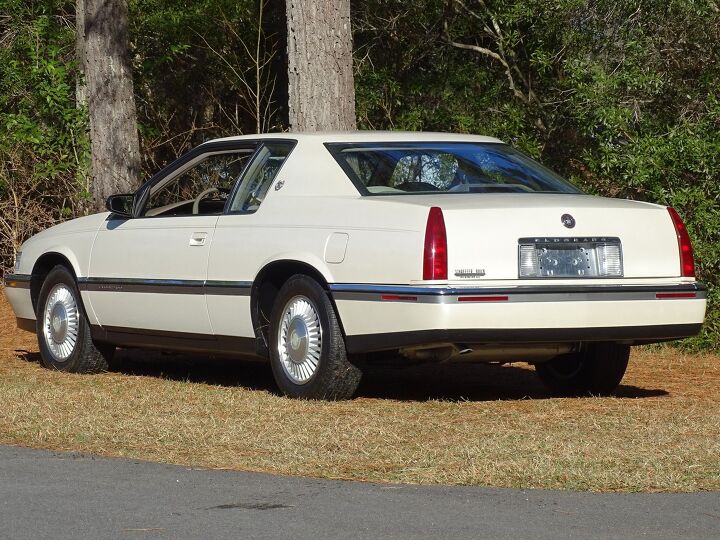
Last week we reviewed the exterior of the “all-new” Cadillac Eldorado of 1992. Though the body was indeed new on the outside, bones underneath were the same as the old one: the platform, wheelbase, and engine were all carried over from the ‘91. While the exterior proved a messy mixed bag of new, old, and throwback design cues, the interior was a more solid step forward. It was apparent even from a casual glance that GM wanted to be taken more seriously as a competitor to established European marques. But the devil is in the details, as they say.
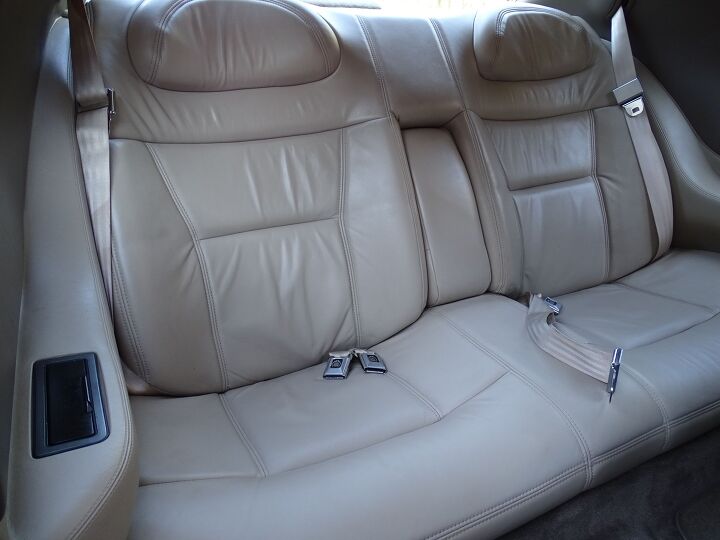
(Note: The beige interior is a 1992 base model Eldorado, while the blue interior is a 1991 base model.)
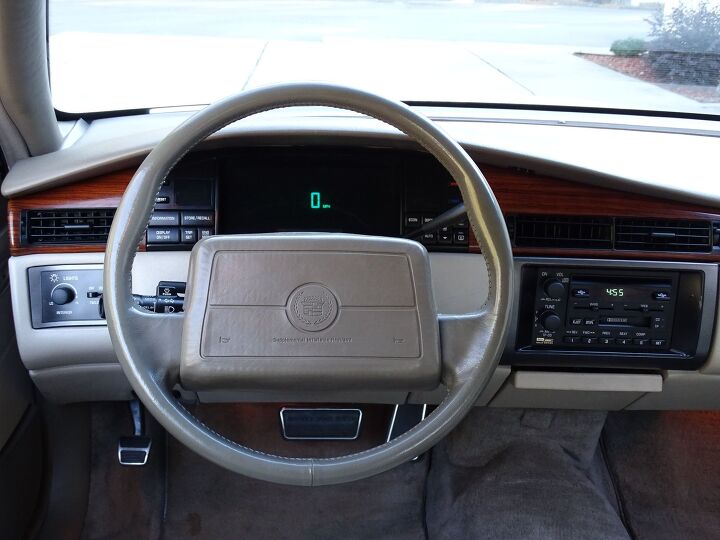
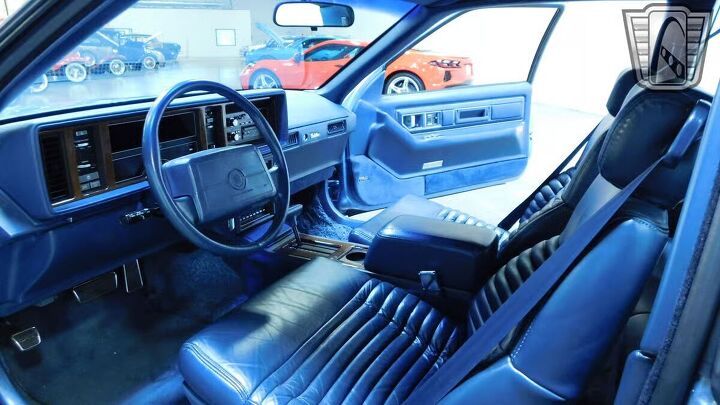
The long coupe doors opened to an interior that was much more opulent and modern looking than its predecessor. Gone were the squared off angles and separate “pods” design for the controls. Gone was the lack of trim and wood that was slightly too gray and cold.
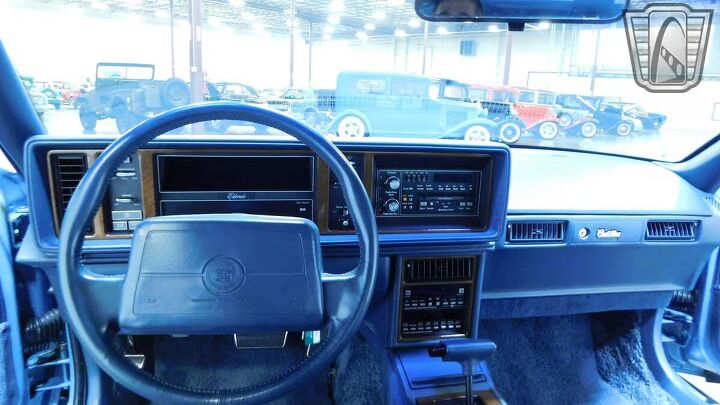
In their place was a sweeping and smooth dash surface that curved gracefully from the door panel and formed a continuous line across the entire dash. In front of the driver was the same two-spoke airbag wheel as the prior model, again found in the same color as the dashboard and seating surfaces.
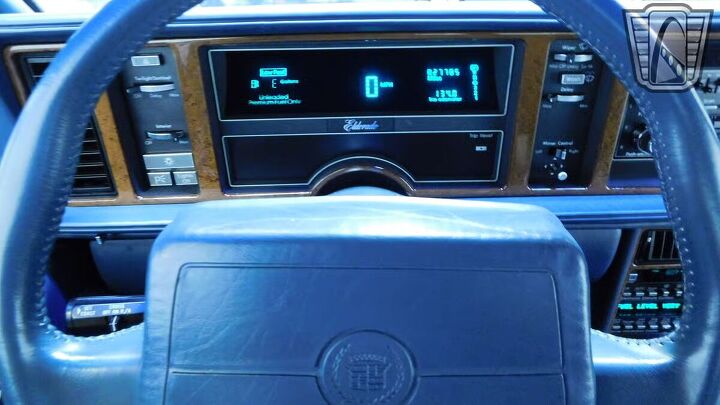
Beyond the steering wheel was yet another set of simple digital gauges, an Eighties hangover which didn’t please consumers of contemporary automobiles. The luxury consumer of the Nineties expected crisp analog gauges, which were available but were not fitted as standard. Their green glow displayed a minimal amount of information like the speed, odometer, gallons to empty, and contained a message center with a line of text. Analog gauges displayed the same information but were rarely seen on early examples.
This integrated information center replaced the one in the 1991 Eldorado that was low on the center console and operated by a multitude of tiny buttons. The new design operated with just three different buttons and displayed even more information. Buttons for the odometer and information center were to the left of the gauges, a space formerly taken by the lighting controls.
Said lighting controls were modernized in 1992 and migrated lower and to the left under the driver’s HVAC vent. Likewise, the wiper and mirror controls moved. Both were formerly to the right of the wheel (weirdly) on sliders. The wipers were moved to the multifunction stalk with the cruise control, and the mirror controls were moved more sensibly to the door.
Taking their place was a brand new and odd design choice. The climate control buttons were small, seven in number, and all were identical in shape. Sitting at the right of the steering wheel, they were obscured by the shift lever when the car was in park and were not accessible to the front passenger. The shift lever issue was only present on base model Eldorados, as the Touring Coupe received a console shifter.
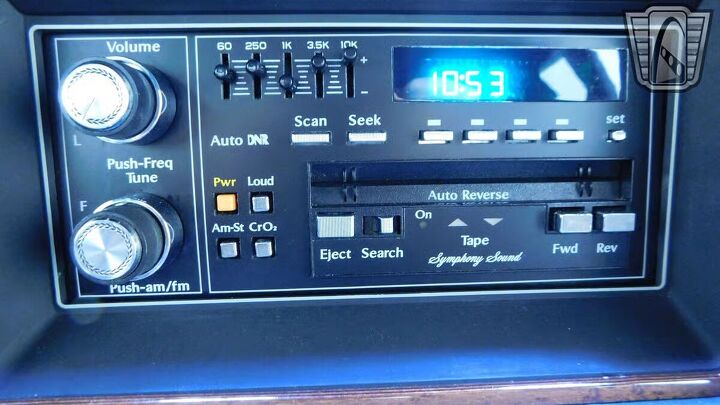
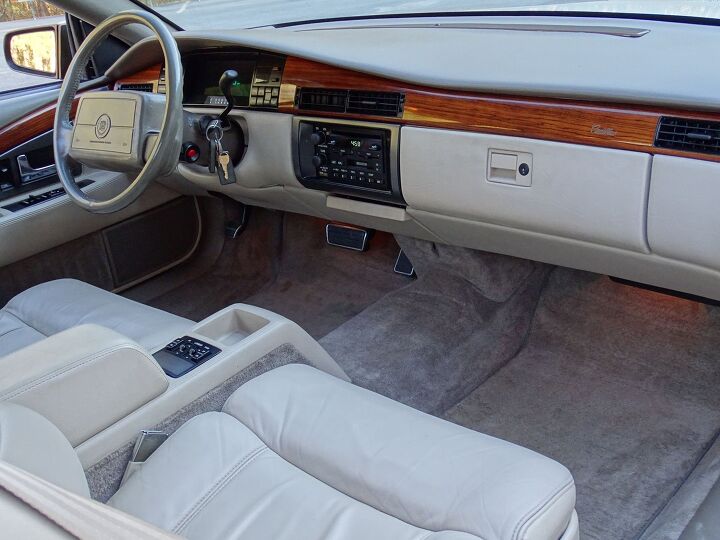
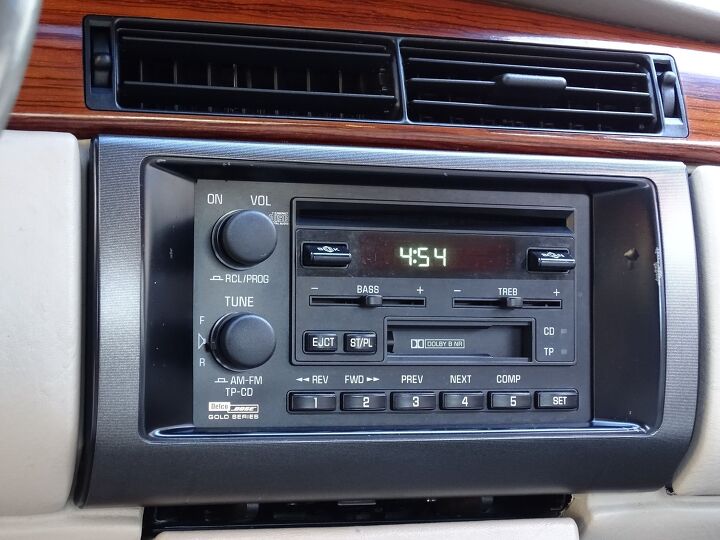
The center dash area next to the climate controls used to house the radio but was now freed to be more design-oriented, with a flowing piece of zebrano wood trim and two rectangular HVAC vents. Below was a redesigned stereo head unit with a CD player that lost the tacky chrome buttons of the old version. Below the stereo there was an ash tray and a lot of open space, as the entire area was previously filled by both climate control and the information center.
To the right of the stereo was a new glovebox located in a more traditional place. This was a forced change over the old “sits on top” glovebox design as Cadillac knew passenger airbags would arrive shortly. The old glovebox design was also unsightly, so it was a welcome change. The formerly bare area of the dash in front of the passenger now had wood trim and silver Cadillac script.
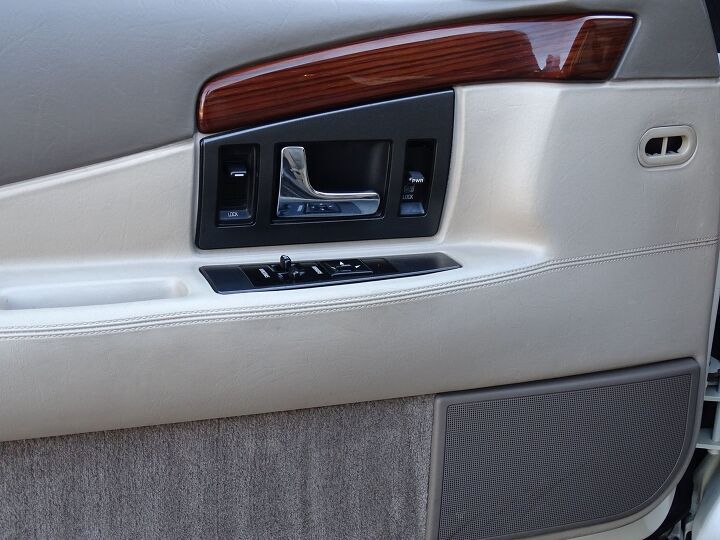
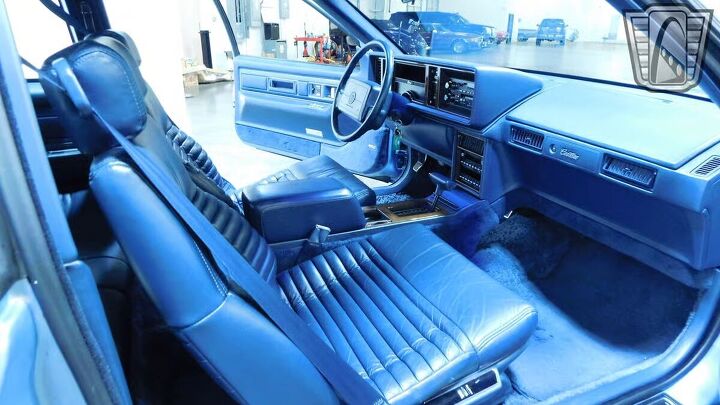
The dash and its wood trim curved into the door panel at either side, which was now two-tone dependent upon interior color selection. Its panels flowed downward toward the door latch with a new and more modern design. The awkward separated panels of the old model were gone, replaced by padded materials.
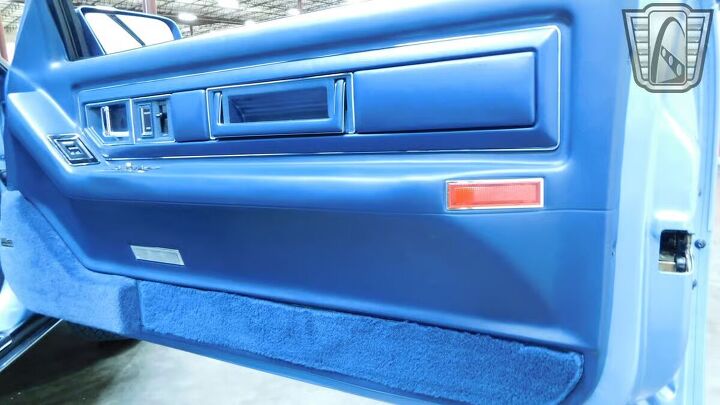
An integrated arm rest that was stitched and in a material that resembled leather replaced the padded vinyl look surface of the prior year. Also gone (finally) was the luggage-style door pull, which was swapped for a simple integrated door pull in the door panel. There were new speakers in either door, and the carpet at the bottom of the door was reduced. Said carpet looked better quality than in 1991. The power lock button was a new lever design, but the door lock itself remained the same as in 1991.
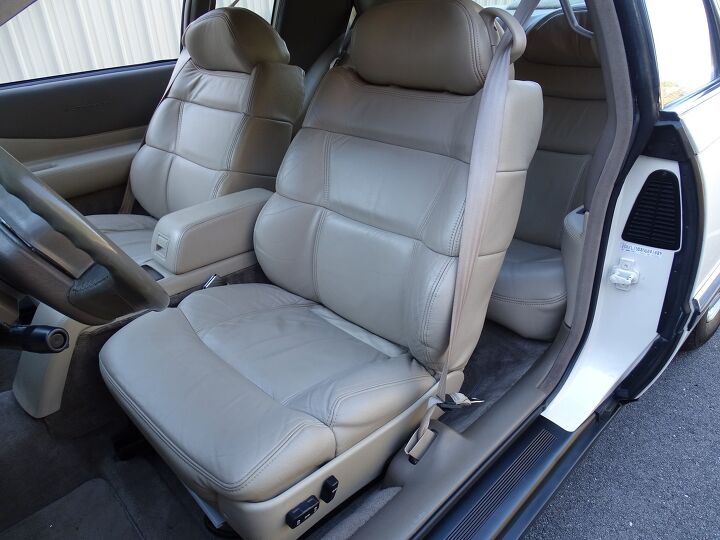
Seats in the 1992 Eldorado looked much more modern and lost the ribbing detail straight out of the Seventies. Also removed was the Cadillac wreath pressed into the seatback at all four seats as Cadillac attempted to shed its brougham image. Thickly padded cushions were sculpted to vaguely resemble lumbar support for the thighs and back. Between the seats was a new control panel for the driver and passenger lumbar adjustment, located in what used to be a cup holder. Those controls had migrated from their awkward previous placement on either door panel.
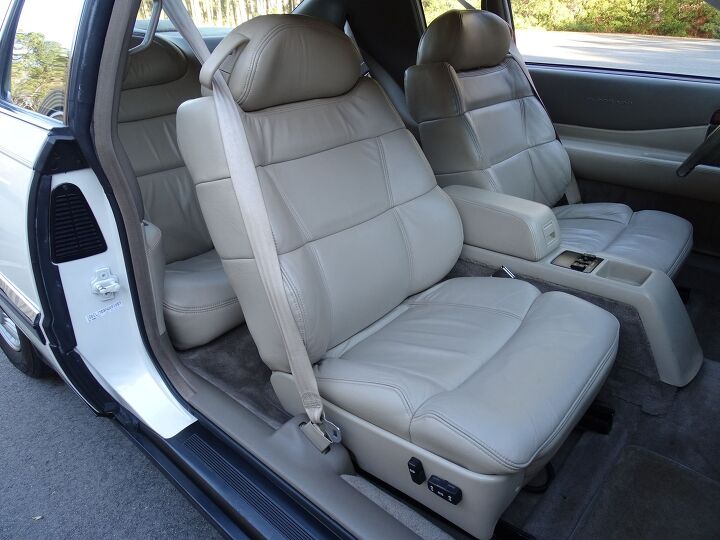
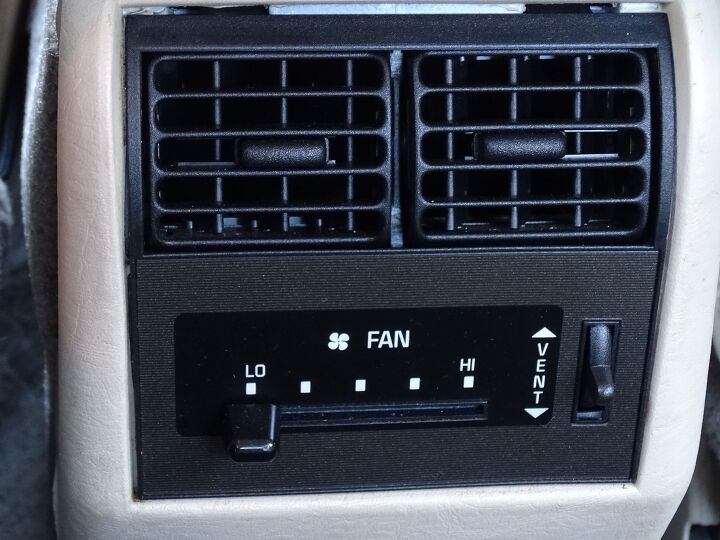
Rear seat passengers had a more comfortable environment in which to reside, with a revised roofline that was taller, a more relaxed seatback angle, larger rear window, and larger rear side windows as well. They luxuriated in seats that were more plush and resembled the chairs at the front. The outboard occupants now had an integrated headrest, though the middle passenger still went without. That unfortunate person also sat perched on a narrow bump between the outside seats. At least they could check out the all-new rear ventilation controls, a first for Eldorado.
Reviews of the day praised the Eldorado’s new interior features but criticized some of the odd choices like the air bladder lumbar inflators and an ashtray that was nearly unusable. Materials were not especially up to the competition either, but were notably better than they were in the prior model. As usual, Cadillac set about improving the Eldorado immediately after its debut, which is where we’ll pick up next time.
Become a TTAC insider. the latest news, features, TTAC takes, and everything else that gets to the truth about cars first by subscribing to our newsletter.
Interested in lots of cars and their various historical contexts. Started writing articles for TTAC in late 2016, when my first posts were QOTDs. From there I started a few new series like Rare Rides, Buy/Drive/Burn, Abandoned History, and most recently Rare Rides Icons. Operating from a home base in Cincinnati, Ohio, a relative auto journalist dead zone. Many of my articles are prompted by something I'll see on social media that sparks my interest and causes me to research. Finding articles and information from the early days of the internet and beyond that covers the little details lost to time: trim packages, color and wheel choices, interior fabrics. Beyond those, I'm fascinated by automotive industry experiments, both failures and successes. Lately I've taken an interest in AI, and generating "what if" type images for car models long dead. Reincarnating a modern Toyota Paseo, Lincoln Mark IX, or Isuzu Trooper through a text prompt is fun. Fun to post them on Twitter too, and watch people overreact. To that end, the social media I use most is Twitter, @CoreyLewis86. I also contribute pieces for Forbes Wheels and Forbes Home.
More by Corey Lewis






Comments
Join the conversation
Actually, though I like the 1992 dashboard better, it does kind of look like the one that was in my mom's Chevrolet Lumina.
There was actually one on Copart today that I forgot to watch so I don't know if caught any bids... one of those things where its better I forgot because this one was clean looking but didn't start and had some kind of mechanic's lien on it (also was in Oregon so shipping was going to be like 2 grand).