

Rare Rides Icons: The Cadillac Eldorado, Distinctly Luxurious (Part LIX)

We return to Eldorado coverage in the middle of the ninth generation’s eight-year run. The large and boaty iteration of the Eldorado debuted in 1971, and in 1973 its looks and placement within the product lineup were reworked. No longer a Fleetwood designated vehicle, the Eldorado stood on its own as it progressively became heavier, more trimmed, and larger than ever. Warning: This post contains facts that disagree with the rest of the internet.
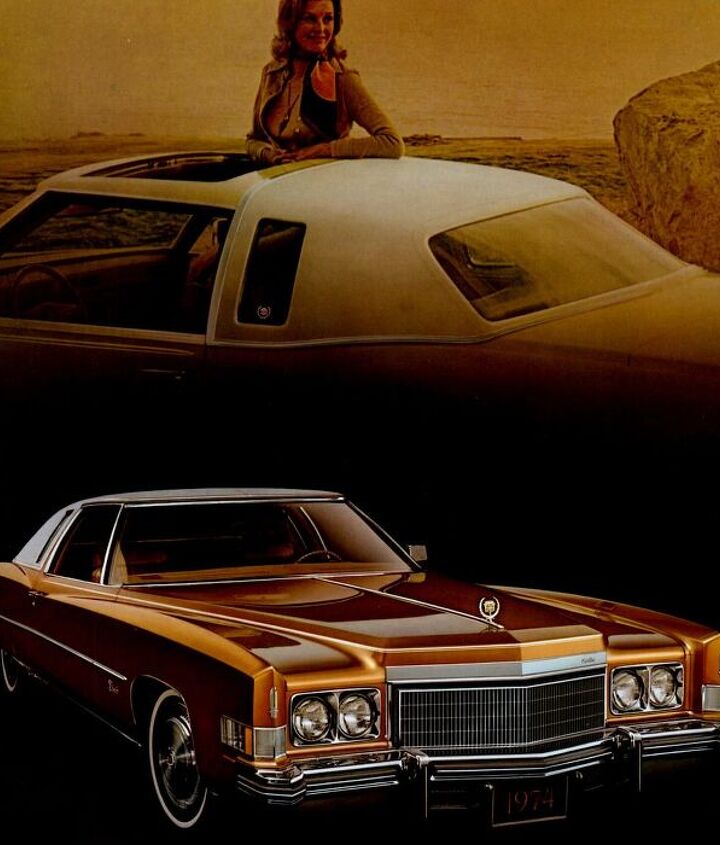
The Eldorado received some slight visual updates in 1974, following the prior year’s refresh. The chunky grille texture was reverted to a tighter eggcrate appearance, though its fitment with large gaps around its exterior were not corrected. Cadillac added an additional chrome strip above the grille to make the grille look even larger than it was. Integrated into the bumper were two more vertical bumper guards on either side of the license plate, for a total of four.

Wheel covers were technically “redesigned” in 1974, but the change was limited to a chromed wheel disc that was no longer painted body color. More substantive changes occurred at the rear, which was redesigned to be in compliance with new five-mile-per-hour legislation. The legislation said that no damage could occur to a vehicle’s lamps in a five-mile-per-hour impact.

To comply, the bumper was redesigned with taller impact points at either corner, which housed only reflector lenses. The brake lamps were relocated from their traditional position at the end of the car’s fins: They moved inward just under the trunk lid. For the first time, the Eldorado’s rear lamps were horizontal in design instead of vertical. The revisions for regulation meant the car’s overall length increased from 223 inches to 224.1”.

The brand also debuted a new dash design across the lineup in 1974, which marketing termed “space age.” It was a sweeping curved design with a much more horizontal, flatter layout than prior iterations. Warning lamps were moved to a strip at the top of the dash, wood trim returned in much greater quantity than before, and the “cockpit” appearance with a separation between the driver and passenger side of the dash was removed entirely. This dash layout was effectively in place at Cadillac from 1974 to 1993.

Eldorado’s 1974 appearance proved a one-off, as it was time for more modernization in 1975. The circular headlamps of the past three decades went by the wayside as square sealed beams took over. The look remained a mainstay in domestic automobile lighting through the late Eighties, as archaic lighting regulation resisted composite lamp designs. The square lamps brought a more cohesive look to the Eldorado’s front end.

Other changes included a revised grille texture, which showed a larger eggcrate once again. Front corner trim was revised, and no longer wore a crest emblem. Instead, the metal of the bumper wrapped upward to cover the area. Indicator and corner marker lamps no longer wrapped around the front corner, but were separated into two pieces.

The corner marker moved to the fender near the wheel well, while the indicator lamp was integrated into the front bumper. Likely better from a visibility standpoint, it also looked more modern. The overall front end look was slightly less heavy-handed, as the prominent curving protrusions of the front bumper went away.

The side profile also had a lighter styling touch this year, as the trim strip along the side was shortened and terminated ahead of the rear wheel. Fender skirts were removed, which assisted the whole profile to look a bit less heavy. Ahead of the front wheel, a new lower chrome strip was added to make the front clip look more streamlined.

Additional revisions to the looks appeared in 1976, as Cadillac’s designers made small edits to keep the Eldorado going. The grill design was edited once again, with a thicker eggcrate that was horizontal instead of vertical, and had a beveled look to each of its sections that made it appear heavier. Front corners were again revised, with a Cadillac badge making an appearance at either side.

Above the grille, the chrome trim panel installed in 1974 was slimmed considerably. The Cadillac script within it was moved, and became a badge at the edge of the hood instead. Trim around the headlamps was simplified and cleaned up this year: The chrome surround was thinner and no longer featured visible screw heads. Wheel covers were revised again, with a new option to have their centers painted black.

Early in the ‘76 model year, Cadillac announced the end of the Eldorado convertible. On April 21, 1976, Cadillac PR made a gushing press release about the end of the line for the last American production convertible. With a typo in its second paragraph “employe,” the three-page letter announced a run of 200 final Eldorado convertibles. We learned about the decline and elimination of the convertible from American manufacturers in an Abandoned History article a couple weeks ago.

All 200 final convertibles were finished in white paint with white roofs and white wheels, with white leather seats and a white dash. Color variation was provided by red seat piping, carpets, and some red and blue pinstripes. Cadillac was sure to state this was to be a collector’s item.


Funny enough, the PR letter contained more errors. In referring to the car as the “1976 Fleetwood Eldorado convertible,” Cadillac seemingly forgot it removed the Fleetwood designation in 1973. Nowhere in the marketing from 1973 to 1978 was the Eldorado referred to as a Fleetwood, only in this letter about the end of the convertible. It’s almost like they couldn’t keep up with their own branding fluff internally.

Collectors, the general old guys public, Car and Driver, and various sources online have at some point termed the final 200 Eldorado convertibles the “Bicentennial Edition,” with claims Cadillac applied this name to celebrate the American bicentennial. However it’s completely false. That name did not appear in the press release, and was not on the plaque the final 200 wore. It was Chevrolet who did the bicentennial work that year for GM, and those were called the Spirit of America.

After the death of the convertible, the Eldorado extended its life beyond when the rest of the Cadillac lineup was replaced. For the first time ever, all other Cadillacs were new for 1977 but the Eldorado soldiered on through ‘77 and ‘78 before being replaced. And it truly got ridiculous at the end, so we’ll pick up there next time.
[Images: GM, seller, seller, seller, seller, seller, YouTube]
Become a TTAC insider. the latest news, features, TTAC takes, and everything else that gets to the truth about cars first by subscribing to our newsletter.
Interested in lots of cars and their various historical contexts. Started writing articles for TTAC in late 2016, when my first posts were QOTDs. From there I started a few new series like Rare Rides, Buy/Drive/Burn, Abandoned History, and most recently Rare Rides Icons. Operating from a home base in Cincinnati, Ohio, a relative auto journalist dead zone. Many of my articles are prompted by something I'll see on social media that sparks my interest and causes me to research. Finding articles and information from the early days of the internet and beyond that covers the little details lost to time: trim packages, color and wheel choices, interior fabrics. Beyond those, I'm fascinated by automotive industry experiments, both failures and successes. Lately I've taken an interest in AI, and generating "what if" type images for car models long dead. Reincarnating a modern Toyota Paseo, Lincoln Mark IX, or Isuzu Trooper through a text prompt is fun. Fun to post them on Twitter too, and watch people overreact. To that end, the social media I use most is Twitter, @CoreyLewis86. I also contribute pieces for Forbes Wheels and Forbes Home.
More by Corey Lewis








Comments
Join the conversation
Photo captions would have been helpful. It was difficult (for me, at least) to correlate the comments in text with the photos intended to illustrate what the writer was pointing out.
Eh, your best bet's a true baby blue Continental.