

ID.7 Long-Term Review & New €25k ID.Polo EV Details (w/ Battery Life)
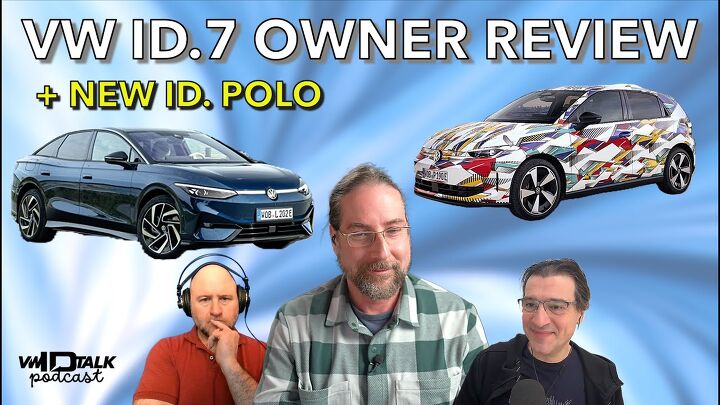
In this episode of the VWD Talk Podcast, we sit down with Chris from @batterylife to discuss the full spectrum of Volkswagen's electric future. Chris shares his honest long-term review of the ID.7 after two years of ownership—is it really the "pinnacle" of the MEB platform?
We also geek out over the upcoming VW ID.Polo (formerly ID.2). From the return of physical buttons and four window switches (finally!) to the new "retro" design and front-wheel-drive platform, we cover everything you need to know about VW's €25k entry-level EV.
Topics Covered: * Chris's 2-year experience with the VW ID.7 (Efficiency & Comfort) * Why the ID.7 beats the Hyundai Ioniq 6 and Mini Cooper E * Deep dive into the ID.Polo: New battery tech, Android Automotive, and the return of buttons * The "Retro" design philosophy: Is it just an electric Polo/Golf?
Check out the VWIDTalk Podcast on YouTube and wherever you get your podcasts ( Apple Podcasts, Spotify, Overdrive and more).
A transcript, cleaned up by AI and edited by a staffer, is below.
The TTAC Creators Series tells stories and amplifies creators from all corners of the car world, including culture, dealerships, collections, modified builds and more.
[Image: YouTube Screenshot]
Become a TTAC insider. Get the latest news, features, TTAC takes, and everything else that gets to the truth about cars first by subscribing to our newsletter.
Transcript:
Here is a cleaned-up, properly punctuated version of your transcript with filler removed, overlaps smoothed out, and readability improved while preserving the original meaning and conversational tone.
Intro Clip
When you see it in the design, the ID Polo looks less futuristic than the ID.3 or ID.7. You can barely tell it’s an electric car, and I think that’s exactly what they’re going for.
Podcast Opening
Welcome back to the VW ID Talk podcast, your home for all things EV—specifically Volkswagen. You can catch us on Spotify, OverDrive, Apple Podcasts, and your favorite podcast platforms, and we’re happy to have you here on YouTube.
Jan, who are we talking to today?
Today we have the pleasure of speaking with Chris from The Battery Life. Hey, Chris.
Hello—thanks for having me.
You look familiar.
Yes, I think we spoke about a year ago.
Has it already been a year? Wow, time flies.
If you don’t know Chris, check out his channel. He actually runs three channels, including a German one, and I also like your “Behind the Battery” channel.
Today we want to talk about three things: Chris’s journey as one of the early EV adopters, going from the ID.3 to now driving the ID.7; his experience testing many vehicles in 2025; and finally, we’re going to geek out about the ID Polo—formerly known as the ID.2—and the new MEB platform that underpins it.
Living With the ID.7
Last time we talked, you had just gotten your ID.7. You described it as having amazing efficiency, performance, and comfort. After nearly two years, do you still feel the same way?
Yes—actually, it’s been two years. I got it in… wow, time really flies.
From our American perspective, that’s a bit skewed since the ID.7 was supposed to launch here and then suddenly disappeared from the website.
No idea why.
It’s a shame. So many people buy crossovers and SUVs, which I understand, but cars like the Hyundai Ioniq 6 are excellent—and they’re just not selling many of them. Automakers are chasing volume.
It would be great for people who want an electric sedan. Your choices are basically the Ioniq 6, a Porsche Taycan, or an Audi.
So, two years in—how do you like the ID.7?
The ID.7 rules. It was a huge step up from the ID.3. The ID.3 isn’t cheap, but when you move into the newer models, everything improves. By the time you get to the ID.7, they’ve made everything better.
The seats alone are incredible—easily the best I’ve ever sat in. I have the premium seats with massage, including in the seat base, and I use it every time I drive. Ventilation is excellent, and the seat heater is the warmest I’ve experienced.
My wife is only five feet tall and often struggles with seat length in other cars, but the adjustability here works perfectly for her.
You also get the biggest battery on the MEB platform, incredible efficiency, and great charging speeds. I see about 192 kW peak charging, and the larger battery can hit 205 kW—roughly 25 minutes from 10% to 80%.
It’s more efficient than a Tesla Model 3 AWD; only the standard-range versions beat it. And the comfort level is outstanding—arguably more comfortable than an Audi A6, just in a different way.
I recently drove a Mini Cooper E for two weeks. It’s a fun, sporty go-kart, but when I picked up my ID.7 again, it felt like coming home.
The only downside? Software updates are slow. I just received my first update three weeks ago, and it required a dealer visit rather than an over-the-air update.
Volkswagen tends to be conservative with software, which can be good—but competitors are moving fast.
Exactly. They want to be certain everything works before releasing it.
MEB Platform Vehicles
You’ve tested many cars built on the MEB platform—Skoda, Cupra, Ford Explorer, and others. How do they compare?
The foundation is extremely similar. Drive an ID.4, then hop into a Cupra Tavascan, Skoda Enyaq, or Ford Explorer—it all feels very familiar. Power delivery, regeneration, and even the software are about 90–95% the same, with only minor differences.
Brand affinity plays a big role. Some people will never buy a Volkswagen but happily choose a nearly identical Skoda.
I really liked the Skoda Elroq, especially the interior. It feels more modern—almost Audi-like—and it supports a front motor for an all-wheel-drive RS version, something the ID.3 lacks.
Interestingly, the Elroq is basically an Enyaq that’s about 30 centimeters shorter, yet roughly €6,000 cheaper.
Best Cars for Different Needs
Out of everything you’ve driven, what’s your dream car, commuter car, and family car?
Honestly, the ID.7 covers both commuting and family duties. When I first got it, I thought five meters in length would be a problem, but the turning circle is excellent—especially with rear-wheel drive—so it’s surprisingly easy to manage.
The ID Polo
What are your thoughts on the upcoming ID Polo?
It’s the next step Volkswagen needs in Europe. By 2026 or 2027, they’ll have to sell many more EVs, and affordable models are essential.
Originally called the ID.2, the Polo name makes it more approachable for people used to internal-combustion cars. Visually, it’s less futuristic—you can barely tell it’s electric—which is likely intentional.
Size-wise, it’s compact but practical. The trunk is comparable to the ID.3, and because the rear motor is gone, you get extra storage underneath. It’s front-wheel drive on the new MEB Plus platform, which introduces cell-to-pack battery technology for higher energy density and lower weight.
There’s also a new motor producing about 290 Nm of torque, and improvements to braking—no rear drum brakes and better blending for a more natural feel. It may even support one-pedal driving.
Entry models will use LFP batteries, while higher trims get NMC packs.
Interior Improvements
You previewed the interior—what stood out?
Volkswagen seems to have addressed many complaints. There are real physical buttons now, shortcut controls beneath the screen, proper volume adjustment, and four window switches.
The display is larger, and the design leans slightly retro—like driving an old Golf, though personally I don’t want nostalgia in an EV.
Of course, at a €25,000 starting price, compromises are inevitable.
Charging, Range, and Positioning
The range is similar to what the ID.3 offered in 2020, but charging is better—around 130 kW peak with roughly 26 minutes from 10% to 80%.
It should still handle longer trips reasonably well, even if faster options exist.
In the U.S., it would compete with cars like the Chevy Bolt or the upcoming Nissan Leaf reboot.
Launch Timeline and Software
The premiere is expected in mid-April, with customer deliveries around September. Registration should open soon, and I’ll be signing up early—both for the channel and because I’m genuinely interested.
The infotainment system is Android-based, so I’m hoping for installable apps and more frequent updates. It represents a new direction for Volkswagen, and hopefully they deliver a car that feels solid rather than cheap.
Early impressions suggest the chassis tuning is excellent—even with front-wheel drive—something German automakers traditionally do well.
Wrap-Up
Anything else you’d like to share?
Just that I’m excited to see where Volkswagen goes next.
Chris, thanks so much for joining us again—it’s always fun talking with you.
Anytime.
And thanks to everyone watching. Don’t forget to subscribe, check out Chris’s channels, and we’ll see you next time.
Bye!

Driven by ID owners, the VWIDTalk Podcast is operated by VW ID owners for VW ID owners, sharing best practices, tips, tricks, and mods in engaging, multi-participant discussions on everything to do with Volkswagen's lineup of electric vehicles. Dive deep, stay positive, and most importantly, enjoy the ride. Hosts: VWIDTalk.com moderators and ID.4 owners Jan Kalis and Wes Garrison
More by VWIDTalk Podcast, TTAC Creator









Comments
Join the conversation
Tail still doesn't know bronto is dead.