


Rare Rides: A 1976 AMC Gremlin, Fully Covered in Jeans


The AMC Gremlin celebrated its 50th birthday recently, a fact which would have passed by without notice were it not for commenter Steve Biro. And since we’re talking Gremlin today, we may as well take a look at an oddball trim that’s as quirky as it is rare.
It’s a Levi’s Gremlin from 1976, and it comes standard with an invitation to the Pants Party.
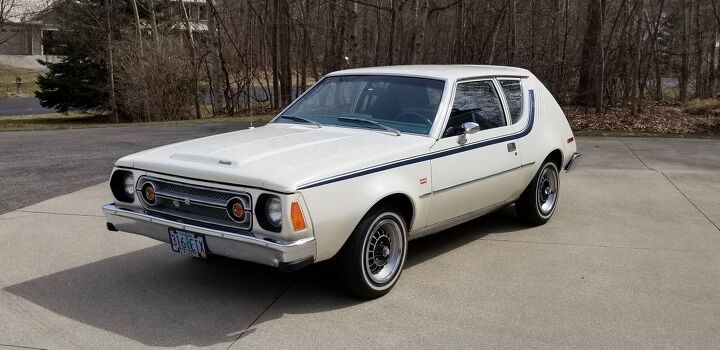
Spirited small automaker AMC, like the other American car manufacturers, needed a car in the early Seventies to counter the invasion of small economy cars from abroad. Entries like the Honda Civic and Toyota Corolla caught American companies without a card to play as fuel economy suddenly became a concern of consumers. Using ingenuity and as few dollars as possible, AMC created the thoughtfully named Gremlin.

Gremlin’s development started in earnest circa 1968, after the debut of the AMX-GT concept. The Richard Teague design was based on the Javelin, but the pony car platform did not mix well with specifications for a subcompact car. The AMX name was used later, but the concept itself did not go to production. Instead, designer Bob Nixon used the same general principles of the AMX-GT, mating the design to a shortened version of the existing compact Hornet platform. Unlike Ford and GM, AMC could not afford an all-new platform for its subcompact. The Hornet’s wheelbase was shortened a full foot (to 96 inches).
Gremlin was introduced April 1, 1970, ahead of the Chevrolet Vega, and a year before Ford’s Pinto and the imported Dodge Colt. The most basic version had no rear seat and no window hatch, and asked $1,879. The standard version, with four real seats and an opening rear window, was priced at $1,959 ($12,900 adjusted), which made it a value leader. Engines ranged from a VW-sourced 1.9-liter inline-four to AMC’s 304 V8 (5.0L). Transmissions were of three or four speeds in manual guise, or a three-speed automatic. Earlier automatics were sourced from Borg-Warner, while later ones were Chrysler’s ironclad TorqueFlite.

The available options were unusual for an economy car, as was the choice in engines. Customers who found its looks acceptable were pleased with their unusual domestic hatchback. In its first full year of sales in 1971, AMC moved 53,480 Gremlins. 1973 was the first considerable update for the Gremlin, as new bumpers were compliant with federal 5-mile-per-hour impact rules. Interior furnishings saw a rearrangement, which spelled more legroom for rear-seat passengers. And more importantly, Levi’s was the hot new trim package.
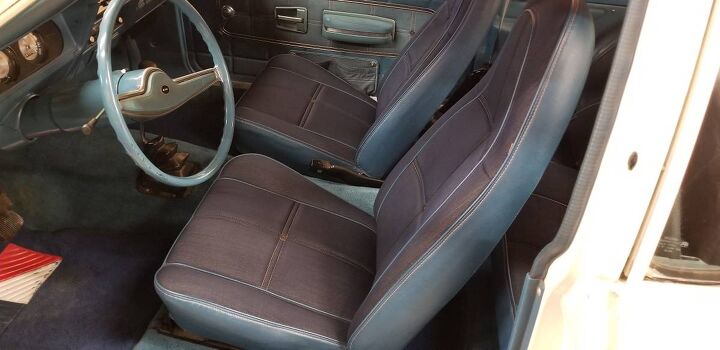
The main appeal for the Levi’s package was the interior trim, which was actually a denim-look nylon, since cotton in a car interior was an impermissible fire hazard. On the doors were removable map pockets, allowing owners to show their friends some cartography. The seats were also complete with authentic Levi’s red tab logos. Real copper rivets completed the jeans look. These no doubt turned into little branding discs in the Arizona sun.
The added appeal of Levi’s and other trims meant a jump in sales to 122,844 in 1973. Late in the year, the Arab Oil Embargo occurred, so Gremlin sales kept going strong. It didn’t last long, and by 1976 sales were slumping for all domestic subcompacts. A new international economy car competition was afoot, one that was front-drive and considerably lighter. That year, AMC refreshed the Gremlin with a new grille and headlamp surrounds, plus revised fenders. New sheet metal in 1977 didn’t rescue the Gremlin from its sales slide, which meant 1978 was its last year. In 1979 Gremlin was replaced by the equally Hornet-based Spirit, which, unfortunately for AMC, was neither lightweight nor front-wheel drive.
Today’s ’76 Gremlin, in excellent condition, hails from the Pacific Northwest region. It’s rust free and has a three-speed manual and the 3.8-liter inline-six. That engine eventually became the 4.0L used by Jeep through 2006. This AMC asks $10,900.
[Images: seller]
Interested in lots of cars and their various historical contexts. Started writing articles for TTAC in late 2016, when my first posts were QOTDs. From there I started a few new series like Rare Rides, Buy/Drive/Burn, Abandoned History, and most recently Rare Rides Icons. Operating from a home base in Cincinnati, Ohio, a relative auto journalist dead zone. Many of my articles are prompted by something I'll see on social media that sparks my interest and causes me to research. Finding articles and information from the early days of the internet and beyond that covers the little details lost to time: trim packages, color and wheel choices, interior fabrics. Beyond those, I'm fascinated by automotive industry experiments, both failures and successes. Lately I've taken an interest in AI, and generating "what if" type images for car models long dead. Reincarnating a modern Toyota Paseo, Lincoln Mark IX, or Isuzu Trooper through a text prompt is fun. Fun to post them on Twitter too, and watch people overreact. To that end, the social media I use most is Twitter, @CoreyLewis86. I also contribute pieces for Forbes Wheels and Forbes Home.
More by Corey Lewis








Comments
Join the conversation
The Honda Civic and the Toyota Corolla? No, the Gremlin was targeted squarely at the Beetle, and even featured it in the first brochure: https://www.hemmings.com/stories/2020/04/01/amc-had-just-one-mission-for-the-gremlin-kill-the-beetle
I remember a guy I worked with in the early 70's who had one of the 1st Vegas and at 50k miles it was ready for its 2nd engine replacement. He said that it was the worst car he had ever owned and it had the life span of a Saturn rocket booster. The Pintos were slow and they had the exploding gas tanks but they were more reliable than the Vega. Is it any wonder that the Japanese gained a foothold in the US with such bad quality in US small cars.