


Rare Rides: A Very Brown Talbot Tagora From 1982


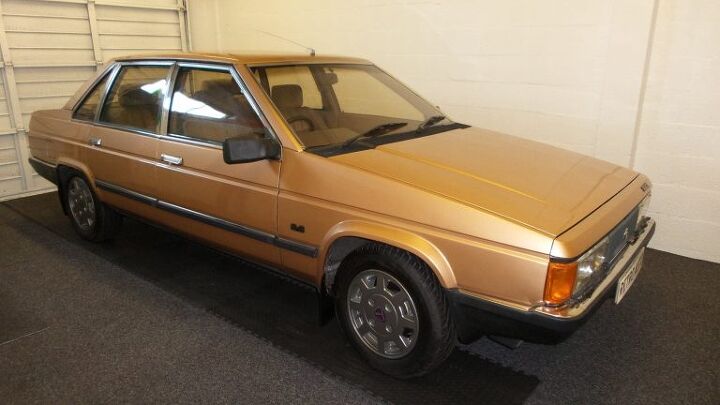
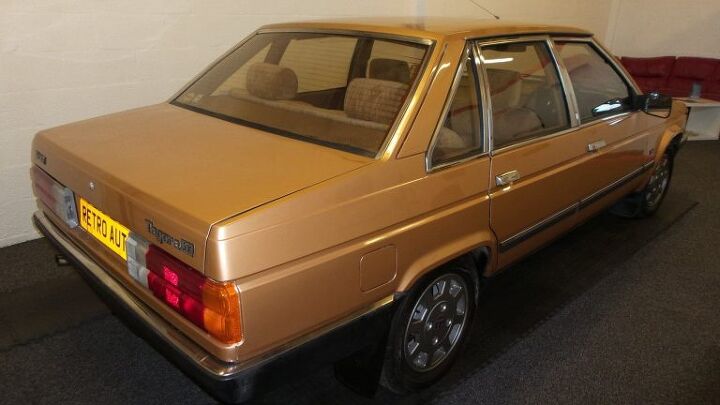
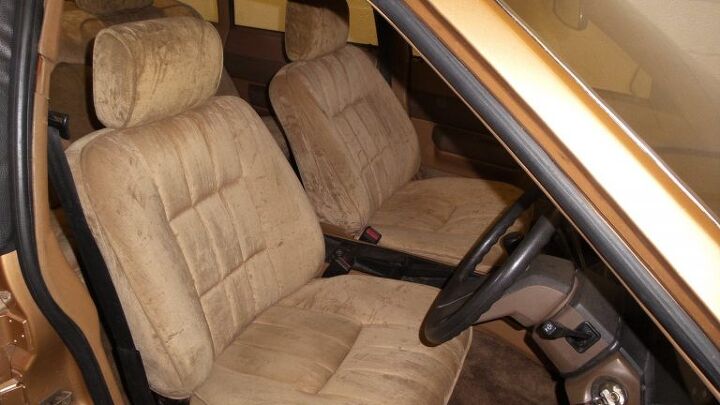
Today’s Rare Ride is the European luxury sedan you’ve never heard of. Plush, brown, and boxy, it’s the Talbot Tagora from 1982.
The Tagora was born at a difficult time for its owner, Chrysler Europe. Chrysler’s European branch was formed in 1967 from a combination of three brands, all hailing from different countries in Europe. France contributed Simca, Rootes hailed from the U.K., and rounding out the trio was Spanish manufacturer Barreiros. Chrysler had the job of consolidating three different brands together into a profitable enterprise, which proved a tall order.
Throughout the Seventies, Chrysler’s large European sedan offering was the 180. It was branded in various ways by Chrysler, Simca, and later on, Talbot. The model proved unsuccessful, so by the middle of the decade Chrysler was working on a replacement. Said replacement was developed under the name C9. Chrysler distributed work across Europe, leaving styling to its design center in the U.K., and sending the technical aspects to Simca in France.
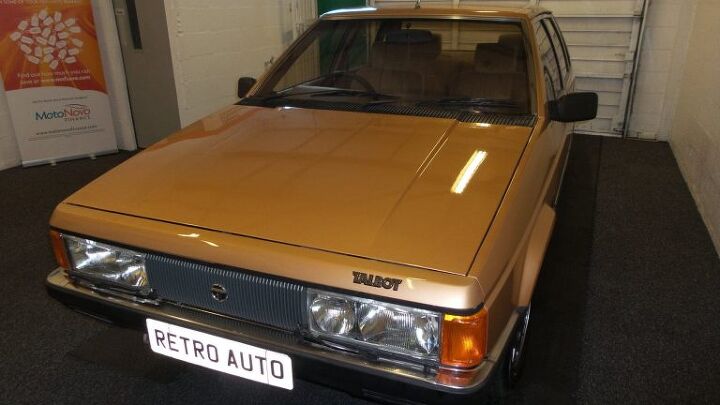
Originally, the British design trended toward daring, adopting some styling cues derived from the beautiful Citroën SM. When the initial design was shown to Chrysler HQ in Detroit, top brass found it all a bit much and ordered a rework. The resulting edits produced a more plain, angular design; one which received production approval.
All was not well at Chrysler Europe, and as the C9 marched toward its production date the whole organization would undergo a significant transition. Chrysler was unable to successfully marry its three European brands together, and the resulting mixed lineup confused customers and prevented profits. Piling on, the late Seventies were already a difficult time for Chrysler’s American arm — something had to give. Ultimately the hammer was delivered by new Chrysler CEO Lee Iacocca. Seeing a money loser, and without much personal interest in European operations, Lee decided it was time for a sale.
Chrysler sold its European operation to PSA Peugeot Citroën group for the princely sum of one dollar. The company received factories, product, and the responsibility for some considerable debts. As the C9 was ready at the very same time, PSA revived the extinct Talbot brand and put its new Tagora into production. The sedan went on sale for the 1980 model year, featuring two different inline-four engines (gasoline and diesel), and an upmarket 2.7-liter PRV V6. Transmissions of three- to five-speeds were available, the only automatic being a three-speed. Peugeot tossed the Chrysler suspension in favor of the setup from its 505 and 604 sedans, plus an elongated the nose to fit the V6 engine.
As mentioned in a previous Rare Rides, PSA group found itself in an unfortunate set of circumstances with the Tagora. The Chrysler-developed and Peugeot-built sedan competed with the Peugeot 505 and 604, and vied for the same general customer as the well-known Citroën CX. Upon introduction, Tagora did not distinguish itself from its competitors and failed to receive acclaim from the motoring press. Though Chrysler expected to sell 60,000 C9s a year, PSA sold roughly 20,000 between 1980 and 1983, the year the Tagora bit the dust.
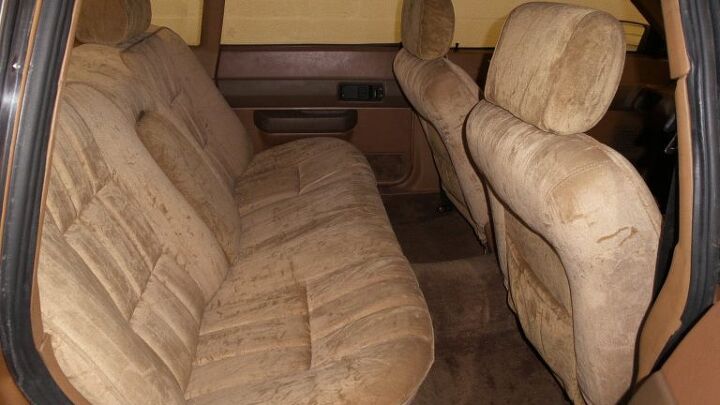
Today’s Rare Ride is located in the UK, and is a top-spec SX trim with V6 and a manual transmission. Already the subject of a restoration, the Talbot asks about $16,000.
[Images: seller]
Interested in lots of cars and their various historical contexts. Started writing articles for TTAC in late 2016, when my first posts were QOTDs. From there I started a few new series like Rare Rides, Buy/Drive/Burn, Abandoned History, and most recently Rare Rides Icons. Operating from a home base in Cincinnati, Ohio, a relative auto journalist dead zone. Many of my articles are prompted by something I'll see on social media that sparks my interest and causes me to research. Finding articles and information from the early days of the internet and beyond that covers the little details lost to time: trim packages, color and wheel choices, interior fabrics. Beyond those, I'm fascinated by automotive industry experiments, both failures and successes. Lately I've taken an interest in AI, and generating "what if" type images for car models long dead. Reincarnating a modern Toyota Paseo, Lincoln Mark IX, or Isuzu Trooper through a text prompt is fun. Fun to post them on Twitter too, and watch people overreact. To that end, the social media I use most is Twitter, @CoreyLewis86. I also contribute pieces for Forbes Wheels and Forbes Home.
More by Corey Lewis








Comments
Join the conversation
Never has a car looked more like a co-mingling of a Volvo 850 and a Renault Medallion.
Looking at the car itself and ignoring the back story, it's quite unusual and a bit of an oddity of its type. It was powered by a 2664cc odd-fire PRV this is true, but not any old PRV. Each engine had its own build number on a plate riveted to the block to donate that this PRV is no ordinary one. It has larger valves, different cams, tubular headers and is topped off with a pair of triple-choke Weber IDA variants called the IT. Not exactly standard fayre for a large saloon! It was only available with a 5 speed manual gearbox and is rear drive with an LSD. It may look pedestrian, but had a big fat sting in its tail.