


2017 Hyundai Ioniq Hybrid's Price is the Latest Blow for Toyota's Prius
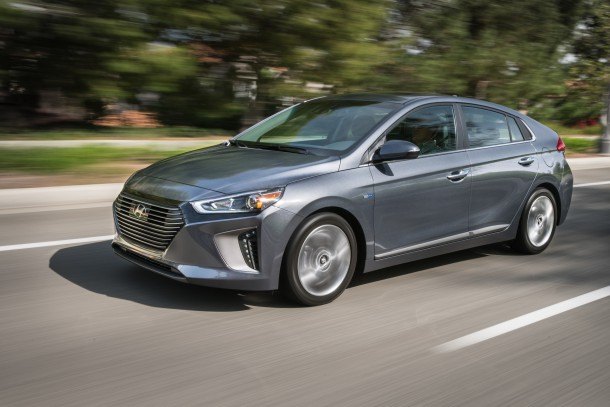
Once upon a time, Toyota’s Prius was the only real choice for anyone looking to get into a futuristic “hybrid” car. The microscopic Honda Insight, looking like a tear dropped from a poet’s eye, held two seats — and that’s no good for taking your friends to book club.
As technology did what it has been known to do (advance), other automakers picked up the torch, outfitting conventional family sedans with battery packs and Atkinson-cycle engines. The segment soon became more diverse, just in time to see the public’s enthusiasm for hybrids taper off.
Now, from Japan’s neighbor, comes a new Hyundai model — offered as a hybrid or electric, and with a plug-in on the way — that undercuts the world’s most recognizable hybrid in price. Your move, Toyota.
As models roll out to dealer lots, Hyundai has announced pricing for both the hybrid and all-electric variant of its Ioniq family, all of which ride atop a dedicated electrified platform.
Selling a straight-up hybrid vehicle these days is tough, as buyers are either choosing to forgo cars in favor of big SUVs and crossovers, or opt for a plug-in variant that offers a measure of all-electric range. Both the Prius and Ioniq have plug-in models on the way.
Unfortunately for Toyota, the Ioniq Hybrid arrives with a lower entry price — $22,200, plus a $835 delivery charge, in base Blue trim. A mid-range SEL trim retails for $23,950, still lower than the base Prius price of $24,685 (plus delivery). Only the Ionic Hybrid’s top Limited trim goes higher with an MSRP of $27,500.
Hyundai, always the value pick, scores again on that front. When you’re a newcomer in a small and competitive market that isn’t exactly on fire, it’s best to do something to stand out. The Ioniq’s powertrain, which features a direct-injection 1.6-liter Atkinson-cycle four-cylinder mated to a 43-horsepower electric motor, makes a combined power rating of 138 hp, to the Prius’ 121.
While the Prius offers a continuously variable transmission for smooth efficiency, Hyundai has gone a different route, preferring the engaged feel of a six-speed dual-clutch automatic. For efficiency, Hyundai’s setup delivers more — an EPA-estimated 58 miles per gallon in combined driving, versus the Prius’s average of 52 mpg. (The Eco version is rated at 56 mpg.)
Coefficient of drag for both models is identical, at 0.24 Cd.
While it would seem the Ionic Hybrid excels in many areas, its electric counterpart arrives at a time when long-range, lower-cost EVs are beginning to hit the market. With 124 miles of range on tap, the Ioniq beats older models like the Ford Focus Electric and Nissan Leaf and matches the upgraded Volkswagen e-Golf. However, it falls far behind the Chevrolet Bolt’s 238 miles and upcoming Tesla Model 3’s 215.
One thing it does have going for it is price. The base Ioniq Electric carries a $29,500 MSRP before delivery, and before a federal tax credit that would push its price $7,500 lower. The Bolt, on the other hand, works out to about $30,000 after the credit.
After a radical redesign failed to result in a surge of new or returning buyers, Toyota’s Prius can only sit and chew its nails.
[Image: Hyundai Motor America]

More by Steph Willems












Comments
Join the conversation
Couple of things: "Both the Prius and Ioniq have plug-in models on the way." The Prius Prime has been out since December, but good luck finding one, as many dealerships are (wisely) selling them as order-only and not stocking any on the lots. The carbon fiber hatch that hindered early production isn't helping either. Regarding the Prius versus Ioniq: I bought a leftover '16 Prius full well knowing the Hyundai was imminent, mostly on the strength of our last three Toyotas all going well over 200k miles with minimal fuss. The Prius (Two model with the older NiMH battery) regularly gets over mpg without trying, which I expect to improve once we get off this awful winter gas and temperatures in the PNW warm back up. I'll believe the Ioniq's mpg figures after a year of Fuelly data.
Wow, Korean really want to beat Japanese in everything from electronic to cars to kpop vs jpop drama even if they come a bit later in the game. 80-90s Japanese made great midsize and compacts, then 10 years later Korean improved their midsize n compact, I only think cuz they hire a great designer. They did lie about the fuel economy few years ago. So no thanks fool me once shame on u fool me twice shame on me. I bought my 2nd gen 3 years ago for $2.9k it had 200k. It has 252k now not bad for a 2005. Still get 48-50mpg in NYC. Still drive good n low maintenance. Nothing rattle inside or outside. Typical Japanese made car. Why Korean go start selling hybrid now? Why don't they jump to long range electric? Even Toyota now put all her resources to catch up on long range electric car. Toyota tried to improve the hybrid very hard and they said it almost reached the maximum efficiency and here Korean claim they can do better with less experience in building hybrid car. I just don't buy it. Sorry I don't believe in new untested products. Unlike Toyota hybrids that have been in the market for so long they must have learn their mistake n improved it further. That's why Korean try to beat Japanese using the I sell u cheaper than them aka dumping. As long they win something.