
Fisker EMotion: On Four Wings and a Battery Prayer
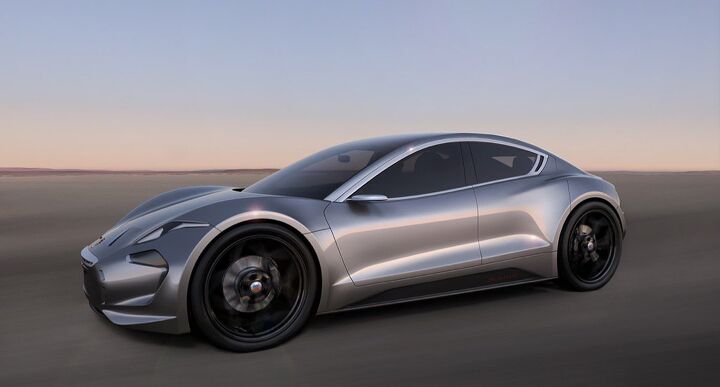
Auto executive and hypeman extraordinaire Henrik Fisker has trickled out details and images of his upcoming electric supercar, the EMotion, but the details simply raise more questions about the vehicle and its technological feasibility.
Eye-rolling name and marketing buzzwords aside, the CEO of the newly formed Fisker Inc. has laid bare the basic abilities of the vehicle, which is expected to debut next year. Boasting a predicted range of 400 miles, the EMotion’s long legs and claimed top speed of 161 miles per hour all depend on a cutting edge technology that some experts say is flawed — at least for use in electric cars.
Fisker, always the optimist, claims this isn’t a problem.
The EMotion sports scissor-style doors that make for a great teaser photo and possesses what Fisker claims is top-notch rear seat room, accomplished by moving the cabin forward. Sure, it looks somewhat like a compressed Fisker Karma, but with hints of Star Wars and the AMC Javelin up front.
Aluminum, composite materials and carbon fiber make up the vehicle’s body, so you know this thing won’t come with a low sticker price.
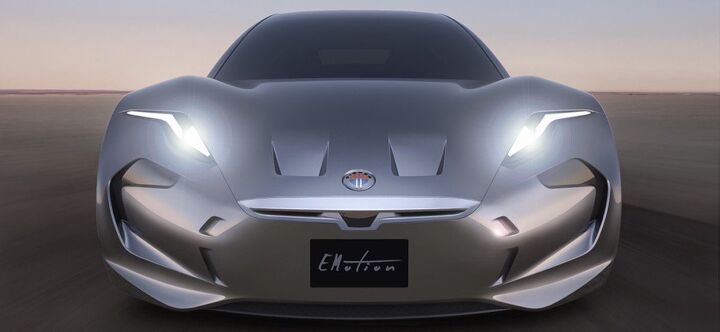
Assuming the doors don’t go Maximum Overdrive on the vehicle’s occupants — a nasty trait that plagued early Tesla Model X buyers — the number one potential weakness for Fisker, besides the financial risk of building a high-end car from scratch, is his EV’s stored energy. An electric car is only as good as its battery allows, and this battery needs to fulfill a big promise.
The EMotion will have the “longest electric range of any production car previously developed,” Fisker claims. How does he plan to pull it off? With graphene. Forget lithium-ion batteries, or even the word “battery” — the Fisker EMotion draws its energy from a graphene supercapacitor.
Graphene, the world’s thinnest and strongest substance, conducts electricity much faster than any other material. It’s a superhighway for electrons, promising incredibly fast charging times. There’s two major problems with a graphene supercapacitor: scarcity of the material, which drives up costs, and the low energy density of a supercapacitor.
Speaking to Business Insider, Lucia Gauchia, an assistant professor of mechanical engineering and energy storage systems at Michigan Technological University, said that graphene hasn’t caught on in the marketplace.
“The reason we are not using it yet, even though the material is not a new one, is that there is no mass production for it yet that can show reasonable cost and scalability,” said Gauchia.
Fisker to the rescue! Jack Kavanaugh, head of Fisker Nanotech, the automaker’s battery supplier, claims that’s not a problem. He told Business Insider that his company is patenting a machine that could “feasibly” produce 1,000 kilograms (2,205 pounds) of graphene at a cost of 10 cents per kilo. And that pesky energy storage problem? Also solved, Kavanaugh claims.
“The challenge with using graphene in a supercapacitor in the past has been that you don’t have the same density and ability to store as much energy,” Kavanaugh said. “Well we have solved that issue with technology we are working on.”
Kavanaugh wouldn’t explain his team’s breakthrough, only saying that altering the structure of graphene would improve the supercapacitor’s energy density.
Suffice it to say there’s still plenty of question marks surrounding the feasibility of this vehicle. If Fisker Inc. really does solve the energy storage problem, then future kudos are deserved. Such a breakthrough could impact the entire automotive industry, but until the vehicle is shown to travel 400 miles on a charge, its “game-changing” abilities exist solely in the realm of the theoretical.
The EMotion will be produced in an existing factory in the U.S., Fisker claims, possibly at specialty car company VLF Automotive’s plant in Auburn Hills, Michigan. Fisker, of course, knows all about that place.
[Sources: Digital Trends, Business Insider] [Image: Fisker Inc.]

More by Steph Willems






Comments
Join the conversation
Graphene supercaps.... This is a moon shot. Tesla wisely used 18650 cells in the Roadster, S, and X, because there was great risk in developing a new technology - risk that could sink the company before it got going. Packaging ~7000 cells has proven to be challenging enough, not to mention building actual cars. Even now, Tesla's big stretch is going with the new 21700 form factor for the Model 3. Likewise, other EV mfrs have all stuck with lithium ion, with incremental, low-risk advances in energy density. I'm all for bold risk-taking, but reality tells me that we'll never see that rendered car subjected to a road test.
Hey, I"ve got an electric lawnmower called an E•Go, so surely Fisker can have a car called the EMotion. (F-ing autocorrect keeps wanting to change that mid-cap.)