
Capsule Review: 2014 Rolls-Royce Wraith
As part of TTAC’s reboot, we promised you, the readers, many things. One of them was “no more luxury car puff pieces”. Jack and I had every intention of adhering to this rule as well, until our staff email inbox received a message from Rolls Royce Motorcars, asking us to come drive the all-new Wraith.
“Go on the program,” said Jack, “and imagine that you are reviewing a Camry”.
The Wraith is not the car that one would typically expect from Rolls-Royce. It used to be that Bentley focused on cars that one would personally drive, while Rolls-Royce was the vehicle of choice for those who preferred to sit in the back seat. But ever since the forced separation of the two marques in 1998, the two have been competing for the same buyers.
Rolls-Royce won’t expressly say that this car is targeted at Bentley customers, just that it’s sportier, with more of a focus on driver engagement and outright performance – the sort of cars that Bentley traditionally offered alongside Rolls-Royce. What they really did say is that the Wraith targeted at “young entrepreneurs in their 20s and 30s”, an assertion that is as starkly detached from reality as Steve Cohen’s remark that the $100,000 sum needed to replace the dead shark in his office was “inconsequential”. Or perhaps there are customers in the BRIC nations who are under 40 and have made their fortune by building a better mouse trap, rather than collecting a parental stipend. Only their marketing team knows.
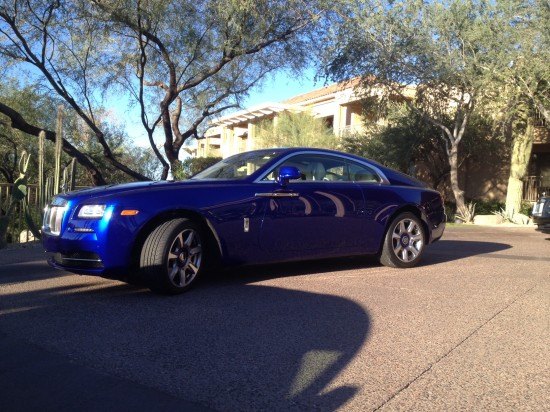
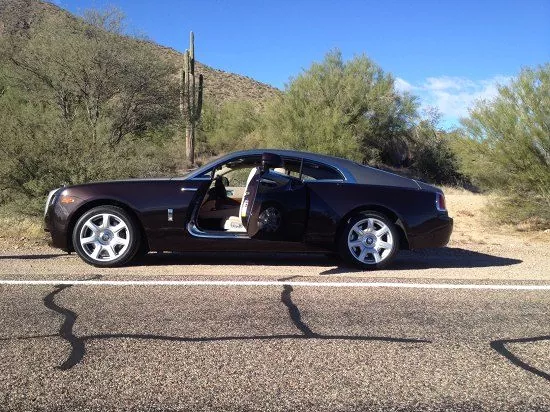
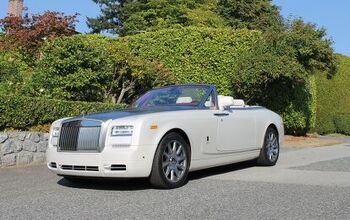
In person, the Wraith is as dramatic as the Phantom itself. The enormous front end is a concession to the aesthetic of contemporary high-end luxury goods, which our social betters have decided must be gauche and ostentatious. But the fastback profile is undeniably elegant, with a gently sloping roof line that recalls the coach-built cars of the pre-WWII era. The two-tone paint of my test car highlights the Wraith’s forms, but remains incapable of doing it justice. Another example, finished in a royal blue shade known as Salmanaca, looked like a modern interpretation of a Bugatti Atlantic from aft of the A-pillar.
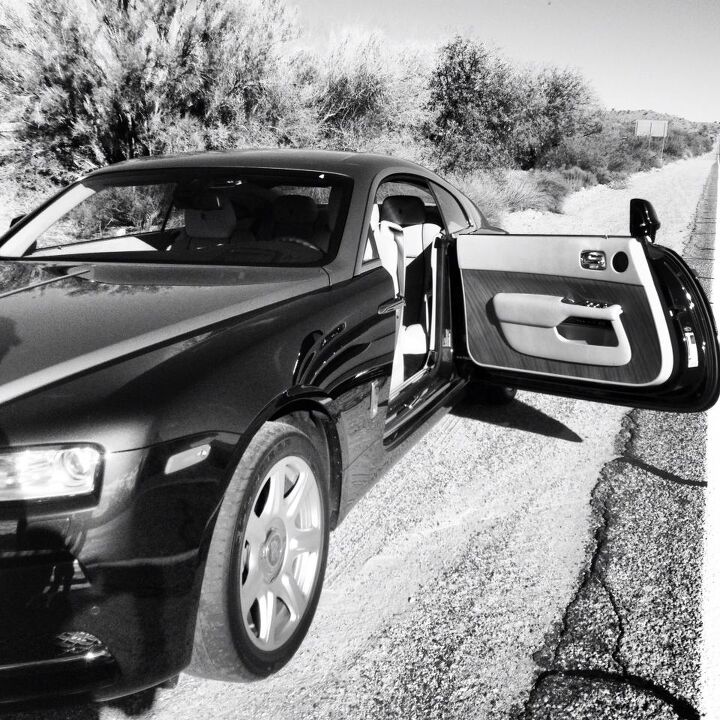
The overall atmosphere of “bespoke” extends to the interior as well. Whereas contemporary Bentleys leave you with a lingering sense that you’re in a very nicely appointed variant of an Audi A8L, there is but one clue that today’s Rolls-Royce shares its bones with something as upper-middle-class as a BMW 7-Series. The gear selector, mounted on the steering column, will remind you of the very first Bangle Siebener. The newest 7-Series has abandoned the stalk setup for a proper gearstick. but it doesn’t have the superlative interior finishings of the Roller. The wood trim in the Wraith has more in common with a fine hardwood parquet floor than any of the Zebrano veneers that most people are familiar with, while the upholstery wouldn’t be out of place in the leather goods section of Bergdorf Goodman. Every single panel, knob, switch and interior component is jewel-like, perfectly placed and installed, and for good reason.
The interior is the focal point of this car. It’s what you are supposed to take in as you glide down the road in utter isolation. For all the talk of this being a “driver oriented” Rolls-Royce, it’s more akin to a two-and-a-half ton drawing-room with four club chairs. Even with a 623 horsepower twin-turbo V12, there is nothing beyond a vague sense of forward motion to indicate that you are piloting the fastest production Rolls-Royce ever. This boosted bent twelve is the last word in linear power delivery. Press the throttle, and the car summons all its might instantaneously, almost like a Tesla Model S with just the briefest pause before you feel maximum torque.
The 8-speed automatic uses a GPS-based system to change gears based on the type of terrain you are navigating, downshifting on grades and upshifting on flat roads to make sure the car is in the right gear at the right time – all without you ever knowing. There is very little feedback from the oversized steering wheel (another beautiful component, but one more at home in a marine application), while the handling and braking capabilities of the car are merely an afterthought. This is a slow speed cruiser, not some sort of grand tourer capable of carving up back roads if need be.
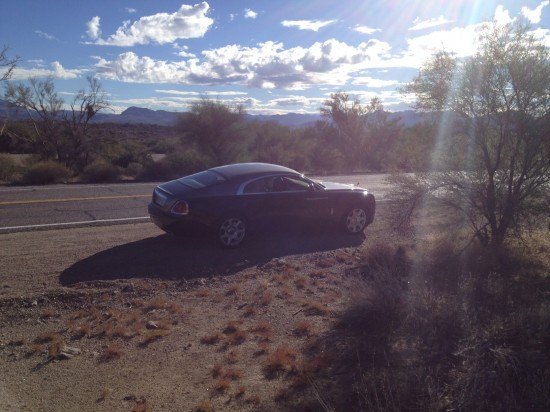
That impression is only furthered by the Wraith’s concerted attempt to filter out every single bit of sensory feedback from the driving experience. Wind, engine, road and tire noise are perfectly isolated, as are most potholes, bumps and road imperfections. The overall silence borders on eerie – stopping in the middle of the desert to take photographs, I was struck by how the still, motionless desert was actually nosier than when I was inside the car, on account of the passing cars on the two-lane highway. Get back inside the Wraith, and it is utterly silent, something that I’ve only experienced sitting in a canoe on a remote lake in Northern Ontario hundreds of miles from civilization.
The only thing it couldn’t filter out was the homeless man sitting at the end of the freeway ramp, eyeing the Wraith intently when I exited. Lacking any American currency smaller than a $20 bill, I was utterly paralyzed in this situation – to give him spare change would have been an insult. To roll down the window and say “sorry”, or dismiss him with the wave of the hand would have been acceptable in a normal car, but even more distasteful given the circumstances. In a $300,000 Rolls-Royce, there is no option that isn’t unseemly or downright cowardly. Especially if it’s avoiding eye contact and praying for the light to turn green like I did.
There was a time when Rolls-Royce claimed to make the best car in the world. The cost was a by-product of that mission. But in 2013, quantity of MSRP has a quality all its own, and the company now finds itself in the uneasy position of attempting to build vehicles that justify a particular price.Although I’m far from averse to automobiles that attract attention, there’s a big difference between driving something that makes an advertisement of personal wealth as its primary mission, and an exotic car full of visual and aural drama. When you leave the lights in a Jaguar F-Type, an Audi R8 or a Ferrari F12, you can revel in the noise of the motor, the clacking of the gated shifter or the sheer occasion of being behind the wheel of a front-engined, V12 supercar. Those cars are able to transport you to an alternate world where you are the star of a 9000 rpm music video in full-on sensory overload.
Not so in the Rolls-Royce Wraith. Instead, you glide away in utter silence, feeling, hearing and experiencing nothing that is not in your own mind – sophistry in motion. It is very easy to become disconnected from the rest of the world, to avoid making eye contact with the homeless man and lose touch with the rest of life’s other unpleasant realities. Being alone with your own thoughts, conflicts and internal misgivings is difficult enough. In a $300,000 four-wheeled sensory deprivation tank, it’s downright terrifying.
Rolls-Royce provided airfare, meals, lodging and transfers for the media drive of the Wraith, as well as the vehicle, insurance and a full tank of gas.

More by Derek Kreindler








Comments
Join the conversation
I would have bought this car already, but I'm waiting for it to come out in a manual.
Good review. Better than that abomination of one written about either the Bently sedan or Rolls sedan about two or so months ago.