

Did Tyler Reddick Go Faster With A Missing Fender At Atlanta?
Tyler Reddick won the Autotrader 400 at EchoPark Speedway with his No. 45 Toyota Camry NASCAR Cup Car.
We dig into the details of whether the fender that flew off the car gave him an aero advantage.
Ed. note -- this article originally ran last month, and we're moving it forward for those who missed it.
Welcome to the Bozi Breakdown. TTAC Creator Bozidar “Bozi” Tatarević is a Bosnian-American racing mechanic, writer, and technical consultant born in Sarajevo in 1986. After immigrating to the U.S. in 1995, he learned English in elementary school and eventually turned his passion for cars—fostered by his father Slav—into a full-time career. Laid off from a tech job in 2008, Bozi began wrenching professionally, eventually launching a shop and car export business with his family. His technical message board posts led to a writing career with outlets like TTAC, Motorsport.com, Road & Track and Racecar Engineering.
In 2018, he made his pro mechanic debut at Watkins Glen and now works as a tire carrier and mechanic for Vasser Sullivan Racing in IMSA, with 10 wins and a 2023 GTD Pro title. Bozi also consults via his agency Podium Prime, with clients ranging from race teams to media production companies.
The TTAC Creators Series tells stories and amplifies creators from all corners of the car world, including culture, dealerships, collections, modified builds and more.
A transcript of the video, summarized by AI and edited by a human staffer, is below.
[Image: YouTube]
Become a TTAC insider. Get the latest news, features, TTAC takes, and everything else that gets to the truth about cars first by subscribing to our newsletter.
Transcript:
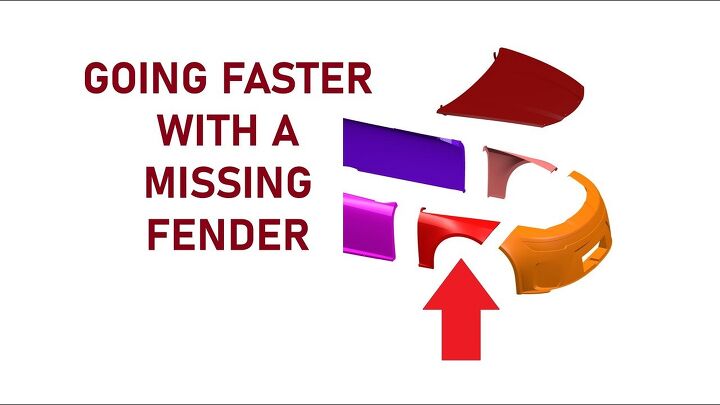
Did a missing right-front fender help Tyler Reddick win the Autotrader 400 at EchoPark Speedway? Today we’re going to answer that question with all the technical details.
My name is Bozi Tatarevic. I’m a technical analyst, and let’s get into what happened at EchoPark and how Tyler got to the front.
With the race winding down, there was a big crash. Reddick ended up running into Denny Hamlin, and the front-right corner of his car was pretty wrecked. There was damage to the splitter, the front bumper, and the right-front fender was completely torn off the car.
Immediately, there were concerns about whether he would still have speed. At superspeedways like Atlanta, Talladega, and Daytona, you want to have as little drag as possible. Whenever you have body panels missing from the car, or gaps in the bodywork, that typically generates drag.
But to everyone’s surprise, once the team completed some repairs and the race restarted, Reddick was making his way toward the front. Almost immediately, speculation began about whether the team had discovered some kind of trick because of that missing right-front fender.
My inspection of the car and the available photos, along with some analysis of how the aerodynamics work on the NASCAR Next Gen car, leads me to believe that the change probably improved aerodynamic performance in some areas while hurting it in others.
One thing we can reasonably deduce from the missing fender is that the car likely gained front downforce. If we look at cars like GT3 race cars and other sports cars, you’ll often see louvers over the fenders or other types of openings. Those features release pressure from the wheel well. When that pressure is released, it typically increases front downforce.
With more front downforce, there’s more grip over the front wheels, which shifts the aerodynamic balance forward. That usually makes the car looser. So the damage probably made the car harder to drive for Tyler, but it may have also helped him. It essentially forced him to drive a very loose race car, and because of his dirt racing background, he may have been able to manage it better than expected.
However, whenever you increase downforce, you typically increase drag as well. Because the missing fender created a new opening, it likely added some drag to the car, which would normally slow it down in a straight line.
That said, because of where the opening was located, the drag penalty probably wasn’t huge. On the Next Gen car, as long as the splitter is mostly intact and the front bumper and hood remain largely in place, airflow over the car is still relatively clean.
One side effect that may have occurred is that the opening in the right-front fender could have generated more dirty air than a typical Cup car. Air escaping from that opening could have traveled over the side and rear of the car, disrupting airflow for cars behind him.
Watching the broadcast, you could see moments where cars struggled to stay directly behind Reddick after the damage occurred. I noticed that with Carson Hocevar, and I believe Chris Buescher as well. When they approached his car, it almost looked like they were bouncing off the airflow. That wouldn’t be surprising if the damaged fender was producing additional turbulent air.
Overall, I don’t think the aerodynamic changes from the missing fender were dramatic. The added downforce and added drag probably balanced each other out. But the extra dirty air might have helped keep trailing cars from getting too close.
There have also been other theories suggesting the opening might have cooled the right-front tire, improving performance. If this had been a track like Martinsville, that could potentially be beneficial, since tire and brake temperatures run very high there.
But at EchoPark Speedway, brake cooling is typically blocked off and temperatures aren’t nearly as critical. In fact, if cooling had been a major advantage, Reddick likely wouldn’t have been weaving back and forth before the restart to warm up his tires.
On the other hand, if the car did gain additional front downforce, it would actually help to increase tire temperatures slightly. Higher tire temperatures raise pressure, which can help rebalance the aerodynamic load.
For those reasons, I don’t think tire cooling played any meaningful role here.
What I do believe made the biggest difference was tires.
If we look back at what happened after the repair, with about 35 laps remaining, Reddick pitted immediately after the incident to repair the damage. On consecutive stops, he received right-side tires and then left-side tires.
He restarted the race, and then during the next caution he returned to pit road for additional repairs. At that point, with roughly 21 laps to go, he received another set of right-side tires.
That meant Reddick effectively had the freshest tire combination in the field.
Several other drivers — including Hocevar, Daniel Suarez, Shane van Gisbergen, Chris Buescher, and Ryan Preece — also pitted around the 35-laps-to-go mark and took four tires. Many of those drivers made strong moves toward the front late in the race as well.
However, those tires were already about 15 laps older than Reddick’s right sides.
By comparison, Reddick had left-side tires from around 35 laps to go and right-side tires from about 20 laps to go. That gave him the freshest overall setup.
Meanwhile, drivers like Bubba Wallace and Chase Briscoe took tires around lap 164. That meant their tires were roughly 70 laps older by the time the final action unfolded, which likely hurt their ability to compete at the front.
So, for anyone wondering, my technical analysis suggests the winning formula was a combination of fresh tires, a loose-handling race car, and possibly a bit of dirty air generated by that missing right-front fender.
Together, those factors helped Tyler Reddick make his way to the front and win the Autotrader 400 at EchoPark Speedway.

TTAC Creator Bozidar “Bozi” Tatarević is a Bosnian-American racing mechanic, writer, and technical consultant born in Sarajevo in 1986. After immigrating to the U.S. in 1995, he learned English in elementary school and eventually turned his passion for cars—fostered by his father Slav—into a full-time career. Laid off from a tech job in 2008, Bozi began wrenching professionally, eventually launching a shop and car export business with his family. His technical message board posts led to a writing career with outlets like TTAC, Motorsport.com, Road & Track and Racecar Engineering. In 2018, he made his pro mechanic debut at Watkins Glen and now works as a tire carrier and mechanic for Vasser Sullivan Racing in IMSA, with 10 wins and a 2023 GTD Pro title. Bozi also consults via his agency Podium Prime, with clients ranging from race teams to media production companies.
More by Bozi Tatarevic, TTAC Creator





Comments
Join the conversation
Nice writeup, thanks.
Good article! Should a damaged car that negatively affects other cars be allowed to compete?