

Honda-Powered Porsches? You Betcha
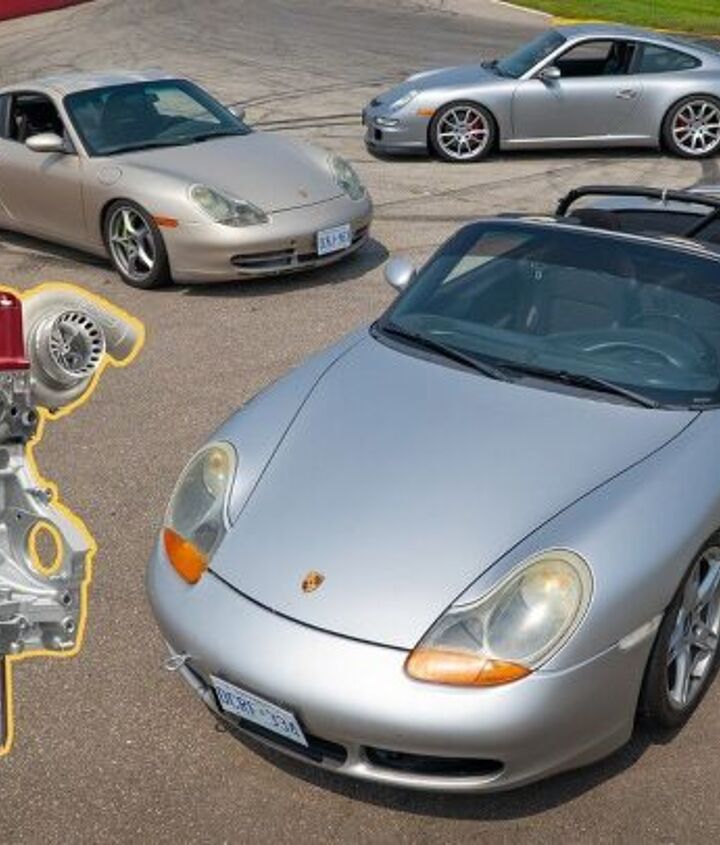
Speed Academy walks us through why Honda-powered Porsches are affordable race-track fun.
The following is a transcript of the episode, organized via AI and edited by a staffer:
Okay, there’s horsepower, fellas. A K motor in just about anything makes it more fun and a little more special.
Welcome to our continuing pursuit to K-swap the world. We’ve got three of the coolest K-swap cars on the planet here today, thanks to Tuning by Nick. Let’s take them for a drive, starting with the most affordable option: the Boxster.
Out here at TMP, my home track, I’m driving the K-swapped Boxster. This one has a K24 that Nick says makes about 250 horsepower at the wheels—a healthy number considering it’s running mostly OEM-style parts. It’s on a Link ECU, Track 1 coilovers, and big 255 Nankang AR1s. This is its first real outing; Nick only drove it around the block a couple of times before today.
The K sounds fantastic in this chassis. With the short rear-mounted exhaust, it has a deeper tone than you’d expect and none of the raspiness Ks are known for. Throttle response is sharp, and it revs to about 7,800 rpm. On track, the front end grip is excellent, and the car feels solid with no shakes or drama. Even with wide front tires, there’s no rubbing.
The K-tuned shifter is tight and precise, and the custom brake kit Nick developed—using Cayenne front calipers and 997 rotors—delivers plenty of stopping power. The car does dive a bit under heavy braking, but overall, it feels stable and confidence-inspiring. Considering this is its shakedown run, I’m impressed. The Boxster is already quick and, with a bit more setup time, could be a very capable track car.
The appeal here is obvious: a cheap Boxster chassis with an unreliable stock engine replaced by a durable, affordable K24. Even naturally aspirated, it delivers strong performance, and the potential for more with a turbo is there—as we’ll see in the 996 and 997.
Now onto the 996. This one runs a turbocharged K24Z7 with Nick’s full swap kit. He’s already sold about a dozen of these kits, so it’s a proven setup. It uses the factory 996 gearbox and a 58 mm turbo. While I don’t know the exact power figures, Nick’s 997 makes high 400s, so this is likely in the same ballpark.
The 996 feels more refined and track-ready than the Boxster. The steering is excellent, though like most 911s it pushes under throttle. With the lighter K engine in back, it may balance a little better than stock. On Continental ExtremeContact Sport tires and Hawk HB+ pads, it stops hard and puts power down effectively. The turbo K24 sounds incredible—deep and burly, not what you’d expect from a Honda motor.
Ergonomics are classic Porsche, with perfect pedal spacing for heel-and-toe. Nick’s touches, like the NSX horn button and DC5 Recaros, nod to his Honda roots. On track, the car feels dialed in, stable on the brakes, and ready to push harder. It genuinely feels like it could have come from the factory this way.
Finally, the 997. Mechanically, it’s very similar to the 996 but with the newer chassis, better interior, and GT3 brakes with aggressive Pagid pads. It runs a wider tire setup—245s up front and 325s in the rear—giving it more grip. Compared to the 996, the gearing feels longer, and the car feels more balanced with less tendency to understeer under throttle.
Power delivery is strong, and the chassis feels perfectly matched to it. The 997 has a more refined feel overall, while still being brutally quick.
Talking with Nick, he explained the costs. He picked up the 996 shell for $8,000 with a blown motor, while the 997 shells run closer to $20,000. The Boxster cost him $4,000 as a roller. Swapping in a K24 isn’t cheap, but compared to rebuilding or replacing a Porsche engine—often $25,000 to $30,000—it makes sense. A naturally aspirated swap can be done for around $15,000, while turbo builds climb closer to $30,000. The key is that once the swap is done, replacement engines are inexpensive, often around $1,000.
In the end, all three cars retain their Porsche character. The Boxster still feels like a Boxster, the 996 like a 996, and the 997 like a 997—just with Honda K power. The naturally aspirated Boxster feels raw and playful, while the turbo 996 and 997 are more refined and street-friendly. Each one has its own character, but together they show how versatile and effective the K-swap formula can be.
Speed Academy is a website and YouTube channel based on making things go fast and enjoying cars. Peter Tarach and Dave Pratte are the forces behind Speed Academy.
The TTAC Creators Series tells stories and amplifies creators from all corners of the car world, including culture, dealerships, collections, modified builds and more.
[Image: Speed Academy Thumbnail]
Become a TTAC insider. Get the latest news, features, TTAC takes, and everything else that gets to the truth about cars first by subscribing to our newsletter.

Speed Academy is a website and YouTube channel based on making things go fast and enjoying cars. Peter Tarach and Dave Pratte are the forces behind Speed Academy.
More by Speed Academy, TTAC Creator






Comments
Join the conversation
"The Boxster cost him $4,000 as a roller. "
"The key is that once the swap is done, replacement engines are inexpensive, often around $1,000."
Stop making me want to do this.
Fixing "German engineering" for reasonable money... shhh stop talking about it before CARB bans it.
why would you destroy a almost perfect car with garbage