Third Gen Ford F-Series — 1st Steps to Market Domination
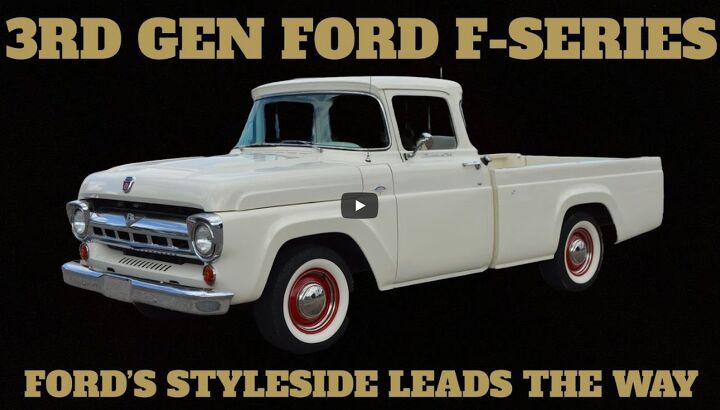
The 3rd generation Ford F-Series - 1st steps to market dominance. At the time cars were far and away the dominate means of transportation in North America.
This generation would be the first time you could order a 4-wheel-drive truck from the factory and there were many items added to F series that would ultimately be adopted by other manufacturers moving forward.
The TTAC Creators Series tells stories and amplifies creators from all corners of the car world, including culture, dealerships, collections, modified builds and more.
An AI-generated transcript summary edited by a staffer is below.
[Image: Tony's Fords and Mustangs/YouTube]
Become a TTAC insider. Get the latest news, features, TTAC takes, and everything else that gets to the truth about cars first by subscribing to our newsletter.
This transcript is a historical overview of the third-generation Ford F-Series pickup trucks, explaining why these models are historically important despite often being overlooked by collectors.
Main Themes
- The narrator emphasizes that trucks in the late 1950s were primarily built as work vehicles for farms and businesses, not everyday transportation.
- This generation marked a turning point where Ford began leading truck design innovation instead of following competitors like GM and Dodge.
Major Innovations
The third-generation F-Series introduced several significant changes:
- Factory Four-Wheel Drive (1959)
- For the first time, Ford offered factory-installed four-wheel drive on F-Series pickups.
- Modernized Styling
- Introduced in 1957, the trucks featured:
- Streamlined bodywork
- Integrated fenders
- A wide grille
- Smooth “Styleside” beds
- A clamshell hood
- Wraparound windshield for better visibility
- Ford’s smooth-sided Styleside design later influenced Chevrolet and Dodge truck styling.
- Factory Four-Wheel Drive (1959)
Mechanical Details
- Offered in three weight classes:
- F-100
- F-250
- F-350
- Body-on-frame construction with leaf springs front and rear.
- Engines included:
- 223 cubic-inch inline-6
- 272 and later 292 cubic-inch V8s
- Transmission choices:
- 3-speed manual
- 4-speed manual
- Automatic options later added.
- Offered in three weight classes:
Features & Options
Standard and optional equipment was surprisingly extensive for the era, including:
- Hydraulic clutch
- Seat belts
- Tinted glass
- Tow hooks
- Heavy-duty radiators
- Dome lights
- Even optional electric shavers.
Year-by-Year Changes
- 1957
- Major redesign introduced.
- Ford outsold Chevrolet overall that year.
- 1958
- New egg-crate grille and quad headlights.
- Minor mechanical changes.
- 1959
- Factory 4WD added.
- Updated grille and more powerful V8 available.
- 1960
- New grille and hood revisions.
- Nylon seat upholstery introduced.
- Expanded marketing of 4-wheel drive.
- 1957
Historical Importance
The narrator concludes that these trucks helped redefine pickups from strictly work tools into vehicles that could also serve as personal transportation. This shift would shape the future of the pickup market for decades.

Tony has been a member of the car culture since the late 1970s, acquiring his first car at the age of 13 in a straight-up swap for a Schwinn 10-speed bicycle. He has personally owned well over 500 cars and trucks since that first car. He was employed as a jet engine Mechanic by the US Air Force for over 10 years and served in theater during Desert Storm. He has always wrenched on his own vehicles. In the Fall of 2021 he launched his own YouTube channel that focuses on Ford Motor Company products, both old and new, however other manufacturers product will appear from time to time. New content and videos are posted every Saturday Morning at 11 AM EST








Comments
Join the conversation
Could you get three motors like the Tesla Cybertruck?
Ford's always been historically late to make changes with the general market direction, which is sometimes a great thing (Crown Vic) and sometimes a terrible thing (still holding onto this turbo fascination from the 1980s no one asked for).
With the trucks they were late to the market with both factory 4x4 and the crew cab. The change on the F100/250 in '61 to the unitized body was a mind-boggling design decision particularly after losing hundreds of millions on Edsel the prior years.
My dad briefly had the Chevy equivalent, '58 Apache, and that generation of pickups was way more fun to look at than to drive. They could give VW Beetles lessons in SLOW.
Tough, though. Knowing nothing of the Apache's future modded appeal, we beat the hell out of ours hauling broken up concrete slabs to our cottage on the outside bank of a river bend.
I am leaving TTAC to become a Solider of the Apocalypse. Happy Memorial Day.
Big congratulations to the SpaceX team on today's v3 launch.
If you are an engineer working for Ford, please punch yourself in the face.
"This shift would shape the future of the pickup market for decades."
I think that's making a bit too much of this very gradual and organic evolution of pickups throughout the mid-century decades.
In any road environment where they needed to post speed limits, these were only slightly less disadvantaged than were farm tractors.