

Cleaner Cabin Air in Your VW ID: How to Add a Second Filter
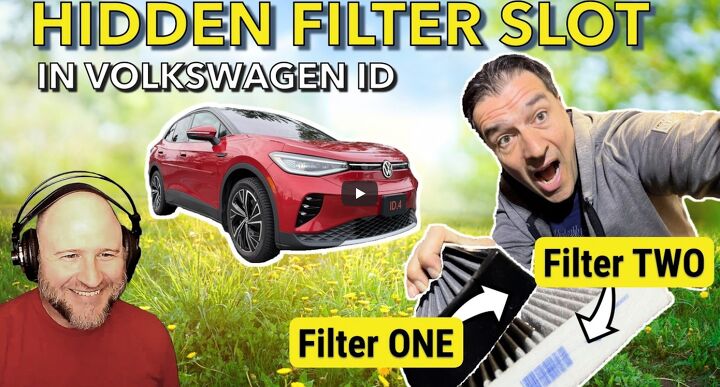
Did you know your VW ID has a built-in slot for a second cabin air filter? With pollen season and wildfire smoke becoming more intense, the standard factory filter just doesn't cut it.
In this episode, we show you exactly how to access the airbox in your frunk area and stack a second Activated Carbon or HEPA filter to keep fine particulate matter (PM 2.5) and bad odors out of your cabin. The best part? No modifications are required! We also cover a crucial coding step for Module 8 to ensure your blower motor doesn't throw any hidden fault codes due to the extra airflow resistance.
Check out the VWIDTalk Podcast on YouTube and wherever you get your podcasts ( Apple Podcasts, Spotify, Overdrive and more).
A transcript, summarized by AI and edited by a staffer, is below.
The TTAC Creators Series tells stories and amplifies creators from all corners of the car world, including culture, dealerships, collections, modified builds and more.
[Image: YouTube Screenshot]
Become a TTAC insider. Get the latest news, features, TTAC takes, and everything else that gets to the truth about cars first by subscribing to our newsletter.
Summary: Improving Air Quality in the VW ID.4
The podcast explains how to improve cabin air quality in the Volkswagen ID.4—especially during pollen season, wildfire events, and general air pollution—by using a second air filter, a feature already built into the car.
Key points:
- Dual-filter system:
- The ID.4 has space for two cabin air filters without any modification. A typical setup includes:
- A coarse (top) filter to catch larger particles like pollen and debris
- A finer activated carbon filter (bottom) to capture smaller particles (e.g., smoke, odors)
- Why add a second filter?
- Standard filters may not effectively capture very fine particles like wildfire smoke (PM2.5)
- Adding a second filter improves protection against allergens, smog, and odors
- Increasing air quality is especially important with rising wildfire frequency and pollution
- Particle size context:
- Human hair: PM60
- Pollen/mold: PM30
- Road dust: PM10
- Wildfire smoke: PM2.5 (requires finer filtration like carbon/HEPA-style filters)
- “Air Care” system:
- Automatically recirculates cabin air to repeatedly filter it
- Monitors CO₂ levels and brings in fresh air when needed
- Even in recirculation mode, air continues passing through filters
- Installation basics:
- Filters are located under the hood (not behind the glove box)
- Access involves unclipping and lifting the air box cover
- Filters are easy to install and replace
- Extra tips:
- Consider a washable pre-filter (e.g., K&N) on top
- Write the installation date on filters to track maintenance
- Ensure correct airflow direction when installing
- Important technical step:
- After adding a second filter, update the car’s HVAC control module (Module 8) to indicate an additional filter
- This prevents the system from misinterpreting increased airflow resistance as a fault
Conclusion:
Using a dual-filter setup (coarse + carbon/HEPA-style) is an easy, built-in upgrade that significantly improves cabin air quality in the ID.4, especially during high-pollution or allergy seasons.

Driven by ID owners, the VWIDTalk Podcast is operated by VW ID owners for VW ID owners, sharing best practices, tips, tricks, and mods in engaging, multi-participant discussions on everything to do with Volkswagen's lineup of electric vehicles. Dive deep, stay positive, and most importantly, enjoy the ride. Hosts: VWIDTalk.com moderators and ID.4 owners Jan Kalis and Wes Garrison
More by VWIDTalk Podcast, TTAC Creator





Comments
Join the conversation
Luke42- I agree that some Japanese cars with turbo 4’s are screechy and noisy. But my particular Japanese truck has a 5.7L V8 and is not screechy and noisy. My 2009 LS3 C6 Corvette 6spd with a Billy Boat Fusion cat back exhaust is not screechy and noisy at all. It sounds great and most would agree. And it’s not about grabbing attention at all. And again don't care about MPG. I see your a pilot also.
It will be great when second owner has no idea that filter exists and now their HVAC is choked down by a plugged up filter.