
Rare Rides Versus: Lincoln Continental Mark III and Cadillac Eldorado


This new third branch of the Rare Rides series will present two competing vehicles from history head-to-head. Each entry will review the two vehicles’ merits in context of the times: historical reviews, model details, pricing, and that ultimate determination of the winner, sales figures. The first Versus subjects were requested by you, the readers. They are the eighth generation Cadillac Eldorado and the Lincoln Continental Mark III, the very first top-tier American personal luxury coupes.

The personal luxury coupe market came into its own in the late Sixties. Different to the more staid coupe versions of full-size sedans, the PLC had sportier styling and was intended to be more driver-focused than a regular coupe. The earliest entry in the Fifties was arguably the Ford Thunderbird, before the PLC had a name. It led to competition like the Buick Riviera of 1963. Executives at Ford and GM saw potential for even more expensive PLCs, as there were no high-end offerings from the likes of Lincoln or Cadillac.
General Motors got to market first. The Cadillac Eldorado was all-new for 1967 when it moved onto the front-drive E-body platform with the Oldsmobile Toronado and the Buick Riviera that debuted in 1966. In its eighth generation at that point, the Eldorado had solid brand recognition in the market even though it was a slow seller up to that point. The ‘67 was immediately praised for its simple, edgy styling and relatively tidy proportions. The Eldorado was also luxurious and offered ample performance from its 429 cubic inch (7.0L) V8.

GM had the head start as it had developed a platform specifically and exclusively for use on more expensive premium and luxury coupes. The launch of the Cadillac Eldorado caught Ford empty handed. In 1967 Ford’s personal luxury offerings were the new midsize Thunderbird (coupe, sedan), and the larger Mercury Cougar that shared its platform with the Ford Torino.
For their part, Lincoln had nothing to offer. The brand’s lineup in 1967 was limited to the Continental range, as it had been since the Elwood Engel penned sedan arrived in 1961. The lineup included the sedan, four-door convertible, and a coupe. The latter body style was of the conservative large coupe variety and could not compete for the dollars of the personal luxury coupe customer.

The following year, Lincoln had its response to the Eldorado when it debuted the Continental Mark III. It was a return to the historical Mark nameplate, as successor to the ill-fated ultra luxury Mark II of 1956. The new coupe ignored the subsequent Marks III-V of 1958 to 1960, three successive years of unibody sedans and coupes that sold very poorly.
Lee Iacocca was behind the development of the Mark III, which was developed on a short timeline and with a tight budget of $30 million ($290m adj.). With its own body, the Mark III shared its platform with the rear-drive Thunderbird that debuted in 1967. It was a way to get a new model out the door quickly, and spread some of the development costs of the expensive Thunderbird. Ford knew the Thunderbird would be successful as it had been thus far, but the Mark III was more of a gamble. The coupe’s styling was pressed through to production by Iacocca (who loved it) after a focus group unanimously stated they really disliked its looks.

The Mark III debuted to much fanfare in spring 1968 as a 1969 model. This was a strategic move on the part of Lincoln, who would claim 22 months of sales as the total for 1969 to make the figures more impressive. It was all a bid to beat the arch rival Eldorado. But that isn’t to say the Mark III was lacking, quite the opposite.
Motor Trend ran a comparison test series called “King of the Hill” beginning in 1970 which pitted the Continental Mark III and the Eldorado against one another. The magazine declared the styling was a toss-up between the two The Eldorado was more svelte and athletic, the Mark III more baroque and luxurious with its Rolls-Royce-like grille.
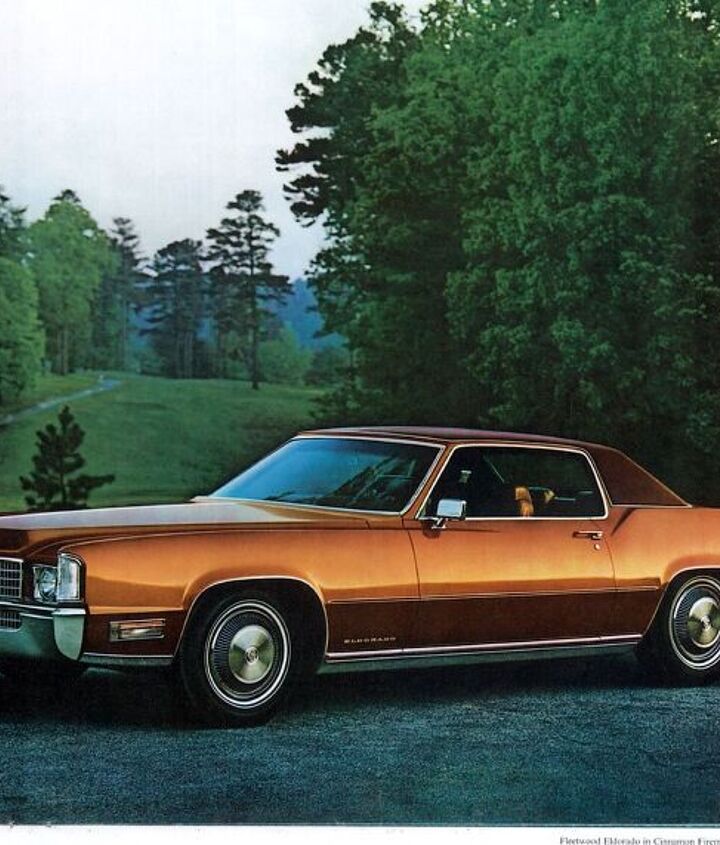
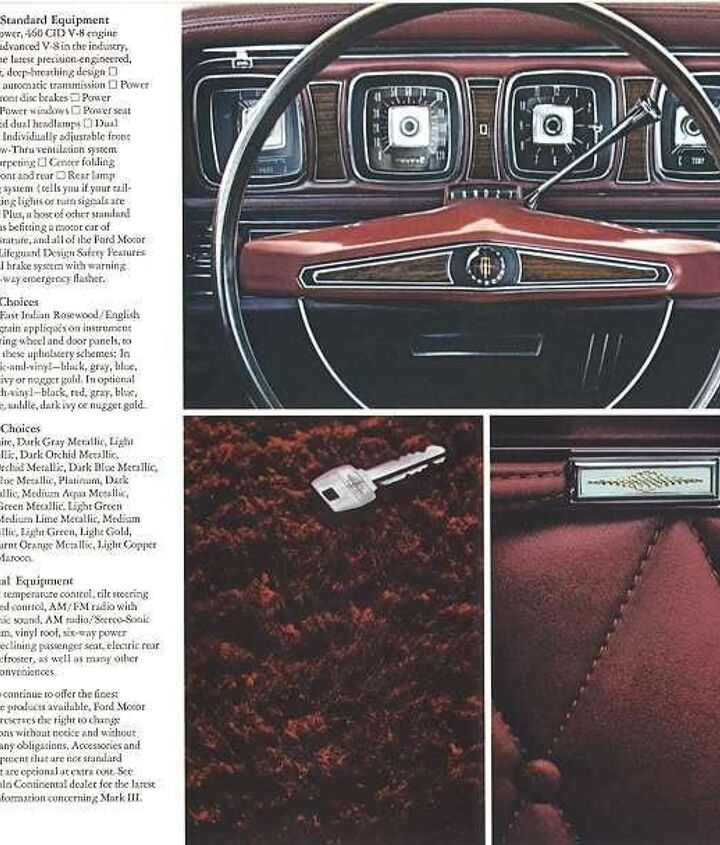
But the Mark III pushed ahead on comfort, where its seating and leather were both deemed of better quality. Eldorado fought back with a superior layout of its switchgear, better headroom, and the Cadillac favorite Twilight Sentinel. The Eldorado was also praised for its variable ratio power steering, which was not an option on the Mark III. The Mark required 4.03 turns from lock-to-lock; 2.7 for Eldorado.

Handling was largely the same between the two boats, but the steering of the Mark really stuck in MT’s craw so the Eldorado was deemed the winner. Mark III stepped ahead of the Cadillac with radial tires, where the Eldorado still used bias-ply. The tires gave the Mark a slightly sportier character despite the steering.

After many luscious adjectives from MT, the Mark III was deemed the overall winner. It was the more plush and luxurious option, with a sportier character and an atmosphere that was overall better and more upscale than the Eldorado. Lincoln also declared the Mark III a winner in its first year as it totalled up 30,858 sales. “We brought out the Mark III in April 1968, and in its very first year it outsold the Cadillac Eldorado, which had been our long-range goal,” said Iacocca.
But that was disingenuous. Those “1969 sales” were over 22 months, so let’s have some facts. In 1968, the Mark III sold 7,770 examples. That figure reached 23,088 in 1969. Sales dipped to 21,432 in 1970, but rebounded to 27,091 for the Mark III’s last outing in 1971.

The new Eldorado in 1967 saw 17,930 sales. That figure increased to an all-time high for the model in 1968, 24,528 cars. In 1969 sales declined to 23,333, but still slightly bested the Mark III when compared directly. For the eighth-gen’s final outing in 1970, sales were 23,842, and again bested the Mark III. The Eldorado was new in 1971 (and worse) and managed 20,568 coupe sales and 6,800 convertibles for a total of 27,368.

Both coupes were very expensive in their day, but the well-heeled did not mind spending for such opulence, style, and cubic inches. Interestingly, the two models traded off which was most expensive each year. In 1968 the Eldorado asked $5,875 ($56,978 adj.), while the Mark III was $6,795 ($63,582 adj.).

1969 pricing was $6,605 ($61,804 adj.) for the Eldorado, and $6,741 ($60,419 adj.) for the Mark. In 1970 the Eldorado asked $6,903 ($58,270 adj.) to the Mark’s $6,822 ($57.586 adj.). And for the final year of our comparison, the 1971 Eldorado coupe was $7,416 ($59,455 adj.) and the Mark III asked $8,421 ($67,512 adj.).

We have a clear winner in our first Rare Rides Versus, despite what an executive or Motor Trend proffered. In 1968, 1969, 1970, and 1971 the Cadillac Eldorado won the sales trophy. We could perhaps concede the Mark III won in 1971, if we only count the true PLC sales figures and discount the convertible’s contribution to the Eldorado. But we’ll leave that to you in the comments.
[Images: GM, Ford]
Become a TTAC insider. the latest news, features, TTAC takes, and everything else that gets to the truth about cars first by subscribing to our newsletter.
Interested in lots of cars and their various historical contexts. Started writing articles for TTAC in late 2016, when my first posts were QOTDs. From there I started a few new series like Rare Rides, Buy/Drive/Burn, Abandoned History, and most recently Rare Rides Icons. Operating from a home base in Cincinnati, Ohio, a relative auto journalist dead zone. Many of my articles are prompted by something I'll see on social media that sparks my interest and causes me to research. Finding articles and information from the early days of the internet and beyond that covers the little details lost to time: trim packages, color and wheel choices, interior fabrics. Beyond those, I'm fascinated by automotive industry experiments, both failures and successes. Lately I've taken an interest in AI, and generating "what if" type images for car models long dead. Reincarnating a modern Toyota Paseo, Lincoln Mark IX, or Isuzu Trooper through a text prompt is fun. Fun to post them on Twitter too, and watch people overreact. To that end, the social media I use most is Twitter, @CoreyLewis86. I also contribute pieces for Forbes Wheels and Forbes Home.
More by Corey Lewis










Comments
Join the conversation
Dad had a '70 Mark III, replacing his '68 Cadillac. The Lincoln was simply a muuch nicer car, particularly the interior. The '67 and '68 Eldo were beautiful exterior wise, but GM tarted them up in '69 and they lost the understated class the earlier models had. Inside, the Mark III was simply in another league.
I am not surprised at the sales figures as the Mark was a brand new nameplate while the Eldorado already had an established name and client base. Also Cadillac would have far more established dealerships and return customers than Lincoln/Continental as Ford's prestige line-up was very much an also ran during the mid/late 1960's. The Mark III/IV/V and the newer Town Car very much changed that.
I am surprised that an Eldorado has a higher value than a Mark III. As the Mark III was a much nicer vehicle inside. And the difference between a Mark IV and an Eldorado of the same period is even greater. My father who had driven Mark IVs on one year leases since they were introduced, switched in 1977 when the Mark V first came out, to a 1977 Eldorado. Disliked the Eldorado so much in comparison that he switched back less than a year later to get a Bill Blass Mark V. Stayed with Marks/Lincolns until 1980 when the Lincoln downsized so he switched over to a Fleetwood (Brougham?) and stayed with Cadillac for the remainder of his life.
Having driven multiple Mark IV's, and Mark Vs and the 1977 Eldorado, I can say that wihtout any doubt, I far prefer the full sized Marks to the Eldorado. And having also driven Sedan de Villes of the era, they in no way compare to the Mark or the Town Cars of that period.