


Rare Rides Icons: The Cadillac Eldorado, Distinctly Luxurious (Part LVIII)

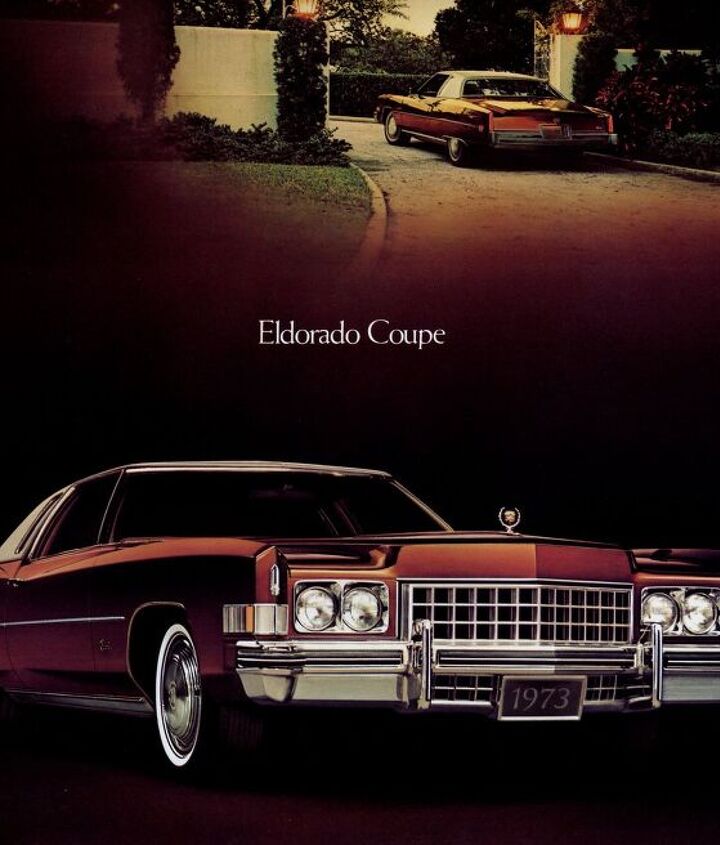
Returning to Cadillac Eldorado coverage today, we find ourselves at the start of the many revisions made to the ninth-generation model. Our previous installments reviewed the boaty corporate-compliance exterior styling compared to the old model, followed by an interior that was in theory “all-new” but looked like a cost-cut version of the eighth generation’s interior treatment. Whether customers would notice or care about these diversions from the Eldorado’s mission and previous greatness remained to be seen. As soon as the ninth-gen went on sale, Cadillac’s designers knew it was time for annual revisions to keep things exciting!

For its second outing in 1972, Eldorado’s changes were purely cosmetic. Designed to lean further into the brougham era and its trappings, the Eldorado labels on the fender and trunk were redesigned from block lettering to the script that would be worn on Cadillacs through the end of the Nineties. The fender lettering was relocated from in front of the door to the front corner of the fender, above the cornering lamp assembly. The small 8.2 Litre badge from 1971 expanded into large block lettering to fill in where the Eldorado fender lettering was previously.

Changes were more considerable in 1973, as Cadillac shuffled the Eldorado’s placement. For the first time since 1965, the Eldorado was no longer a Fleetwood model. Previously the Fleetwood name was applied to the Eldorado to elevate it amongst the Sixty Special and Seventy-Five, models at the pinnacle of Cadillac’s brand that were assembled on a separate line. The change meant the Eldorado was its own series, neither a Fleetwood nor under the DeVille line as in the early Sixties.

There were visual changes as well, and the Eldorado received its first major styling rework. At the front end vertical corner marker lamps were removed and capped by a body-colored filler panel. On it was a Cadillac crest with additional heraldic shield detailing, like on other models. The corner marker and indicator lamps were combined into one segmented flash block-style rectangular housing, which wrapped around the front end.

The grille was completely redesigned in 1973, and adopted a very large and unsophisticated looking eggcrate design. It was notably less chromed than before and also looked as though it fit into its housing poorly. The grille’s size was smaller vertically, as the bumper that previously cut downward around the grille went straight across in 1973.

This led to a much greater bumper area for the revised Eldorado, which meant additional chrome surface area and more chrome detailing on its bumper rub strips. Vertical bumper guards were taller than 1972, though they did not stick out as far in front of the bumper. The hood was also revised into more of a cliff face style and lost its faceted upper surface of the prior two years.

Wheel covers were often painted in body color from 1973 onward, and showed smaller slats as the design ditched the vaned theme of the prior few years. The slats were accompanied by thicker whitewalls as they came back into fashion. Eldorado fender script was relocated yet again in 1973, and moved from the front portion of the fender to near the door shut line below the chrome body strip. Displacement badging was removed this year.

The body strip itself gained more detailing, and was filled in with body colored trim as opposed to its prior look in solid chrome. Chrome also went missing aft of the door, as the faux chrome vent detailing that hearkened back to the 1953 Eldorado was deleted. The revised chrome spear ran through the vent area, and extended most the way down the rear fenderfor a longer, lower look. It concluded at a rear side marker in red that was surrounded with a wreath, and called back to the prior generation Eldorado.

Lighting was revised at the rear of the car, as it took on an appearance that was more Seventies-friendly. Brake lamps moved upward to the top of the small fin, where they were housed inside a fender extender. They lost their thick chrome surround but were still bisected down the middle by a strip of body colored fiberglass and chrome trim.

The trunk lid picked up the angled styling facet that was removed from the hood, and became more sculpted looking and less of a bland surface. The trunk’s edge trailed down to a new bumper, which did away with the weird tiered appearance of 1971-1972. The new bumper was thicker horizontally than before, but had less vertical area. Decorated with gaudy rub strips across the middle and at either corner, it was nonetheless more cohesive looking than the outgoing version.

The visual revisions for 1973 made no difference to the Eldorado’s overall size, but it was the last time it would remain at its original 223-inch length. Despite its enormous proportions and leisure suit vibe, the Eldorado was chosen as the pace car for the 1973 Indianapolis 500. Cadillac made 566 special Indianapolis 500 Pace Car Edition convertibles and sent 33 of them to the track at race week.

All 530 remaining Indy 500 examples were sent to each and every dealer in the United States, at a rate of one per dealership. With product streamlining and the overall decrease in small franchises, one might think that dealership count would be much smaller today. But no! As of April 2025, there are 589 Cadillac dealerships across the United States.

All Pace Car Edition vehicles were finished in Cotillion White with a red leather interior. They featured chromed wheel covers, and jaunty dual red pinstripes. The lower one was located on the body sides as expected, but the upper pinstripe ran a full 360 around the upper character line, including the trunk lid and the hood.

Additionally, the special numbered pace cars that saw track duty that year were emblazoned with OFFICIAL PACE CAR graphics and date information, a seal of Indiana and the “500 Festival,” and the Indianapolis 500 logo. Each car received a red numbered sticker on its windshield, an irreplaceable detail in 2025.

Believe it or not, the Eldorados seen here went on to have five more years of annual revisions before the generation was discontinued at the end of 1978. In our next installment we’ll pick up with the remaining years, where each one was another test of just how far Cadillac’s trim experts could push things ever closer to pimptastic. See you next time.
Become a TTAC insider. the latest news, features, TTAC takes, and everything else that gets to the truth about cars first by subscribing to our newsletter.
Interested in lots of cars and their various historical contexts. Started writing articles for TTAC in late 2016, when my first posts were QOTDs. From there I started a few new series like Rare Rides, Buy/Drive/Burn, Abandoned History, and most recently Rare Rides Icons. Operating from a home base in Cincinnati, Ohio, a relative auto journalist dead zone. Many of my articles are prompted by something I'll see on social media that sparks my interest and causes me to research. Finding articles and information from the early days of the internet and beyond that covers the little details lost to time: trim packages, color and wheel choices, interior fabrics. Beyond those, I'm fascinated by automotive industry experiments, both failures and successes. Lately I've taken an interest in AI, and generating "what if" type images for car models long dead. Reincarnating a modern Toyota Paseo, Lincoln Mark IX, or Isuzu Trooper through a text prompt is fun. Fun to post them on Twitter too, and watch people overreact. To that end, the social media I use most is Twitter, @CoreyLewis86. I also contribute pieces for Forbes Wheels and Forbes Home.
More by Corey Lewis








Comments
Join the conversation
I was around then, and I'm pretty sure that the wide whitewalls on the yellow car aren't the original style. That's a '50s thing that was considered as outdated and disgusting as tall tailfins were by then. Outside of pimpmobiles.
I was a teenager when these rolling aircraft carriers roamed the streets, but that 500 CID powerplant was to be respected. Personally, I was a bigger fan of the Continent Mark IV