

Rare Rides Icons: Lamborghini's Front-Engine Grand Touring Coupes (Part X)

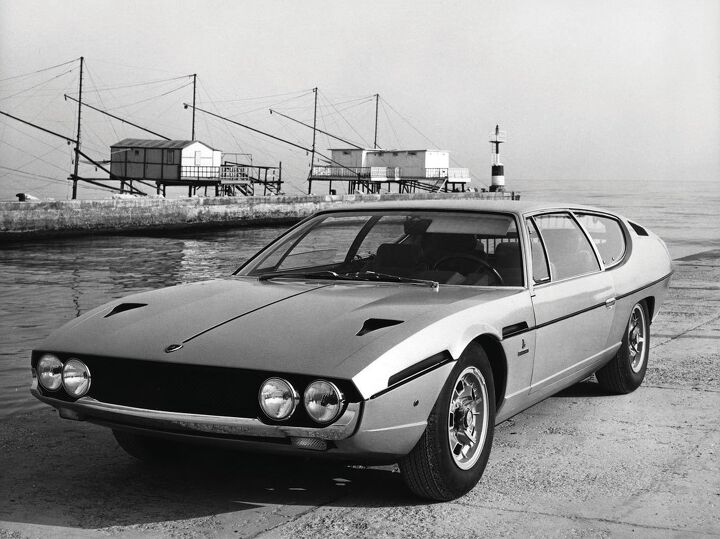
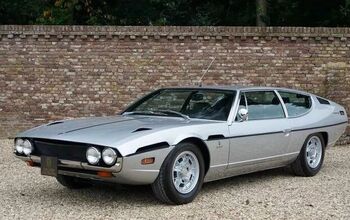
In 1968, Lamborghini launched two new front-engine grand touring coupes at the same time. It was only the second time the company introduced two new models in the same model year. The two cars in question were the restrained and conservative Islero 2+2, and the larger more in-your-face Espada. While we covered Islero’s rapid demise previously in this series, the four-seat Espada had a much more successful life.
It was the realization of a large four-seat coupe from company founder Ferruccio Lamborghini, who’d wished for a car of said type since the company’s inception. The short-lived Islero turned into a last-of-moment for Lamborghini, as its sales flop proved the company with the raging bull logo was better served by more exciting, outlandish designs.
We covered Espada's styling in our previous entry. Penned by Marcelo Gandini at Bertone, the Espada was nearly a Xerox copy of the Jaguar Pirana concept, at 125 percent magnification. But its large size and generous interior space for four caused some new challenges for Lamborghini’s engineers; the road to the production Espada was not a smooth one.

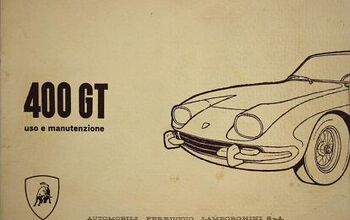
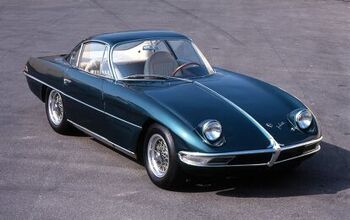
Lamborghini could not use the old 400GT chassis for the company’s upcoming four-seat car, though it would do so for the smaller Islero (essentially a heavily updated 400GT). In 1965 the company began development of a new chassis with a new layout. Company engineers Paolo Stanzani, Gian Paolo Dallara, and engineer/driver Bob Wallace worked on the new chassis as their primary project.
The plan was to generate two models on the new chassis, both to spread costs more effectively and broaden Lamborghini’s product range. The more important of the two new products would be a fast, wild race car that would still be usable on the road. And the other would be a more practical four-seat car with race car bones. At least that’s what the engineers thought.
The new chassis was developed in short order, and debuted at the Turin Motor Show of 1965. Titled Transversale Posteriore 4 Litiri, the chassis was mid-rear engined with a transverse layout, and used a larger “4 liter” (3.9 in reality) version of the company’s current 3.5-liter V12. The new chassis made an impression in Turin, and started stories about Lamborghini joining motorsport, and posing a direct challenge to Ferrari.
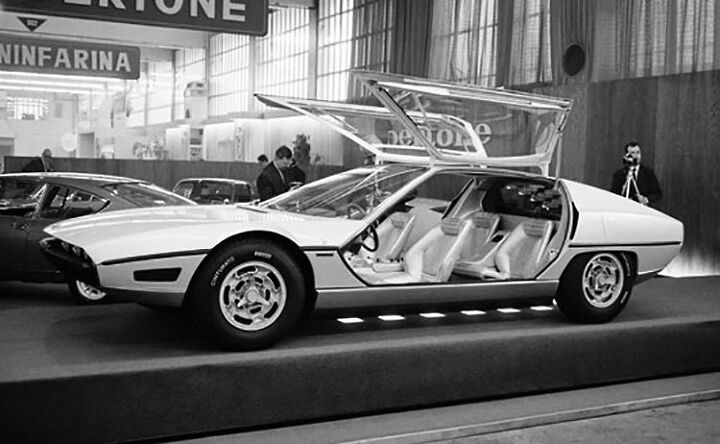
However, Ferruccio was more concerned that his cars have performance and luxury than racing credentials. He let his engineers have their race car flight of fancy when they engineered the chassis, but he knew the company’s new sports car (the Miura) would never race. Lamborghini planned for the flashy Miura to get all the attention, and the new four-seat model to give the company luxury credibility and a solid income stream.
A prototype Miura debuted in 1966 in near production guise, and put the TP400 chassis to its first use. It went on sale the same year as the 400GT, while the eventual Espada was still in its early development. As the Miura was in production, Lamborghini’s engineers turned their attention to chassis alterations for a mid-engined four-seat car.
The first task was to extend the chassis to add extra interior space. This was accomplished by a wheelbase stretch of about 4.7 inches. The engine was then relocated to the very back of the chassis to make room for seats. Espada was shaping up to be one of the few true rear-engine cars.
In a nod to space management, Ferruccio declared that the new four-seater should be powered by half of the company’s current V12. Dallara split the engine accordingly, and turned it into a 2.0-liter inline-six. Assuming a direct halving of power, that meant about 162 horses at the time.
At that point, the Marzal concept appeared (1967), and Lamborghini realized he’d given too much stylistic freedom to Gandini. Unlike Gandini, Lamborghini did not appreciate concepts that weren’t production-ready or gullwing doors and thought the latter was inappropriate. He stated, “Such doors offer no privacy, a lady’s legs would be there for all to see.” This was particularly true in the Marzal, where the doors were mostly glass.
Thus began a lot of back-and-forth between Lamborghini and Bertone about the overall shape and details of the unnamed four-seater. In the interim Gandini finalized the Jaguar Pirana, which Lamborghini liked quite a lot. And as it was almost immediately apparent that Jaguar would not pick up the commissioned design for production, Gandini was free to adapt it into what became the Espada. More on that in a moment.
On the engineering side of the house, it was apparent that the pre-production inline-six was not powerful enough for four-seat grand touring duty. In addition, the engine’s placement at the rear was posing a problem generally for the car’s engineering. Shortly after the Pirana debuted, Lamborghini declared it was time to start over on a new prototype and ditch rear-engine aspirations. The new car would have an adequate amount of power because it would use the 3.9-liter V12 from the Miura.
Since the Pirana concept was front-engine (as it was based on the E-Type), it made even more sense as a starting place for Lamborghini’s four-seater. While the styling was being finalized, engineering work started on the Espada anew with an engine at the front. Bertone reused the Pirana’s plywood styling template for the Espada prototype.
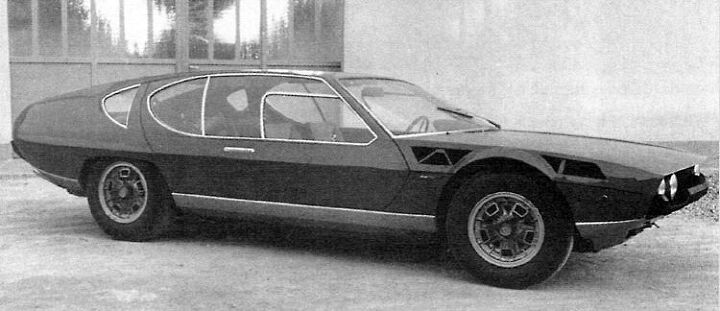
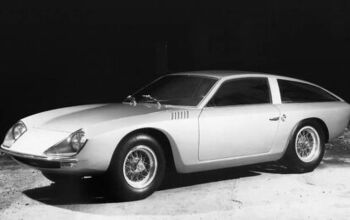
Work continued on the prototype through late 1967, and as the final details congealed the company drove around a running version with crazy windows and body cutouts. Said prototype was never shown to the general public. Note in the picture above, one detail remained throughout development.
Gullwing doors! Gandini wouldn’t let them go, even after Lamborghini told him they weren’t going to happen. Again the design went back to the drawing board at Bertone, where Gandini reluctantly substituted in some regular doors and a more reasonable side window line. The resulting car was much more cohesive in appearance and met with Ferruccio’s approval.
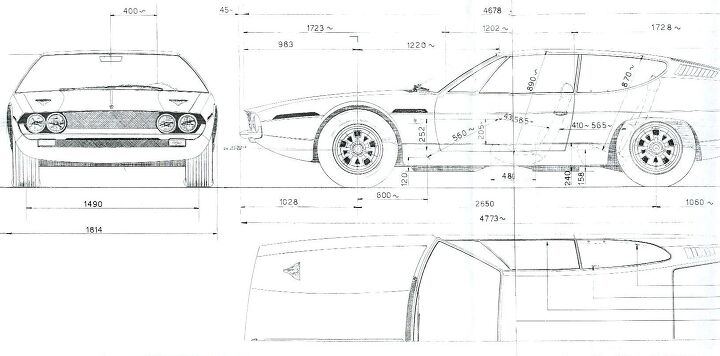
Because it used the Miura’s platform, Espada was notably lower and longer than the Islero. Suitable for its four-place mission, the hatchback even had room for 10 cubic feet of luggage without obstructing the view out the rear window. For reference, a modern Mitsubishi Mirage G4 sedan has 12.4 cubic feet of trunk space.
Even without wacky gullwing doors, the Espada looked like nothing else on the road in 1968. It debuted with up-to-date, modern engineering. The new Lamborghini was not a crude adaptation of a sports car to a four-seater that one might assume given the company’s limited budget and tight design schedule.
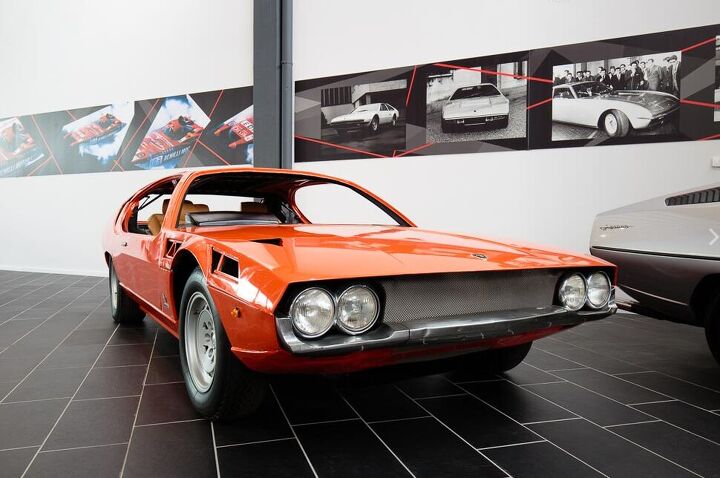
Ferruccio began the Espada project with a single idea in mind: That his company build a more modern take on a Rolls-Royce. He stated “The Rolls-Royce is a good car, quiet and comfortable… but it is too upright and stodgy. In Italy we need a car with every luxury… but it must have style and it must be beautiful.”
In March 1968, that dream came to fruition. In our next installment, we’ll discuss the engineering that found its way into the production Espada, and the very few examples produced during its brief Series I production period.
[Images: Lamborghini, Ferruccio Lamborghini Museum]
Become a TTAC insider. Get the latest news, features, TTAC takes, and everything else that gets to The Truth About Cars first by subscribing to our newsletter.
Interested in lots of cars and their various historical contexts. Started writing articles for TTAC in late 2016, when my first posts were QOTDs. From there I started a few new series like Rare Rides, Buy/Drive/Burn, Abandoned History, and most recently Rare Rides Icons. Operating from a home base in Cincinnati, Ohio, a relative auto journalist dead zone. Many of my articles are prompted by something I'll see on social media that sparks my interest and causes me to research. Finding articles and information from the early days of the internet and beyond that covers the little details lost to time: trim packages, color and wheel choices, interior fabrics. Beyond those, I'm fascinated by automotive industry experiments, both failures and successes. Lately I've taken an interest in AI, and generating "what if" type images for car models long dead. Reincarnating a modern Toyota Paseo, Lincoln Mark IX, or Isuzu Trooper through a text prompt is fun. Fun to post them on Twitter too, and watch people overreact. To that end, the social media I use most is Twitter, @CoreyLewis86. I also contribute pieces for Forbes Wheels and Forbes Home.
More by Corey Lewis









Comments
Join the conversation
That last picture showing the front of the car reminds me of an AMC Matador coupe.