


Rare Rides Icons: The Lincoln Mark Series Cars, Feeling Continental (Part II)

We pick up our Lincoln Mark series again today, at a point where Ford’s executives were really not interested in selling a personal luxury coupe. The original Continental was developed as a concept at the request of Edsel Ford, who wanted a car to take on his spring vacation in 1939. After an informal debut in Florida, Edsel came back with 200 orders and the Continental entered production.
Halted by World War II, the Continental picked up where it left off and underwent a light reworking at the hands of Virgil Exner. But the end of the Forties were not kind to the likes of the V12 engine, nor did Ford want to create a new Continental to replace the decade-old one circa 1948. Continental went away, its name unused. Instead, Lincoln foisted reworked Mercurys as the Cosmopolitan and ignored personal luxury. The brand generally lowered the bar of exclusivity set by Continental and the K-Series cars, and made things more affordable to the upper-middle portion of the American consumer base. Things stayed that way at Lincoln for some time.
By the mid-Fifties, the Lincoln lineup had seen a rework. The Cosmopolitan name took the place of the formerly unnamed EL series “senior” Lincoln, while the upmarket version was renamed Capri. Cosmopolitan had its last outing in 1954, replaced in ’55 by the Custom. The new and plain sounding Custom still played second fiddle to the Capri. Believe it or not, those two models were the only two Lincoln offered at the time. For comparison, Cadillac had three distinct model lines and offered the personal luxury Eldorado – on sale since the ’53 model year.
The Eldorado turned out to be a tipping point for the folks at Lincoln. They realized that even though they hit it and quit it, personal luxury was in the automotive world’s consciousness once again. Around the time of the Eldorado’s debut, Ford began working on a new personal luxury car offering. But once the threatening and enormous Eldorado was out in the world, Ford wanted to one-up General Motors: An all-new brand was in order.
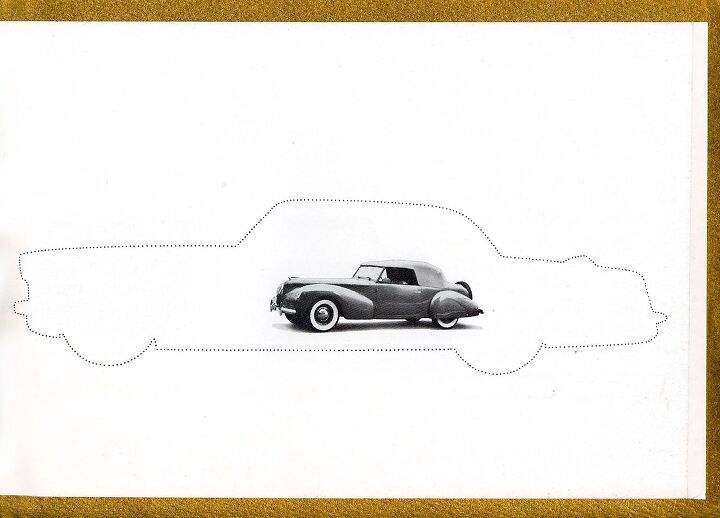
The new coupe was to be very expensive, and very exclusive. It was not to be marketed as a regular Lincoln-Mercury product, but rather as a separate brand. Since big, bold luxury was back, Lincoln felt it could resurrect some of the glory the brand had when it offered the old Continental and the coachbuilt K-Series cars in the Thirties. The new division would be called Continental, and its model the Mark II.
Mark II’s design was completed circa 1953, at the hands of chief stylist John Reinhart and body engineer Gordon Buehrig. Buehrig (1904-1990) was the more famous of the two men and had a long career designing cars at Packard, Cord, and GM. He also designed the Stutz Blackhawks that raced at Le Mans. Later in his career, he worked at Studebaker and then Ford, and retired from the latter in 1965. Very late in his life, he helped the Franklin Mint develop its line of model cars.
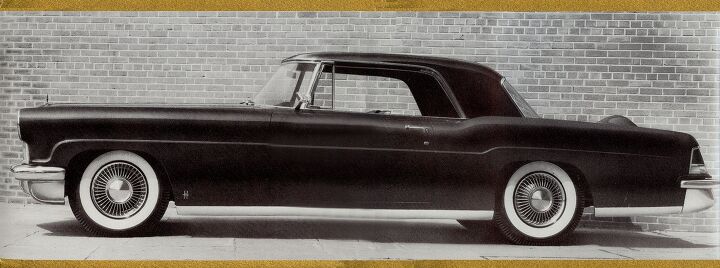
Reinhart and Buehrig finalized a shape that was in the same mold as the first Continental but modernized into a Midcentury timeline. The Mark II was available only as a coupe, simplifying the model’s offerings and diverging from Continental’s initial design as a convertible. In what would previously have been called a “Club Coupe,” the Mark II was designed with the same long, sweeping hood that ended in a chromed front end.
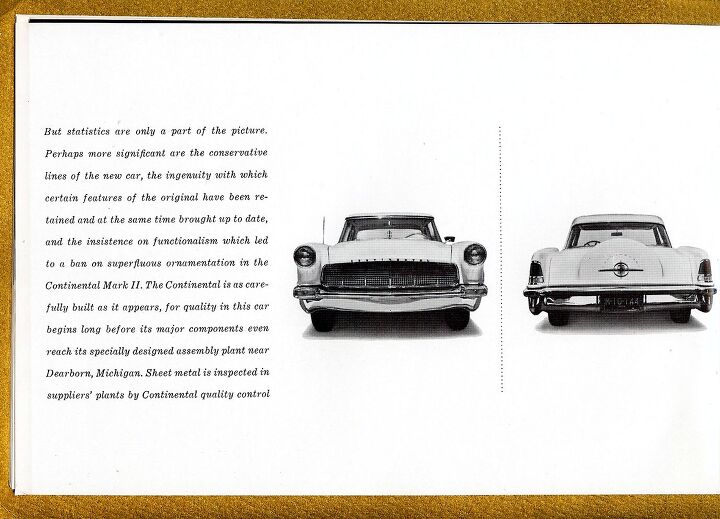
Said front end was simplified over the first Continental and featured a more judicious use of chrome. Bearing in mind the old Continental was already subdued in its chroming, the 1956 Mark II was practically delicate looking in the era. Circular headlamps stuck out at the ends of the smooth fenders and protruded slightly less than the turn indicators that were integrated into the chrome bumper.
The bumper’s shape was fairly simple and came to a point in the middle. It avoided any superficial detailing and did not contain an indentation for the license plate (which would’ve ruined the smooth appearance). Above the bumper was an egg-crate grille divided into six sections, three per side. Finished in chrome, the surround of the grille was thin, which helped the visage avoid a heavy-handed look. On the leading edge of the hood above the grille, “CONTINENTAL” was spelled out in shimmering, golden block letters.
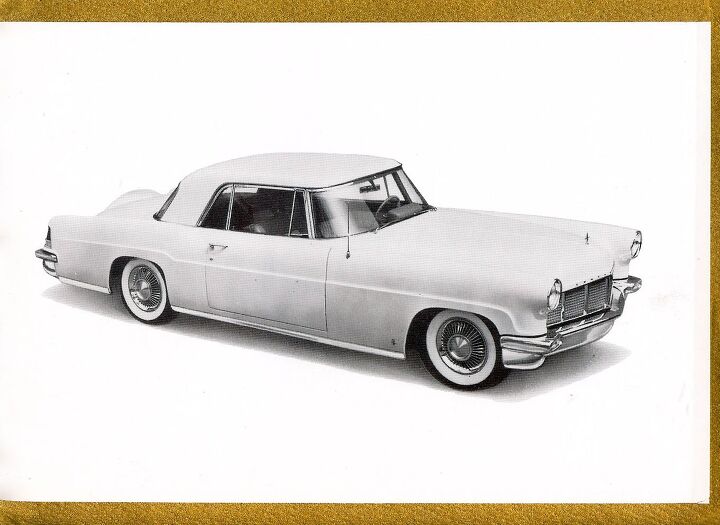
Also in gold was the hood ornament, which was a crosshair design perched high atop the hood’s central character line. The crosshair logo would eventually be adopted by the rest of Lincoln, but at the time Lincolns wore an airplane logo where a plane was depicted from behind. The front end detail was finished by a character line in the fender that appeared gradually as it wrapped around from the grille, and became pronounced as it swept upward over the front wheel well.
That character line continued down the side, along a very smooth fender, and across a door that was equally so. Mark II’s roof was a modern take on the original Continental: Formal and upright, it made do with two pillars instead of three and turned the Mark II into a hardtop. There was minimal adornment along the side of the Mark II, just a simple door handle and lock cylinder in chrome. The character line eased upward after the thick B-pillar and continued all the way to the tail lamps at the rear.
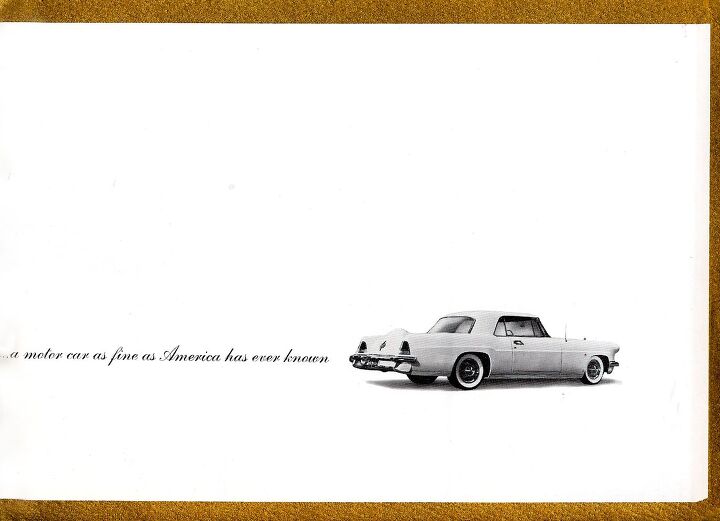
With more adornment than the front, the Mark II’s rear was nevertheless restrained. Simple red brake lamps were on the smooth side, with reverse lights below. The shape was almost a slice of layer cake, surrounded by a thin strip of chrome frosting. Between the lamps was the integrated continental kit hump, the detail the Mark II became most known for. It made room for the spare tire inside and wore Continental block lettering.
Under the lettering lived another Continental crosshair logo, with more detailing than the hood ornament. The crosshair contained heraldry on a shield, piqued out in black and gold. At the rear, the crosshairs themselves were chrome instead of gold.
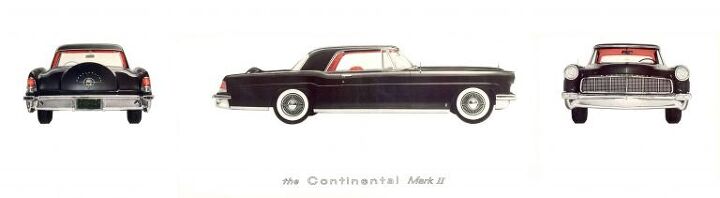
The Mark II’s bumper was a great piece of design, finished entirely in chrome. It cut aggressively into the rear fender and came to a point in the middle that mirrored that at the front. An unusual feature, the Mark II’s exhaust exited from dual tails built into the bumper itself, just under the brake lamps. One might wonder if many a leg was burned via a casual brush against the exhaust outlets, which were at shin or knee level.
It’s not really fair to compare the interior design of two cars separated by a couple of decades, so we’ll focus on just the Mark II here. Its interior was finished as an understated testament to personal luxury. Interiors were often in two-tone (a darker color accompanied by cream), in various configurations. Sometimes the seats were two-tone, others just had contrast piping. Dash and door panels were coordinated two-tone. The driver faced a large steering wheel that was color-matched to the interior, in an expected three-spoke design. The transmission indicator was built into the top of the wheel.
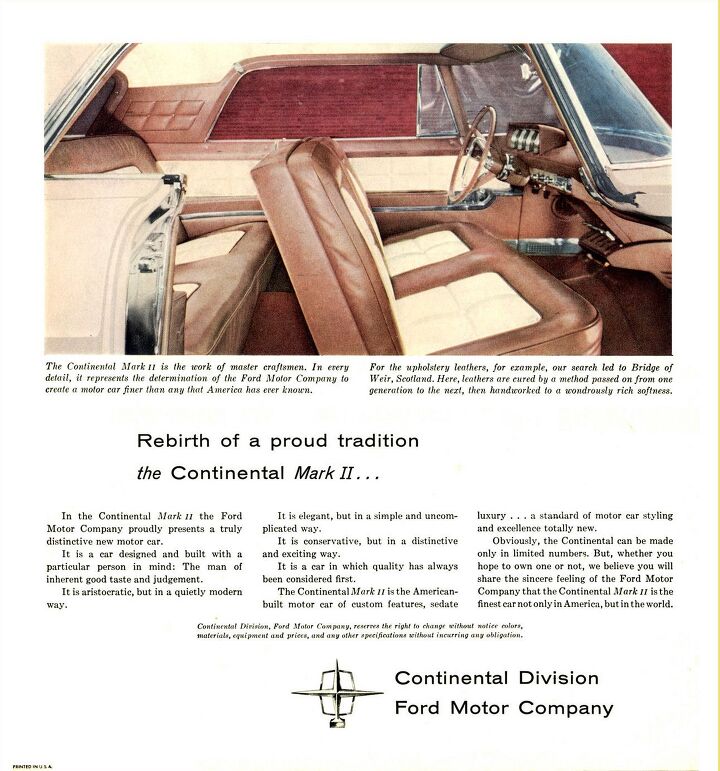
Gauges were chrome-ringed and backed by a teal color; a most excellent Midcentury style. The left gauge implemented a chronometer look and showed the turn indicators, temperature, fuel, and the like, while the second to the left was the speedometer and odometer. The center-right gauge was an analog clock with a second hand, and the rightmost gauge reflected RPMs. A functional yet very simple arrangement overall.
There was no center console, but the center stack contained the radio and cigarette lighter and was backed in the same textured gold metal as the gauge surround. Below, aircraft-style levers controlled the climate and totaled five in number. The doors also opened with levers, which were a grab handle style that was pulled toward the rear for operation. Power windows were standard and encased in chrome for driver and passenger. Seats were of a bench variety, and while the bottom cushion was one piece the seatback was split in the middle and folded forward at an angle for easier access to the rear. Back seat passengers were treated to plenty of space, and a nice view out that was not obstructed by pillars.
Design work finished on what would become an absolute classic, Ford needed to introduce the world to Continental. That’s where we’ll pick up in Part III, and go on to cover the mechanical details.
[Images: Ford]
Interested in lots of cars and their various historical contexts. Started writing articles for TTAC in late 2016, when my first posts were QOTDs. From there I started a few new series like Rare Rides, Buy/Drive/Burn, Abandoned History, and most recently Rare Rides Icons. Operating from a home base in Cincinnati, Ohio, a relative auto journalist dead zone. Many of my articles are prompted by something I'll see on social media that sparks my interest and causes me to research. Finding articles and information from the early days of the internet and beyond that covers the little details lost to time: trim packages, color and wheel choices, interior fabrics. Beyond those, I'm fascinated by automotive industry experiments, both failures and successes. Lately I've taken an interest in AI, and generating "what if" type images for car models long dead. Reincarnating a modern Toyota Paseo, Lincoln Mark IX, or Isuzu Trooper through a text prompt is fun. Fun to post them on Twitter too, and watch people overreact. To that end, the social media I use most is Twitter, @CoreyLewis86. I also contribute pieces for Forbes Wheels and Forbes Home.
More by Corey Lewis










Comments
Join the conversation
My favorite Lincoln. The Gilmore Museum in Hickory Corners, MI (about 20 minutes outside Kalamazoo) has a building dedicated to Lincoln with a couple MK II's on display. They are truly beautiful cars.
There is a silver/grey Mark II on display in the parking garage (street level) of the Petersen Auto Museum in LA. No charge to see it. Right across from the parking garage payment kiosk. It belonged to Mike Todd, a big time Hollywood producer. His then wife, Elizabeth Taylor, eventually had two Mark II's.