
Rare Rides: A 1990 Buick Reatta Convertible in Nearly New Condition

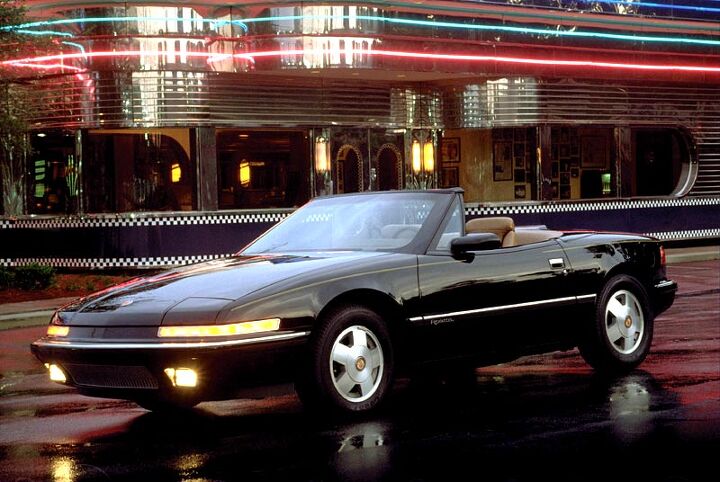
Today’s Rare Ride represents the only time in history Buick built a two-seat car, and the only time a Buick had pop-up headlamps. It was also the last time Buick made a factory convertible in the United States, as the Opel Cascada wasn’t built domestically and was not a real Buick.
Let’s check out the Eighties low-volume experiment that was Reatta.
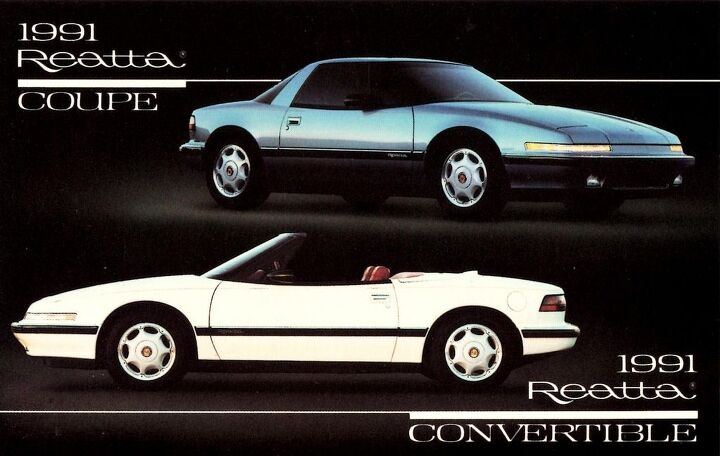
Designed in 1983 by Dave McIntosh, the Reatta was meant as a halo product for the Buick brand: more special than the larger Riviera, but less ambitious (and stupid) than GM’s other halo two-seater, the Allanté. Reatta was produced at the Reatta Craft Center, a special facility that assembled each car at various independent stations rather than via assembly line. Stations carried out their assigned work, and when completed the Reatta was transported via robot to the next station. Almost sounds British if you remove the robot factor.
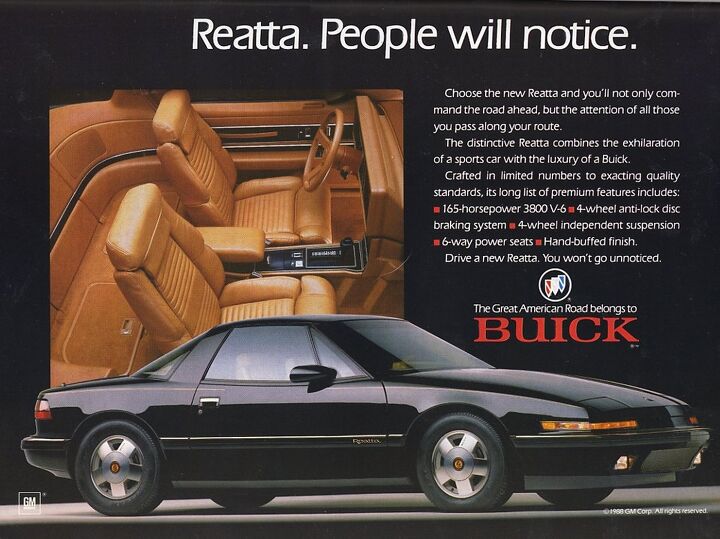
Based on the E-body platform with the larger Riviera and other GM personal luxury coupes, Reatta received the common and very excellent Buick 3800 V6. For 1988 through 1990 the LN3 (165HP) version was used, and 1991 cars swapped it for the newer L27 (170HP). Three different versions of four-speed automatic were used depending upon the year. 1991 examples also had an electronically controlled transmission and a revised ABS module.
While bucket seats and lockable storage bins were permanent Reatta features, its CRT center screen was not. A touch-based system called the Electronic Control Center, the green and black screen controlled climate, radio, a trip computer, and diagnostic functions. It was very advanced for the time, but most customers and media were not about it. For 1990 the Reatta was updated slightly, and while exterior visuals remained largely the same, the interior received a driver’s airbag and optional CD player, a new center console, and conventional buttons took the place of the CRT. All examples of Reatta had digital gauges, which were revised to look more modern in 1990 and matched those in the Riviera. 1990 also saw the introduction of the convertible, a version which intended to launch at Reatta’s debut. Its folding roof design was complicated and engineered by ASC. Convertibles were built at the Reatta Craft Center alongside coupes.
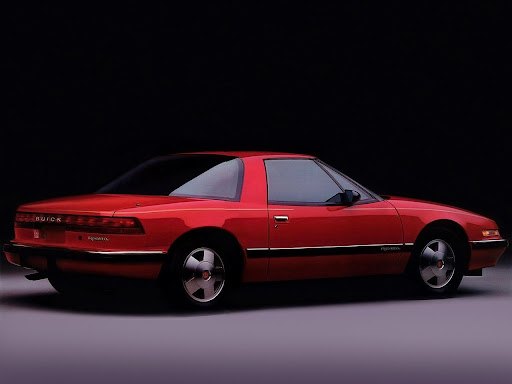
Worth a mention is the special Select Sixty program in 1988 and 1990. In 1988, about 60 Reattas were allocated to top Buick dealers. They had a black interior and tan paint, along with special Select Sixty badging. In 1990 Select Sixty was repeated, and 65 white convertibles were made with white tops, red and white interiors, and unique Select Sixty white wheels. Your author’s never seen an ’88 example of the Select Sixty, but the ’90 is very striking.
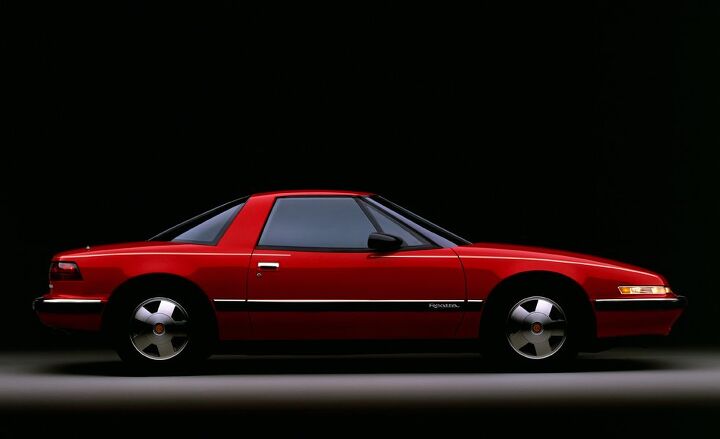
Given the exciting halo nature of the Reatta, Buick planned to shift around 20,000 per year. Unfortunately, they never reached even half that number annually, and only sold 21,751 in total between 1988 and 1991. The Reatta was too expensive for a Buick, and at a base of $28,300 in 1990 ($60,300 adj.) its convertible version cost an additional $6,700. Adjusted for inflation, that’s $74,600. A relative bust, the Reatta program was canceled without replacement, and Buick never again built a sports coupe. The Reatta Craft Center was renamed Lansing Craft Center, and went on to build other convertibles, the EV1, and finally the Chevrolet SSR before its closure.
Today’s Rare Ride is a 1990 Reatta cabriolet, in a nice black and grey color scheme. It’s never been owned by an individual, but went straight into its dealer’s collection. With 16,000 miles on the clock, it asks $19,500. Recent years have seen the value of Reattas escalate given their rarity. Clean ones are even harder to find, given they were at bargain-basement prices by the late Nineties and fell into careless hands.
[Images: GM]
Interested in lots of cars and their various historical contexts. Started writing articles for TTAC in late 2016, when my first posts were QOTDs. From there I started a few new series like Rare Rides, Buy/Drive/Burn, Abandoned History, and most recently Rare Rides Icons. Operating from a home base in Cincinnati, Ohio, a relative auto journalist dead zone. Many of my articles are prompted by something I'll see on social media that sparks my interest and causes me to research. Finding articles and information from the early days of the internet and beyond that covers the little details lost to time: trim packages, color and wheel choices, interior fabrics. Beyond those, I'm fascinated by automotive industry experiments, both failures and successes. Lately I've taken an interest in AI, and generating "what if" type images for car models long dead. Reincarnating a modern Toyota Paseo, Lincoln Mark IX, or Isuzu Trooper through a text prompt is fun. Fun to post them on Twitter too, and watch people overreact. To that end, the social media I use most is Twitter, @CoreyLewis86. I also contribute pieces for Forbes Wheels and Forbes Home.
More by Corey Lewis






Comments
Join the conversation
I know of a red 1991 convertible 55,000 miles for sale at $16000
I Love my 90 convertible with 70k miles (red/saddle beige). Great car and unique styling, I doubt I’ll ever sell unless someone has $20,000!