
Rare Rides: The Superbly Rare 1963 Aston Martin Lagonda Rapide

Corey Lewis
by Corey Lewis

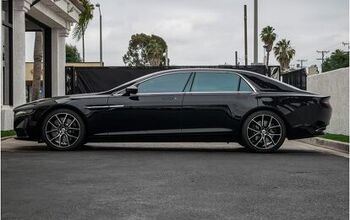
Rare Rides has featured a couple of fine Lagonda sedans previously. First was the 1980s rectangle designed by William Towns, which miraculously remained in production from 1976 to 1990. Next was the Lagonda Taraf, a super sedan intended only for the oil-flush UAE market.

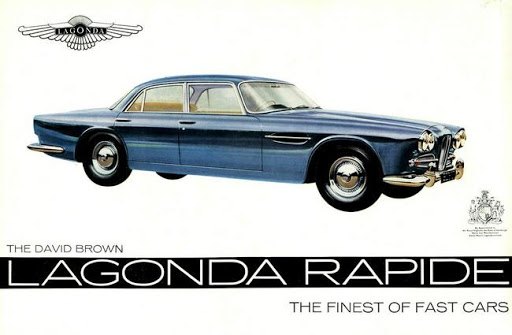
Today we bring you the genesis of the Aston Martin Lagonda sedan line, the Rapide.

The Rapide was developed during David Brown’s ownership of Aston Martin. If you recall, Brown also saw the development of the Rover Metro into the luxury Aston Martin Frazer Tickford Metro. In the early Sixties, Mr. Brown owned Aston Martin and the deceased Lagonda brand. Though he purchased the Lagonda marque in 1948, Lagonda had faded away in 1958. The company made a very small number of coupes post-WWII, with Aston Martin engines.

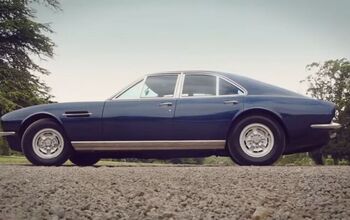
The Rapide was a luxurious, V12-engined car at Lagonda in the Thirties, and Mr. Brown decided it was that name which should revive Lagonda. Design work was handed off to Carrozzeria Touring, the sedan based on the contemporary DB4 coupe. Though it shared a basis, the sedan’s 196-inch length was considerably longer than the 177 inches of the DB4. Touring applied a split grille design with three sections to the Rapide, and quad headlamps additionally separated Lagonda from Aston Martin’s corporate styling. It took three years to develop the Rapide, and the large sedan entered production in 1961.
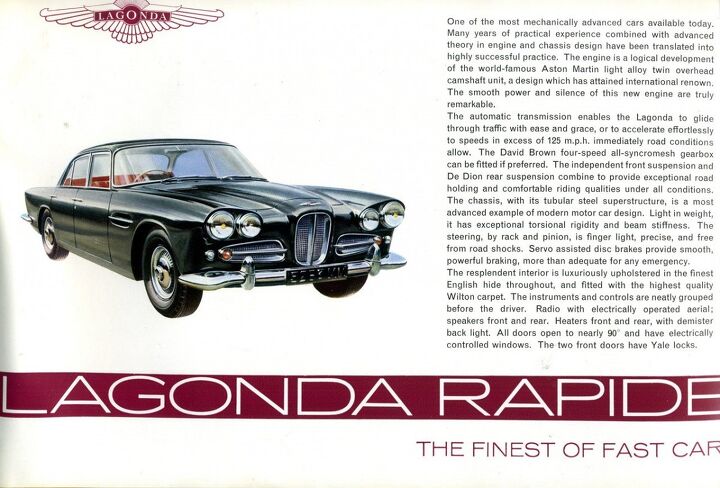
An early super sedan, Rapide used an enlarged straight-six of 4.0-liters that was notably more potent than the 3.6 found in the DB4. Featuring dual overhead cams, the 4.0 would later see use in the DB5 and produced 236 horses in Rapide implementation. That made for a very quick-for-1961 run to 60 of 8.9 seconds. The Rapide debuted other features used in the later DB5: a de Dion rear suspension, and a body composed of a magnesium-aluminum alloy. Most Rapides were automatic and routed their power through a three-speed Borg-Warner unit, though a select few were ordered with a four-speed manual.

Extremely expensive, the Rapide was around £5,000 when it was new. That figure was 25 percent higher than a DB4, and twice the price of a Jaguar MKX or E-Type. Between 1961 and 1964, just 55 examples were produced. Aston Martin would not make another sedan until the Lagonda of 1974 mentioned above. And that was well after the conclusion of David Brown’s Aston/Lagonda ownership.

Today’s red over tan Rare Ride is presently at auction and ends bidding tomorrow. Current ask is £70,000 and it isn’t at its reserve. Probably not even close.

[Images: Aston Martin]

Corey Lewis
Corey Lewis

Interested in lots of cars and their various historical contexts. Started writing articles for TTAC in late 2016, when my first posts were QOTDs. From there I started a few new series like Rare Rides, Buy/Drive/Burn, Abandoned History, and most recently Rare Rides Icons. Operating from a home base in Cincinnati, Ohio, a relative auto journalist dead zone. Many of my articles are prompted by something I'll see on social media that sparks my interest and causes me to research. Finding articles and information from the early days of the internet and beyond that covers the little details lost to time: trim packages, color and wheel choices, interior fabrics. Beyond those, I'm fascinated by automotive industry experiments, both failures and successes. Lately I've taken an interest in AI, and generating "what if" type images for car models long dead. Reincarnating a modern Toyota Paseo, Lincoln Mark IX, or Isuzu Trooper through a text prompt is fun. Fun to post them on Twitter too, and watch people overreact. To that end, the social media I use most is Twitter, @CoreyLewis86. I also contribute pieces for Forbes Wheels and Forbes Home.

More by Corey Lewis

Comments
Join the conversation
2 of 7 comments
  • Amwhalbi My 1972 Mercury Capri was my first stick shift car. God, I miss that thing. It was a blast to drive.
  • Vid169489471 The technology exists today to produce a variable color temperature (kelvin) LED lamp. It can vary from 2700k that soft orange look to 6500k the bright daylight with the bluish tint.Since everything in a late model car is computer controlled, it would be an easy task to write a few lines of code that enables your vehicle to not only dim down from hi to low beam but to shift color temp down to the 2700k range for oncoming traffic, then back up to 5000k once oncoming traffic has passed. For the operator it would be automatic and seamless. For older cars they could be retrofitted with LEDs that are 2700k on low beam and 5000k on hi beam. As far as standards, there could be a lumens max, and a minimum. Several States already have minimum lumen standards going back to the old incandescent bulbs. Why not update these to national standards.
  • Jam169859557 More regulation is needed for ALL vehicle lighting systems. [list=1][*]The lighting that is most blinding are the rapidly flashing red, blue and amber lights on emergency vehicles. The lights themselves are blinding, flashing so rapidly that it's impossible for even the sharpest eyes to adjust. What's worse, is the nature of the emergency requires a careful view of the area surrounding the emergency vehicle. There is something going on that needs to be seen. More flashing lights is not the solution.[/*][*]Brighter headlights need to be regulated. The tall riding vehicles do not need headlights positioned so high that they blind drivers in lower riding vehicles. And those heasdlights need to be aimed properly. When I first started driving my 2020 Subaru Outback, many drivers would flash their lights, hoping I would dim my lights. This stopped after I performed am easy adjustment that tilted the beam lower. Late model Subaru headlamps are designed with a sharp cutoff that project less glare above the hood line. When the headlights are properly aimed, other drivers are not blinded by the beam.[/*][*]Customized light assemblies make it more difficult to see the marker lights (tail lamps, turn signals and side marker lamps) that have been tinted. There are many municiple codes that prohibit this tinting, but these laws are seldom enforced.[/*][/list=1]Solutions: Tight controls on emergency vehicle lighting. In trying to make these vehicles more visible, a dangerous side effect is reducing the ability of drivers to see the surrounding perils.Headlight design regulations that reduce the height of the headlight assemblies. Just because a pickup truck has a hood that sits 4 feet abouve the pavement, it does not mean the headlights need to be so high. Owneres should maintain proper adjustments to their vehicle headlights.Establish and enforce regulation requiring a illumination standard be followed.
  • Stl170698708 as someone who hates big government, and their interference;but you can add me to the list of people that are blinded by the lights.unfortunately "the poop is out of the horse and no way is it going back in"They have had 5 years to make lights bigger, badder and brighter because in the vehicle work it is go big or go home!Trucks are the worst because so many people use them to express their dominance and that is big, big, big $$ both at the Original Purchase and in the Aftermarket world.If, we are so lucky to get some good government regulation on this it will also take some very good Court enforcement to get the aftermarket people with fines and lawsuits.Much like the EPA did with the Diesel Tuner Industry that felt emission regulations didn't apply to them.This is from someone that owns said pickup truck with the same bright headlights,but i only use the truck when I have too and always turn off the Fog lights when driving in traffic.
  • Art65765977 I saw a porsche 911 with the most amazing headlights from behind approaching the Sunshine skyway in Florida. The pattern was 108 degrees across sweeping the road like a broom. My brother and I were amazed. I don't know what it looked like from the front but i am sure it was better than American cars
Next