

Welcome to Electric Avenue — More Chargers on the Way
Jason R. Sakurai
by Jason R. Sakurai

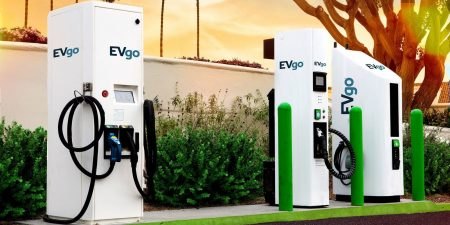
The Electric Highway Coalition, a consortium of six utility companies, will provide a network of 20-30 minute DC fast chargers for EV drivers, as reported by Electrek. Each of the utilities will be responsible for providing EV charging within their service areas, with most sites located along major highways for easy access and adjacency to other amenities.
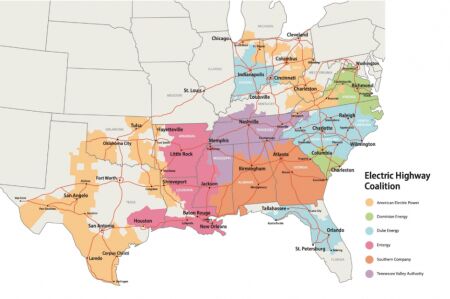
Their mandate is to ensure drivers of EV have accessible charging stations along the Atlantic coast as far north as Washington, D.C., throughout the South, into the Gulf states, and the Central Plains. The power companies involved are: American Electric Power in Ohio, West Virginia, Texas and Oklahoma; Entergy Corporation in Arkansas and Louisiana; Tennessee Valley Authority in Mississippi and Tennessee; Southern Company in Alabama and Georgia; Duke Energy in Indiana, Florida, North and South Carolina; and Dominion Energy in Virginia and parts of South Carolina.

Jeff Lyash, Tennessee Valley Authority (TVA) president and CEO said, “Together, we can power the electric road trip of tomorrow by ensuring seamless travel across a large region of the U.S. This is one of many strategic partnerships that TVA is building to increase the number of electric vehicles to well over 200,000 in the Tennessee Valley by 2028. EV adoption will spur jobs and economic investment in the region, keep refueling dollars in the local economy, reduce the region’s largest source of carbon emissions, and save drivers and businesses money.”

Jointly, the Tennessee Department of Environment and Conservation and the TVA announced the development of a statewide network of EV fast charging stations every 50 miles along the interstates and major highways.

The most interesting part of this announcement came from the American Public Power Association, a service organization representing 2,000 community-owned utilities, who reported last year that there would be 10 to 35 million EVs in the U.S. by 2030, up from 1.5 million EVs in the U.S. in 2020, anywhere from a 6.66- to 23.33- percent increase in the number of EVs. They also noted that it would an investment of $75-$125 billion would be needed to revamp the electric power system by that date to service an estimated 20 million EVs. That’s somewhere between $3,750-$6,250 per EV. At that rate, maybe the astronomical rate being charged by the utility companies in Texas recently is their way of financing EV expansion?

[Images: Electric Highway Coalition, TVA]

Jason R. Sakurai
Jason R. Sakurai

With a father who owned a dealership, I literally grew up in the business. After college, I worked for GM, Nissan and Mazda, writing articles for automotive enthusiast magazines as a side gig. I discovered you could make a living selling ad space at Four Wheeler magazine, before I moved on to selling TV for the National Hot Rod Association. After that, I started Roadhouse, a marketing, advertising and PR firm dedicated to the automotive, outdoor/apparel, and entertainment industries. Through the years, I continued writing, shooting, and editing. It keep things interesting.

More by Jason R. Sakurai

Comments
Join the conversation
4 of 29 comments
  • Craiger Craiger on Mar 03, 2021

    I just hope that there will be enough charging ports at various stations if EVs proliferate. It's one thing to wait in line for a guy in front of you to fill his gas tank, but waiting in line behind multiple EVs would take much longer.

  • Inside Looking Out Inside Looking Out on Mar 03, 2021

    How US was able to build Interstate highway system which is considered as a one of the wonders of the world and put man on the moon and same time not capable of building a single high speed rail? Or set up reliable energy system similar to Russian Unified Energy System. I predict daily blackouts and people freezing to death in US if government goes forward with making ICE cars illegal.

  • Amwhalbi My 1972 Mercury Capri was my first stick shift car. God, I miss that thing. It was a blast to drive.
  • Vid169489471 The technology exists today to produce a variable color temperature (kelvin) LED lamp. It can vary from 2700k that soft orange look to 6500k the bright daylight with the bluish tint.Since everything in a late model car is computer controlled, it would be an easy task to write a few lines of code that enables your vehicle to not only dim down from hi to low beam but to shift color temp down to the 2700k range for oncoming traffic, then back up to 5000k once oncoming traffic has passed. For the operator it would be automatic and seamless. For older cars they could be retrofitted with LEDs that are 2700k on low beam and 5000k on hi beam. As far as standards, there could be a lumens max, and a minimum. Several States already have minimum lumen standards going back to the old incandescent bulbs. Why not update these to national standards.
  • Jam169859557 More regulation is needed for ALL vehicle lighting systems. [list=1][*]The lighting that is most blinding are the rapidly flashing red, blue and amber lights on emergency vehicles. The lights themselves are blinding, flashing so rapidly that it's impossible for even the sharpest eyes to adjust. What's worse, is the nature of the emergency requires a careful view of the area surrounding the emergency vehicle. There is something going on that needs to be seen. More flashing lights is not the solution.[/*][*]Brighter headlights need to be regulated. The tall riding vehicles do not need headlights positioned so high that they blind drivers in lower riding vehicles. And those heasdlights need to be aimed properly. When I first started driving my 2020 Subaru Outback, many drivers would flash their lights, hoping I would dim my lights. This stopped after I performed am easy adjustment that tilted the beam lower. Late model Subaru headlamps are designed with a sharp cutoff that project less glare above the hood line. When the headlights are properly aimed, other drivers are not blinded by the beam.[/*][*]Customized light assemblies make it more difficult to see the marker lights (tail lamps, turn signals and side marker lamps) that have been tinted. There are many municiple codes that prohibit this tinting, but these laws are seldom enforced.[/*][/list=1]Solutions: Tight controls on emergency vehicle lighting. In trying to make these vehicles more visible, a dangerous side effect is reducing the ability of drivers to see the surrounding perils.Headlight design regulations that reduce the height of the headlight assemblies. Just because a pickup truck has a hood that sits 4 feet abouve the pavement, it does not mean the headlights need to be so high. Owneres should maintain proper adjustments to their vehicle headlights.Establish and enforce regulation requiring a illumination standard be followed.
  • Stl170698708 as someone who hates big government, and their interference;but you can add me to the list of people that are blinded by the lights.unfortunately "the poop is out of the horse and no way is it going back in"They have had 5 years to make lights bigger, badder and brighter because in the vehicle work it is go big or go home!Trucks are the worst because so many people use them to express their dominance and that is big, big, big $$ both at the Original Purchase and in the Aftermarket world.If, we are so lucky to get some good government regulation on this it will also take some very good Court enforcement to get the aftermarket people with fines and lawsuits.Much like the EPA did with the Diesel Tuner Industry that felt emission regulations didn't apply to them.This is from someone that owns said pickup truck with the same bright headlights,but i only use the truck when I have too and always turn off the Fog lights when driving in traffic.
  • Art65765977 I saw a porsche 911 with the most amazing headlights from behind approaching the Sunshine skyway in Florida. The pattern was 108 degrees across sweeping the road like a broom. My brother and I were amazed. I don't know what it looked like from the front but i am sure it was better than American cars
Next