Rare Rides: The 1954 Woodill Wildfire-Buick, Fiberglass and Fun-sized

Today’s Rare Ride was formerly unknown to your author. A brief boutique brand in the Fifties, Woodill went away long before most of you were even born. Let’s see if we can learn a bit more about this American take on the classic British roadster formula.
In the early Fifties, fiberglass started its spread across America as an easily workable, affordable material for use in the construction of sporty car bodies. The first of this new kind of sports car to enter production was the Glasspar G2, produced by Bill Tritt (a yacht maker) in 1949. In those days such roadsters were not offered by the major OEMs in Detroit, which opened a path for smaller shed-built, or “boutique” if you prefer, cars.
In short order, car dealers entered into small-scale production of their own takes on the idea created by the G2. That’s where Woodill entered the picture: A successful dealer of Willys trucks in California, he imagined his own G2-type vehicle. The roadster would of course be driven by Willys parts underneath. Woodill commissioned a Glasspar-built body from Tritt, then took his idea to Willys HQ, where he was quickly shot down. At the time Willys was in merger talks with Kaiser, and the Kaiser-Darrin roadster was already well into its development.
“I’ll do it myself then,” said Woodill. Shortly thereafter, the new Woodill Wildfire was ready for sale. Available at his dealership, the Wildfire used Willys mechanicals as planned; a low-power inline-six and manual transmission. Starting in 1952, the car was available in kit form, or as a complete car built by Woodill.
The Wildfire dumped the mostly unsuitable Willys engine for a Ford V8 at some point, but by then a little fiberglass competition had arrived – the Corvette. Corvette spelled the beginning of the end for piecemeal fiberglass cars from car dealers when it was introduced in 1953, as consumers eagerly threw their dollars at General Motors. The Wildfire remained on offer through 1958, with roughly 300 produced. Of that figure, 15 were sold as complete cars, and 285 as kits.
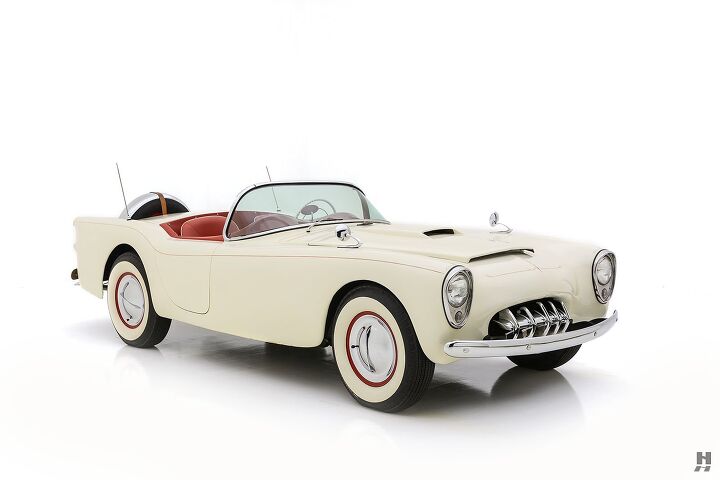
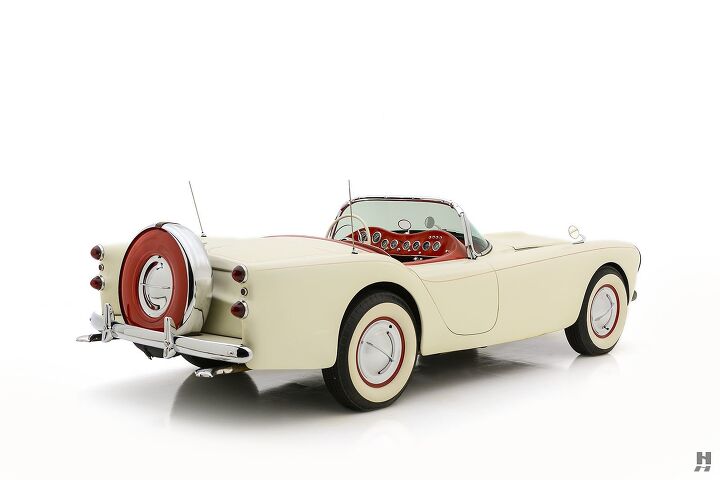
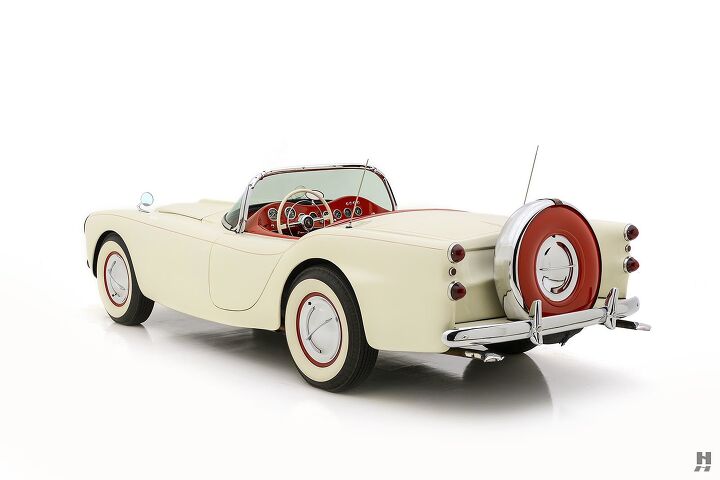
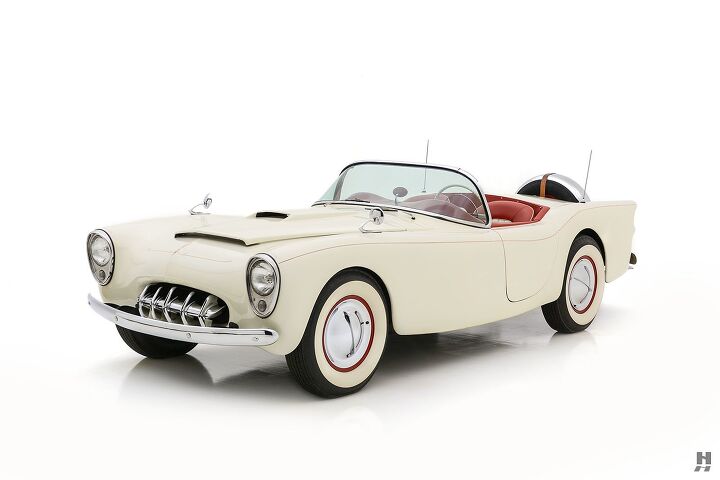
But today’s Rare Ride is an even rarer subset of those kit cars. In 1954 a few kits were purchased by a Buick dealer in California, Harry Clark. Clark put his own (fairly extensive) Buickification on the Wildfire. The front featured ’53 Buick lamps, and a modified form of a Chevy grille from the same year. He used a more curved windshield than the standard Wildfire. Clark also grabbed the rear fender molds from a ’53 Buick, and made them in fiberglass for his roadster. And perhaps most notably to add an upscale Buick vibe, a continental kit was attached at the rear. Chrome bumpers front and rear were donated by Ford, for some reason.
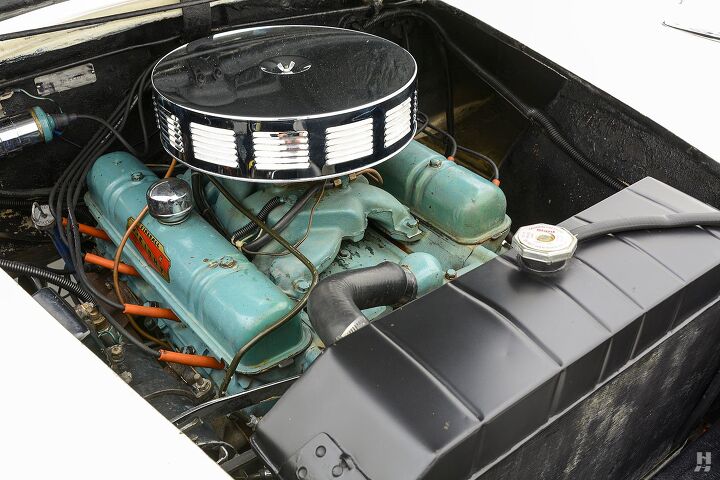
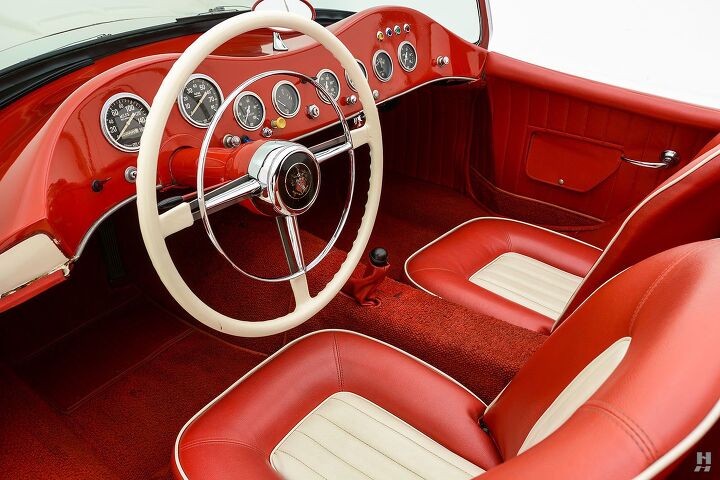
Power for these few examples was GM as well, in the form of the new 322 cubic inch Nailhead V8 from Buick. It was luxuriously matched with a Dynaflow automatic transmission, with floor-mount lever.
The extensive changes turned the Wildfire into a Wildfire-Buick, its only badging the Buick crest on the steering wheel. Perhaps the only one left today, this fully restored roadster asks $67,500. The joy of explaining what it is every time you park is thrown in for free.
[Images: seller]
Interested in lots of cars and their various historical contexts. Started writing articles for TTAC in late 2016, when my first posts were QOTDs. From there I started a few new series like Rare Rides, Buy/Drive/Burn, Abandoned History, and most recently Rare Rides Icons. Operating from a home base in Cincinnati, Ohio, a relative auto journalist dead zone. Many of my articles are prompted by something I'll see on social media that sparks my interest and causes me to research. Finding articles and information from the early days of the internet and beyond that covers the little details lost to time: trim packages, color and wheel choices, interior fabrics. Beyond those, I'm fascinated by automotive industry experiments, both failures and successes. Lately I've taken an interest in AI, and generating "what if" type images for car models long dead. Reincarnating a modern Toyota Paseo, Lincoln Mark IX, or Isuzu Trooper through a text prompt is fun. Fun to post them on Twitter too, and watch people overreact. To that end, the social media I use most is Twitter, @CoreyLewis86. I also contribute pieces for Forbes Wheels and Forbes Home.
More by Corey Lewis








Comments
Join the conversation
Looks bad from the rear but still an interesting car . To bad about the DynaSquish box, you have to suffer driving one to fully grasp how awful they are . -Nate
The tail lights look like those on a 53 Buick. Looks like they reached into the parts bin for 53 Buicks.