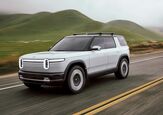
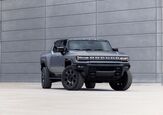

Buy/Drive/Burn: Compact Japanese SUVs From 1991

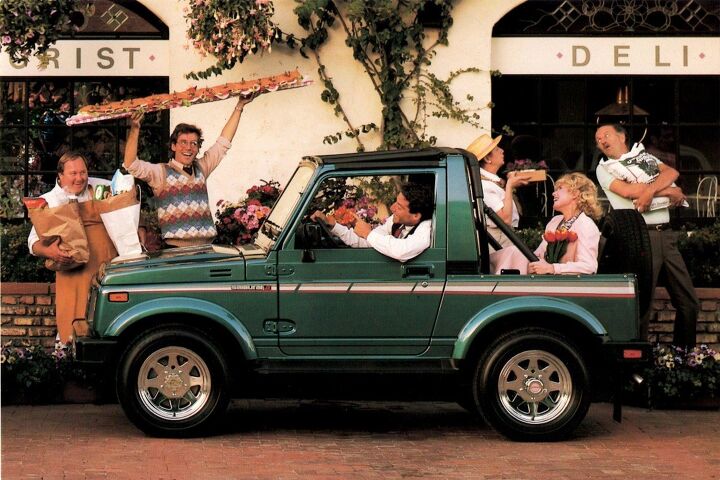
Last time on Buy/Drive/Burn, we considered three-door Japanese SUVs from 1989. In this edition, we move forward a couple years in history and down a size class. Up for grabs are compact SUVs with removable roofs, all of them Japanese.
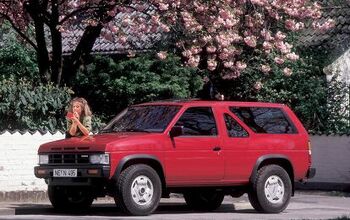
Suzuki Samurai
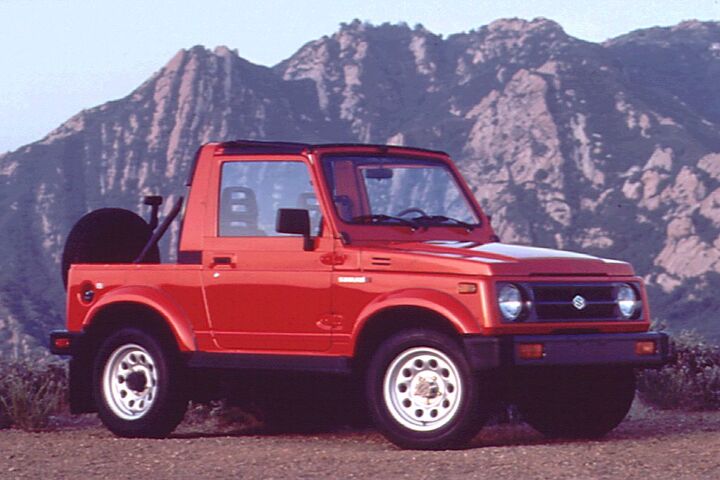
The smallest of our trio was also the oldest. Suzuki started making their second generation Jimny in 1981, code named SJ30. The tiny truck wore about 13 different names depending on market, and was also sold as a Chevrolet, Holden, Santana, and Maruti. The first Samurais arrived in North America for the 1986 model year. Small revisions in 1988 upped comfort and livability factors, and late in 1991 the 1.3-liter engine was replaced by a new version which had fuel injection (TBI). A five-speed manual handled all 66 horsepower. Upcoming safety regulations killed the Samurai after the 1995 model year, though it remained on sale elsewhere through 1998. Samurai’s American market replacement was the Suzuki version of the Geo below.
Geo Tracker
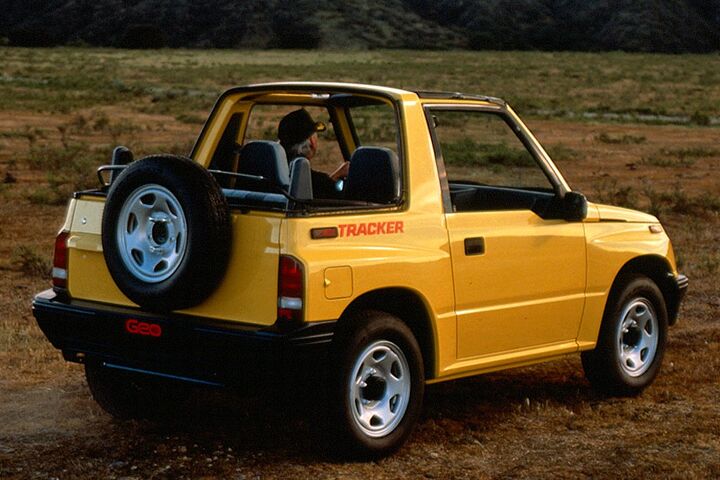
Jointly developed between GM and Suzuki, production of the Geo Tracker began in Japan in 1989. Japanese production for the first two model years was an accommodation to the folks in Ingersoll, Ontario, who couldn’t get the new CAMI plant up and running on time. Our northern neighbours didn’t receive Geos, so the Tracker was called a Sunrunner and sold by Asuna, and later, Pontiac. Canada also called it the GMC Tracker. Through 1995, the 1.6-liter engine provided 80 horsepower distributed via five manual gears. The Suzuki Sidekick and Geo twins lasted through 1998 in their initial guise. Let’s just say things went way downhill from there.
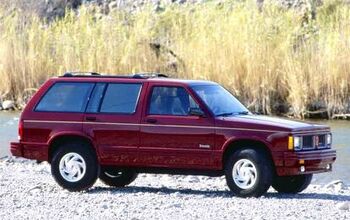
Isuzu Amigo
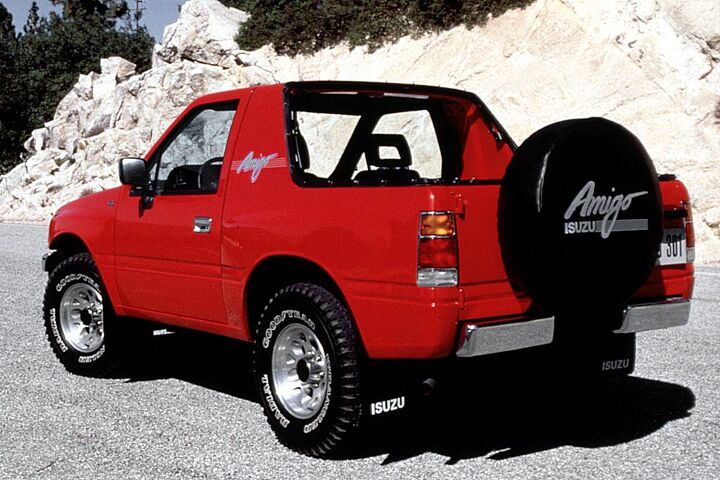
The largest option of our trio, Isuzu’s Amigo made its way to North America as a 1990 model. The Amigo and Rodeo also had about 13 different names, like MU, MU Wizard, Chevrolet Frontera and Rodeo, and the Honda Jazz in Japan. The first couple of Amigo years were spartan: Options were limited to things like air conditioning, and whether owners wanted two or four seats. Rear-drive versions had a 2.3-liter engine, while the four-wheel drive version (today’s option) was blessed with a larger 2.6-liter inline-four. The five-speed manual wrangled 120 horsepower in that guise. A five-door Rodeo joined the Amigo for 1991, and North American examples were built at the Subaru-Isuzu plant in Lafayette, Indiana (learned something). Amigo took a nap after 1994, and the Rodeo soldiered on alone until 1998, when both models rejoined the fray for a second generation. Amigo became Rodeo Sport in 2001, and died with Rodeo after 2004.
Three Nineties SUVs that promise fun in the sun, which goes home with the Big Buy?
[Images: Geo, Suzuki, Isuzu]
Interested in lots of cars and their various historical contexts. Started writing articles for TTAC in late 2016, when my first posts were QOTDs. From there I started a few new series like Rare Rides, Buy/Drive/Burn, Abandoned History, and most recently Rare Rides Icons. Operating from a home base in Cincinnati, Ohio, a relative auto journalist dead zone. Many of my articles are prompted by something I'll see on social media that sparks my interest and causes me to research. Finding articles and information from the early days of the internet and beyond that covers the little details lost to time: trim packages, color and wheel choices, interior fabrics. Beyond those, I'm fascinated by automotive industry experiments, both failures and successes. Lately I've taken an interest in AI, and generating "what if" type images for car models long dead. Reincarnating a modern Toyota Paseo, Lincoln Mark IX, or Isuzu Trooper through a text prompt is fun. Fun to post them on Twitter too, and watch people overreact. To that end, the social media I use most is Twitter, @CoreyLewis86. I also contribute pieces for Forbes Wheels and Forbes Home.
More by Corey Lewis











Comments
Join the conversation
Buy: the Amigo but it would have to be the 2nd gen one Drive: the Tracker ( i almost bought one as my first car a 5spd one) Burn: that horrible Samurai
Is it wrong to make the decision based on quoted power outputs over all else? They all have similar aesthetic attributes and seem to be on tipsy side. Buy: FWD Amigo Drive: Tracker Burn: Samurai. Wasn't this the guy that had a particular penchant for removing its passengers the easy way, rolling over?