


Now, About Ford's Upcoming F-150 Diesel…

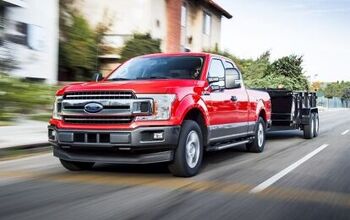
Ford was all but gloating… okay, it was gloating when it unveiled the coveted “30 mpg highway” figure for the upcoming 3.0-liter Power Stroke diesel V6 earlier this week. A full-size pickup with a 30 mpg rating? That sets it apart from all others, including the 27 mpg (highway) Ram 1500 EcoDiesel.
What the automaker didn’t mention was how much green you’ll need to shell out for a Power Stroke-powered F-150. Well, the beans are now spilled, but the product positioning seems a little odd.
Speaking to The Drive, an unnamed Ford spokesman described the markup for the 250 horsepower, 440 lb-ft engine, and where it sits in the trim lineup.
“On the F-150 Lariat, with its standard 2.7-liter EcoBoost engine, the walk to the 3.0-liter Power Stroke is $4,000, or $2,400 more than the 3.5-liter EcoBoost option,” the spokesman said. “On the F-150 King Ranch and Platinum, with the standard 5.0-liter V-8 engine, the walk to the 3.0-liter Power Stroke is $3,000, or $2,400 more than the 3.5-liter EcoBoost option.”
Lariat. That’s not the trim you think of when envisioning a prospective work truck with a diesel under the hood, though it’s the lowest trim deemed acceptable by the posh horsey set. The base XL starts out at $27,705 before delivery, and an extra $995 replaces the entry level 3.3-liter V6 with Ford’s excellent 2.7-liter EcoBoost V6. That engine boasts 400 lb-ft of torque, as does the optional 5.0-liter V8 found in both XL and XLT trims. The 3.5-liter EcoBoost pushes twist to 470 lb-ft, and is also optional on lower trims.
The 2.7-liter is standard kit on the Lariat trim, which starts at $7,715 more than an XLT. Paying an extra four grand on top of that for 40 extra foot-pounds of torque and four extra miles per gallon on the highway (and 3 mpg combined) seems like a decision you’d have to make over the course of an evening with your spouse and a calculator. There’s no regular cab bodystyle in the Lariat, either, not that many construction workers or fleet managers seek out that trim’s creature comforts.
While the new diesel promises superior fuel economy, Ford clearly isn’t pushing overall economy with this option. Diesel fuel currently runs about 15 cents a gallon more than gasoline, so you’d need to cover plenty of highway miles in a year for this upgrade to make financial sense — and if operational costs were truly that pressing, you wouldn’t be in the market for a Lariat, anyway.
[Image: Ford Motor Company]

More by Steph Willems
















Comments
Join the conversation
Pontiac 6000 turbo
Many of the people buying brand new diesel powered pickup trucks would be better off financially had they purchased a gasoline powered version. People are weird, and they love bragging rights. They will spend thousands more up front to be able to brag about their truck's fuel economy at the next party. Here in California at least diesel fuel runs about 15% more than regular gasoline. So ya gotta get more than a 15% fuel economy improvement just to break even at the pump, never mind the high up front costs, expensive long term maintenance and unknown durability of new designs.