

Rare Rides Icons: The Lincoln Mark Series Cars, Feeling Continental (Part XXX)

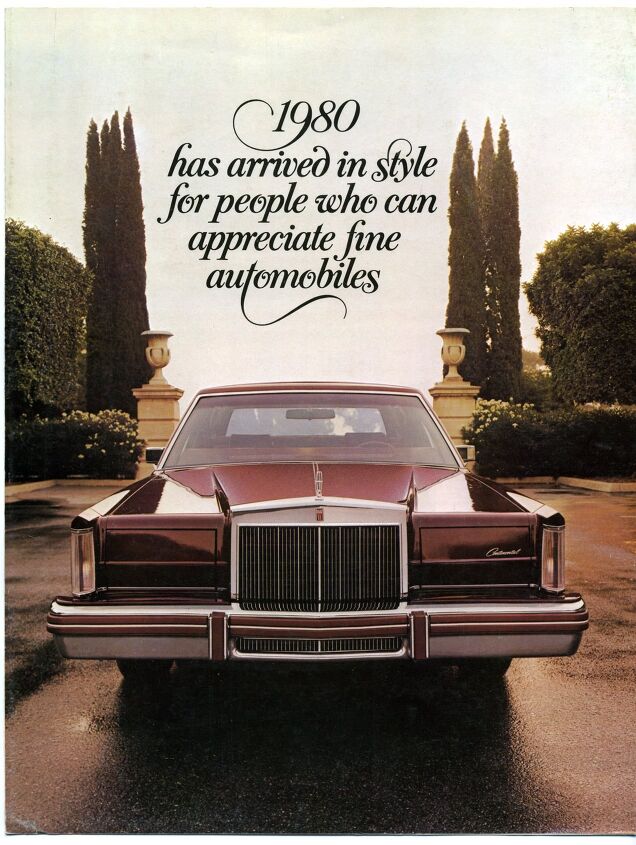
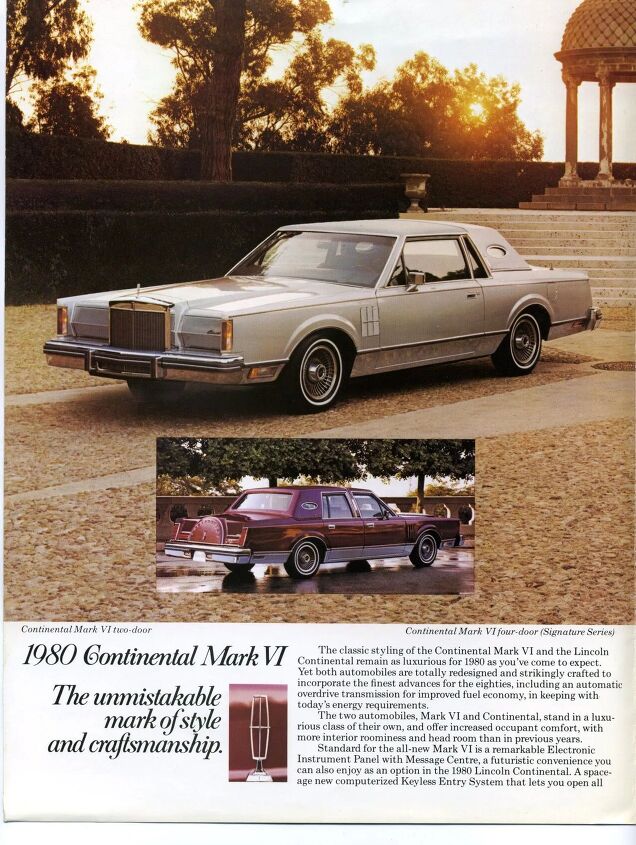
It’s our 30th installment in the Lincoln Mark series, and we’re at a low point. As mentioned last time a confluence of different factors forced downsizing across the American car landscape. Money-saving tactics from the accountants at Ford meant the new, “improved,” and much smaller Mark VI wore almost identical styling to its lesser Continental sibling (a first). Both cars even shared a platform, with Mark VI offered in required two- and unexpected four-door guises.
Everything was coming up Panther at Ford in 1980. After the downsized platform appeared on Ford and Mercury full-size models of 1979 (LTD, Marquis), it expanded in use to every new Lincoln model in 1980. A basic body-on-frame design, the Panther platform was nothing shocking in its day.
Panther was a successor to the full-size platform Ford had used since 1969 and served as a downsized compliance response to CAFE regulation. With a live rear axle suspension, the platform was easy to build and adapt, and cheap to repair. Every single Panther platform car was fitted with a V8 engine in one of five different displacements, depending upon model and year.
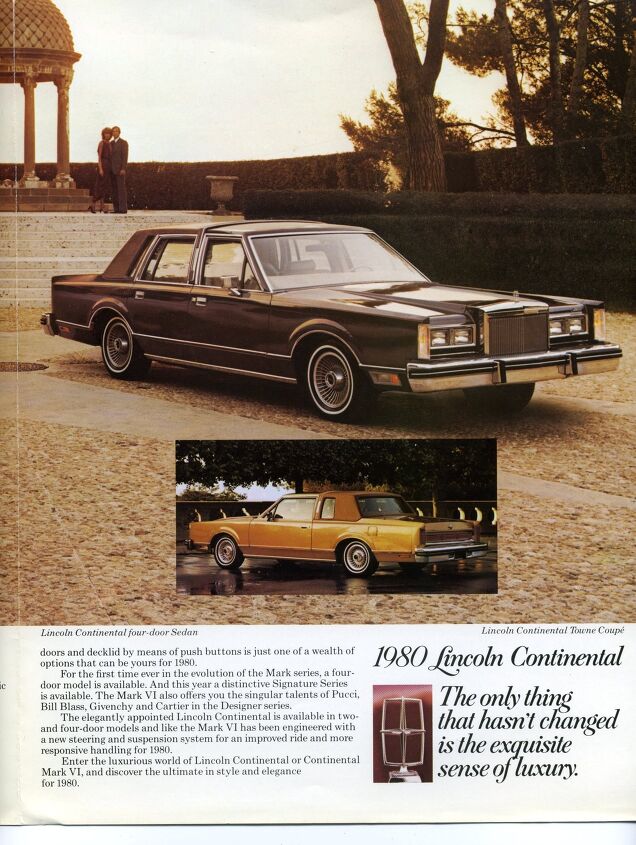
The Panther platform remained in its first iteration through 1991 with only minor revisions and was the only version produced in three different body styles: Two doors as a coupe, a four-door sedan, and a wagon. Those first two versions are where our interests lie today, as the Mark VI branched out into a four-door model and repeated a short sedan dalliance it carried on from 1958 to 1960. Worth a mention, after the Mark moved away from the Panther platform the vehicles that still used it (like the LTD) would continue with two-door models through 1987.
Lincoln’s Panther lineup used two different wheelbase lengths in 1980. As it was body-on-frame Panther’s wheelbase stretched without too much fuss, and it became the platform of choice for most limousine manufacturers in the Eighties. An important and relevant note here: the Ford LTD and Mercury Marquis of 1979 were (for the first time) on the same 114.4-inch wheelbase regardless of body style.
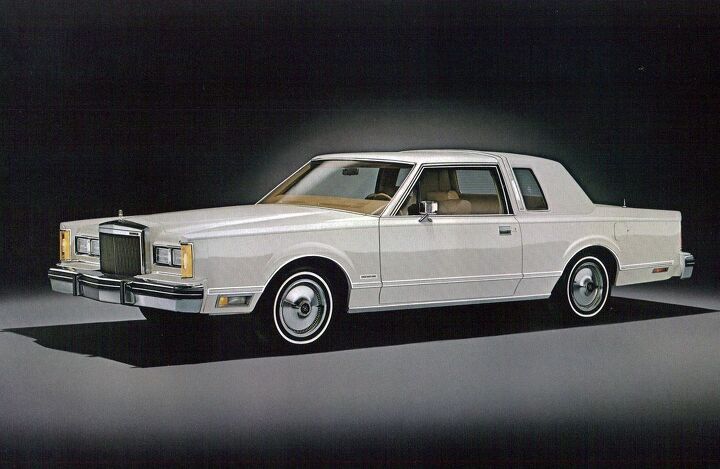
The 114.4-inch wheelbase was also used for the two-door Mark VI, though the Mark did not share bodywork with either the Ford or Mercury. The Continental of 1980 used a longer wheelbase, 117.4 inches, implemented on both its body styles. The four-door Mark VI used the Continental’s 117.4-inch wheelbase and had the exact same dimensions as the Continental sedan.
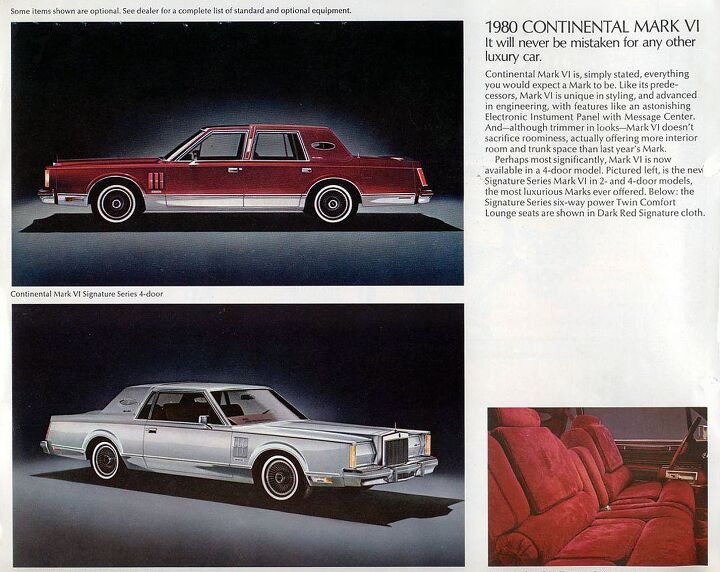
Size comparisons were quite relevant to the Lincoln buyer of 1980, as there was simply less car on sale that year for the same sort of money as the year prior. The Mark V’s 120.4-inch full-size Thunderbird wheelbase shrunk six inches in 1980. Overall length decreased to a greater degree, as the 230.3” Mark V luxury liner became the 216” two-door Mark VI.
There was less width in 1980: Mark VI’s span of 78.1 inches was notably narrower than the 79.7” of the 1979 car. And the “longer, lower” theme of the Seventies was out the window, as an overall height of 52.9 inches in 1979 grew to 55.1 inches on the Mark VI coupe of 1980. The payoff for less everything was better fuel economy and less weight.
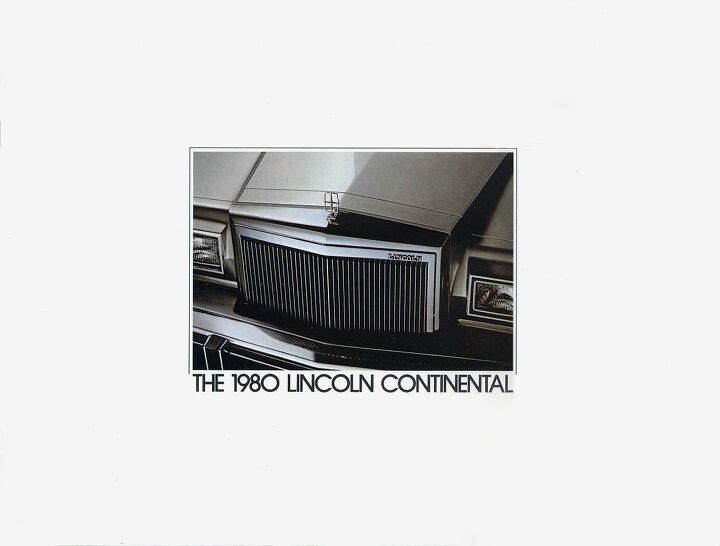
The hefty Mark V weighed between 4,762 and 4,960 pounds, the latter figure if equipped with the proper 460 V8. In 1980 the new Mark VI weighed well under the two-ton mark: 3,892 pounds for a basic coupe, and just 4,219 pounds for a fully-loaded sedan. For a modern comparison, a 2012 Lexus LS 460 weighed 4,244 pounds in rear-drive guise.
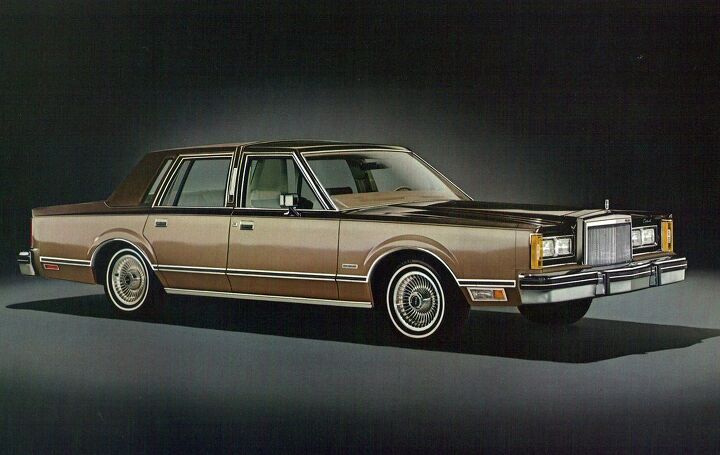
There’s no prior model handy for Mark VI sedan size comparison, but as it was essentially a trim package on the 1980 Continental the two cars shared measurements. Atop the 117.4-inch wheelbase was a 219.2-inch body. The sedan was just over three inches longer than the Mark VI coupe, but both Mark and the 1980 Continental were a shadow of the enormous 233-inch length of the 1979 Continental.
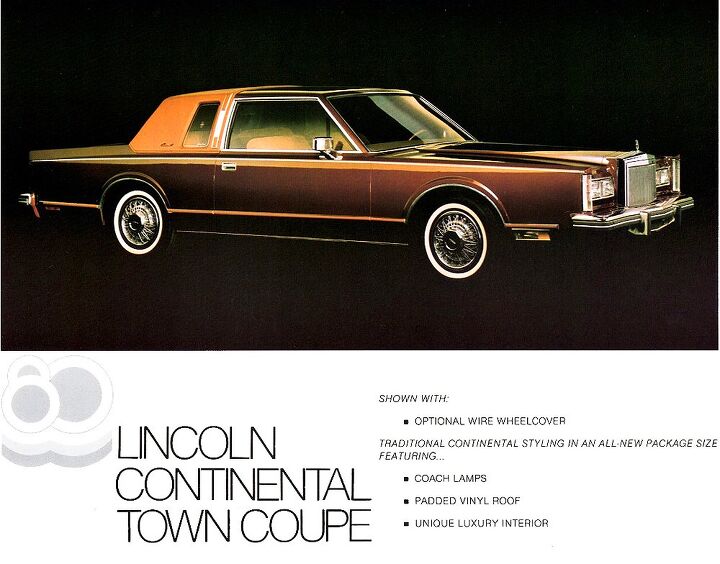
Mark VI and Continental had the same 78.1-inch width in any of their respective formats. Aside from the minor visual differences discussed in our last entry, the Mark VI sedan sat slightly lower to the ground: 55.8 inches versus 56.1” on Continental. In its four-door guise, the Continental weighed about 100 pounds less than the Mark VI due to its lower level of trim.
Even with its new shrunken size, Lincoln expected they’d have a hit on their hands with the Mark VI because of the competition. Staunch rivals like the Cadillac Eldorado had shrunken much more in 1979, as the front-drive E-body migrated to a 114-inch wheelbase. The new Eldorado was 204 inches long and 71.4 inches wide, an entire foot shorter than the Mark VI coupe and nearly 7 inches narrower.
The downsized Cordoba had an even shorter 112.7-inch wheelbase from 1980 and landed in the middle in length at 209 inches. But Cordoba lacked the prestige of the Eldorado or Mark VI. And both competitors had no sedan on offer, which Lee Iacocca felt really mattered to consumers (right as his tenure at Ford came to an end).
Eldorado and Cordoba were also offered with distinctly unluxurious six-cylinder options in addition to the required V8 power. Continental and Mark VI were powered by two different V8s, both from the Windsor small block family. We’re all familiar with the smaller of the two, the 302 cubic-inch Windsor (1966-2001) which Ford branded as 5.0 but was actually a 4.9.
It managed a strangled 140 horsepower in the Mark VI, and 231 lb-ft of torque. But there was a difference underhood: It was the first Ford V8 that included fuel injection! The modern technology was another nod to CAFE compliance, as the US would shift toward the enjoyment and operational ease which was modern electronic fuel injection.
The 351 Windsor V8 was for the more spendy Mark VI buyer, however, its 5.8 liters of displacement made the same 140 horsepower. Though it managed 265 lb-ft of torque, its two-barrel carb and lack of a real advantage over the 302 made it unpopular. It was dropped after 1980 and left the 302 to power the rest of the Mark VI’s run.
In either engine configuration, the only transmission on offer was the exciting and brand-new AOD four-speed. Abandoned history has covered the AOD previously, as it was an offshoot of the MX/FX transmission from the long-running Ford-O-Matic automatic family.
Engineering discussion covered, in our next installment, we’ll discuss the divisive looks of the downsized Mark VI. Touring Lamps, anyone?
Become a TTAC insider. Get the latest news, features, TTAC takes, and everything else that gets to the truth about cars first by subscribing to our newsletter.
[Images: Ford]
Interested in lots of cars and their various historical contexts. Started writing articles for TTAC in late 2016, when my first posts were QOTDs. From there I started a few new series like Rare Rides, Buy/Drive/Burn, Abandoned History, and most recently Rare Rides Icons. Operating from a home base in Cincinnati, Ohio, a relative auto journalist dead zone. Many of my articles are prompted by something I'll see on social media that sparks my interest and causes me to research. Finding articles and information from the early days of the internet and beyond that covers the little details lost to time: trim packages, color and wheel choices, interior fabrics. Beyond those, I'm fascinated by automotive industry experiments, both failures and successes. Lately I've taken an interest in AI, and generating "what if" type images for car models long dead. Reincarnating a modern Toyota Paseo, Lincoln Mark IX, or Isuzu Trooper through a text prompt is fun. Fun to post them on Twitter too, and watch people overreact. To that end, the social media I use most is Twitter, @CoreyLewis86. I also contribute pieces for Forbes Wheels and Forbes Home.
More by Corey Lewis










Comments
Join the conversation
A 4 door Mark. A 2 door Continental. I did not know that.
Nope, not a good review at all, it forgot one hugely important number: how many dead hookers will fit in the trunk? Details matter.