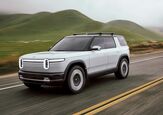


Ford Scaling Back EV Plans, Taking $19.5 Billion Punch


Ford Motor Company is pulling back on its electric-vehicle plans in a move that will cost the company $19.5 billion.
The cited reason for the strategic change is that the company had overestimated demand for EVs and underestimated how long that gasoline and diesel engines would last. Hybrids, too, presumably.
Political realities play a part -- President Donald Trump's administration has killed the EV tax credit and proposed rolling back fuel-economy standards.
We also suspect, though it's not clear, that slow growth of the infrastructure needed to support EVs has played a part. While the amount of public chargers has grown, they are still less ubiquitous than gas stations -- and fast charging an EV still takes longer than refueling a gasoline or hybrid vehicle.
Ford had built a new factory in Tennessee that was slated to produce an EV pickup -- now that plant will build a gas-engine vehicle. A planned EV van for commercial use has been cancelled and Ford will now instead build new ICE and hybrid vehicles in Ohio.
Meanwhile, the F-150 Lightning will no longer be an EV. Instead, the truck will get a gasoline-fueled generator that can charge the battery when it's depleted.
Despite these changes, Ford says it still plans to build a medium-size EV pickup in Kentucky. That truck is expected to have an MSRP around $30K and the platform will able to be used for other types of EVs, according to Ford.
Ford boss Jim Farley says that even with the changes, Ford will be able to compete with high-quality Chinese EVs if and when they go on sale in the States. Right now, tariffs are keeping them at bay, but sooner or later, they'll be on sale in the U.S. Chinese vehicles are gaining market share in other global markets.
From the NYT:
“They don’t know about truck customers in the U.S. We do,” Mr. Farley said in an interview Monday, referring to Chinese automakers.
The changes announced Monday will allow Ford to be more profitable and competitive, he said. The planned medium pickup will help Ford defend against low-cost Chinese models, he added.
“I think this makes our company much more China-proof,” Mr. Farley said.
Ford says that despite the large financial whammy, the company expects to still report a profit of $7 billion before taxes and interest for 2025. Ford will report a loss in the fourth quarter, including most of the $19.5 billion.
Ford still remains optimistic regarding further electrification of its fleet. From a press release:
By 2030, about 50 [percent] of Ford’s global volume will be hybrids, extended-range EVs and electric vehicles, versus 17 [percent] today

Allow me to take off the news reporter hat for a second and put on my analyst/opinion hat. Ford's move shows why some government efforts to get the fleet to be all-EV by 2030 were too optimistic. It also shows why automakers, who require three-to-five years to plan new and redesigned models, like policy stability -- Trump's moves to back fossil fuels over cleaner energy aren't just bad for the environment, but with regulations loosening, Ford may be sensing that its previous EV strategy might've been a money-loser if customers shift back to ICE vehicles.
Or, perhaps, Ford may have made this move even if Trump kept the EV tax credit and rolled with the stricter fuel-economy regs pushed by his predecessor, Joe Biden. That's because, as we've documented ad nauseum on this site, that EV charging infrastructure, while much improved, has yet to match the ease and convenience of refueling an ICE vehicle -- or even a hybrid.
There are also still some consumer concerns, mostly unfounded, about the costs of replacing an EV battery. Most EVs also command high sticker prices.
EVs are improving quickly in terms of range -- and many drive as well as, if not better than, ICE or hybrid vehicles. But until some consumer fears, no matter how unfounded, are better addressed, and until prices come down and charging becomes easier, the market share of EVs will grow slowly as opposed to truly taking off.
And the product-planning aspect cannot be understated. That's why we rolled our eyes at overly-optimistic timelines for a fully EV fleet that were being mandated by government fiat, and also part of why I criticized Trump's rollbacks. I am all for regulations that improve our environment, but at some point realism needs to outstrip political talking points from the left and right. Whether it's leftists pushing for full electrification when the technology isn't ready or right-wingers pulling back on regulations that OEMs had been planning to accommodate, politicians are moving goalposts in a manner that makes it difficult for automakers to plan -- and costs money if and when strategies must be adjusted.
Every automaker has had an electrification plan -- we'll have to see how others adjust to changing policies, technological realities, consumer preference, the Chinese presence, and other factors as time marches on.
[Image: Ford]
Become a TTAC insider. Get the latest news, features, TTAC takes, and everything else that gets to the truth about cars first by subscribing to our newsletter.
Tim Healey grew up around the auto-parts business and has always had a love for cars — his parents joke his first word was “‘Vette”. Despite this, he wanted to pursue a career in sports writing but he ended up falling semi-accidentally into the automotive-journalism industry, first at Consumer Guide Automotive and later at Web2Carz.com. He also worked as an industry analyst at Mintel Group and freelanced for About.com, CarFax, Vehix.com, High Gear Media, Torque News, FutureCar.com, Cars.com, among others, and of course Vertical Scope sites such as AutoGuide.com, Off-Road.com, and HybridCars.com. He’s an urbanite and as such, doesn’t need a daily driver, but if he had one, it would be compact, sporty, and have a manual transmission.
More by Tim Healey









Comments
Join the conversation
Tim, I want to give you credit for your main point, which is solid - governments 'moving the goal posts' makes it nigh-impossible for automakers to plan and run their businesses efficiently.
But you also said this:
"...that EV charging infrastructure, while much improved, has yet to match the ease and convenience of refueling an ICE vehicle -- or even a hybrid."
...which is claptrap if it doesn't acknowledge this "EV infrastructure" includes literally tens of millions of homes, and millions of businesses, at which one can fuel up your EV, 24/7. Unless you have a petroleum cracker in your backyard and a way to do it more efficiently than Chevron, your "fueling infrastructure" is well behind that for EVs unless you are driving more than 150 miles per day.
And before your aim your bricks - we own two gas-powered cars, one diesel-powered vehicle, and one EV. I'm not grinding granola and switchgrass to make artisinal energy.
Ford was losing billions on its ev programs..
Scrapping them will stop the bleeding not cost more as the headline implies.
If the government would stay out of decisions that the market should make goalpost would no longer be a problem.
Let's not go back to those who want to dictate what we want.