


What's The Latest on Toyota’s New Performance Motor?

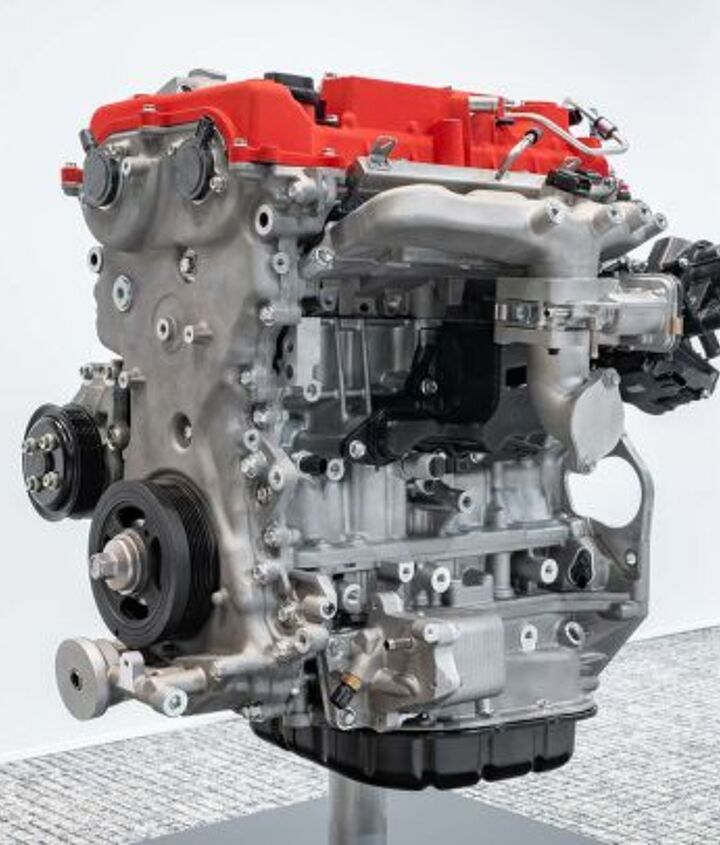
Last year, Toyota announced that it was developing “ new engines tailored to electrification and the pursuit of carbon neutrality” in tandem with Mazda and Subaru. While the units would differ immensely from each other, all of them leverage things like electrification and/or alternative fuel types to maximize the efficiency of internal combustion. However, Toyota has let slip that it was actually eyeballing performance applications and that the 2.0-liter turbo was already being tested for use in GR-branded sports cars before moving to the more mainstream models.
Playing into corporate heritage, Subaru’s unit is supposed to be horizontally opposed and Mazda’s is supposed to be a rotary. Toyota’s will be a pair of inline-fours (2.0 and 1.5-liter) banking on various forms of hybridization to produce oodles of power while still remaining emissions compliant in regions that are becoming increasingly unfriendly to combustion-engine automobiles.
Autocar has reported that the larger motor is already being tested inside the mid-engined GR Yaris M Concept and will eventually migrate over to Gazoo Racing’s production models.
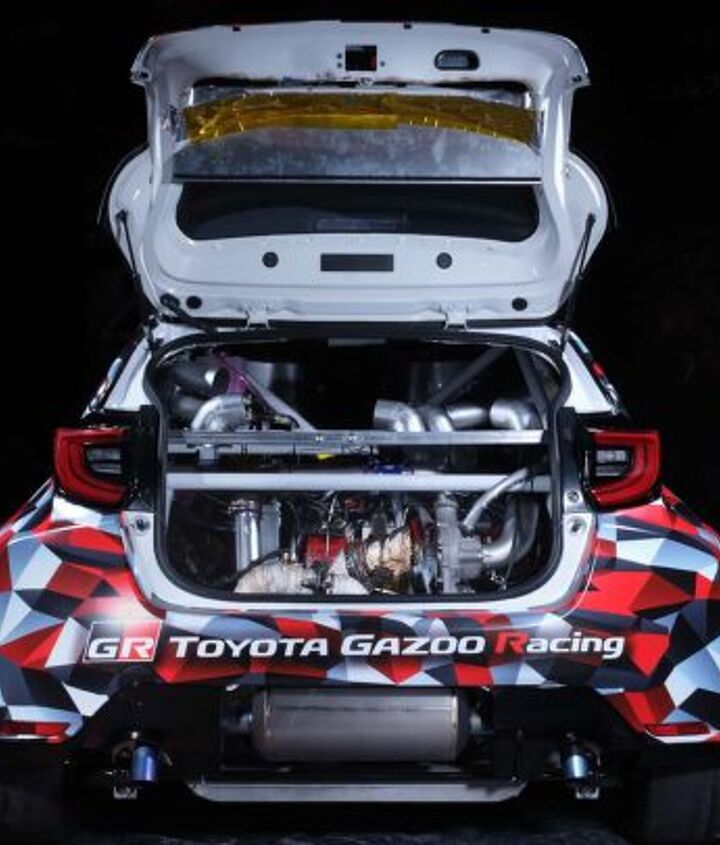
From Autocar:
The new engine can support both plug-in hybrid and mild hybrid set-ups and features a shorter piston stroke than Toyota’s current engines, making it smaller and lighter.
This is important, because a hybrid element can be fitted with minimal weight penalty, suggested Hiroyuki Yamada, a GR engineer working on the project.
He added: “We can use hybrid for future cars [which use this engine]. We will use it in our motorsport activities in the future, because of emissions.
“This technology we create will we apply to both motorsport and passenger [car] engines. In the future, we want a more fuel-efficient engine [for GR cars].”
While we’re not exactly excited about the prospect of increasingly complex powertrains, Toyota has a good track record with hybrids and there are rumors that the resulting vehicles could see as much as 400 horsepower from the 2.0-liter turbo. It likewise sounds like the powertrain won’t always need to be a plug-in, since Toyota made direct mention of mild-hybrid setups that run like normal combustion cars (just with a 48-volt helper motor).

Testing the unit in the GR Yaris has led to loads of speculation that the new engine could come equipped to successive generations of the performance hatchback. This likewise opens the door for it to replace the same 1.6-liter, three-cylinder turbo G16E-GTS fitted to the 300-hp GR Corolla currently sold in North America.
Rumors have suggested that it could also be used for the upcoming Celica sports car and Toyota's assumed successor to the MR2. Gazoo Racing has been a broad success for Toyota and the brand wants to maintain its momentum by releasing more performance vehicles at a point where other manufacturers have started to ignore them.

But it’s not supposed to be limited exclusively to sporting applications and race vehicles. Car recently received confirmation from Bart Eelen, Head of Product Communication for Toyota Europe, that the new motor would eventually start appearing in regular passenger cars. We probably won’t see 400-horsepower RAV4s and Camrys, unless they’re wearing a GR badge. But we could see de-tuned variants of the 2.0-liter turbo making its way into Toyota’s high-volume models in the coming years.
The manufacturer looks to have big plans for these motors, allegedly made easier by their convenient dimensions and adaptability.

“We’re in the process of developing a brand-new family of four-cylinder combustion engines with both 1.5 and 2.0-litre capacities,” stated Matt Harrison, CEO for Toyota Europe. “These engines will feature new technologies and new thinking. For instance, they will have a shorter piston stroke that allows them to be much more compact. That allows us more freedom for our designers and engineers when it comes to packaging.”
“New [internal combustion] engines are pretty rare these days, but we really wanted to do this,” added Eelen. “The block is super compact, and the centre of gravity is super low — and the engine combines both efficiency and performance.”

[Images: Toyota]
Become a TTAC insider. Get the latest news, features, TTAC takes, and everything else that gets to the truth about cars first by subscribing to our newsletter.
Consumer advocate tracking industry trends and regulations. Before joining TTAC, Matt spent a decade working for marketing and research firms based in NYC. Clients included several of the world’s largest automakers, global tire brands, and aftermarket part suppliers. Dissatisfied, he pivoted to writing about cars. Since then, he has become an ardent supporter of the right-to-repair movement, been interviewed about the automotive sector by national broadcasts, participated in a few amateur rallying events, and driven more rental cars than anyone ever should. Handy with a wrench, Matt grew up surrounded by Detroit auto workers and learned to drive by twelve. A contrarian, Matt claims to prefer understeer and motorcycles.
More by Matt Posky








Comments
Join the conversation
Note to car companies. Just copy what Toyota is doing. Few missteps in the last 40 years.
Another 2ish liter turbocharged engine with electric assist….no thanks. I just spent the past few days driving a Jeep Grand Cherokee 4XE…not good at all. Rough power delivery and terrible transition between gas and electric. Once the battery runs out you have to rev the nuts off of the 2.0L mill to get going. What was wrong with electrifying the 3.6 motor?