NTSB, NHTSA Investigating Ford BlueCruise Fatal Crashes
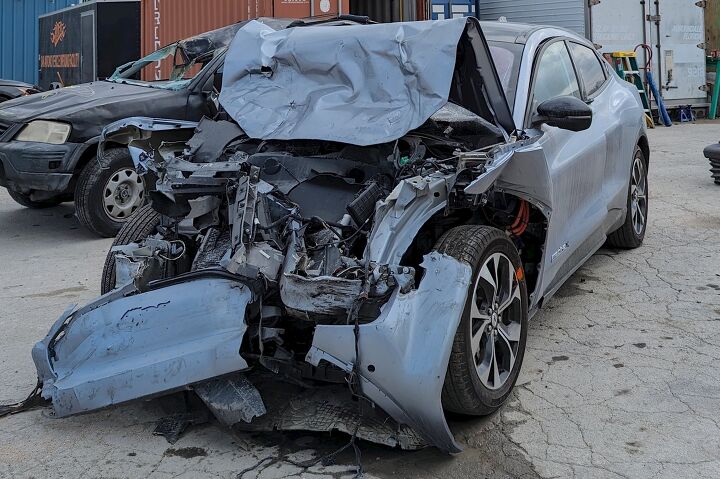
Two crashes involving vehicles using Ford’s semi-autonomous driving technology, BlueCruise, are the subject of a March 31 hearing by the National Transportation Safety Board (NTSB).

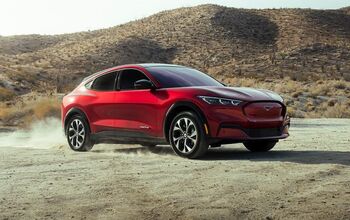
The public board meeting aims to “determine the probable causes” of two crashes. They involve 2022 Ford Mustang Mach-E electric vehicles crashing into stationary vehicles while traveling at highway speeds. The collisions happened in San Antonio and Philadelphia.
Ford officials were unable to respond to TTAC requests for comment before publication.
“During the meeting, NTSB board members will discuss safety issues related to these crashes and vote on the probable causes and safety recommendations designed to prevent similar crashes in the future,” the agency said in a release.
The San Antonio crash happened Feb. 24, 2024 about 9:50 p.m. According to the NTSB report, the 2022 Mustang Mach-E was traveling on Interstate 10 when it hit a stationary 1999 Honda CR-V, causing it to overturn. The 56-year-old driver of the Honda was killed while the Ford driver sustained minor injuries.

“A witness who had been traveling in the center lane of eastbound I-10 in front of the Ford reported that she encountered the stopped Honda in the center lane and that the vehicle’s tail or hazard lights were not illuminated. The witness changed lanes to the right to avoid striking the vehicle and later, in her rearview mirror, saw another vehicle strike the stopped Honda,” according to the case file.
On March 3, 2024, a 2022 Mustang Mach-E was in the left lane on I-95 in Philadelphia and struck the rear of a 2012 Hyundai Elantra, which then hit the rear of a 2006 Toyota Prius. Both were stopped in the travel lane of the freeway. Those vehicles hit a passing Toyota Corolla. The drivers of the two stationary vehicles died while the Corolla driver was unhurt. The Mach-E driver suffered minor injuries.
According to the NTSB report, “The vehicle was equipped with advanced driver assistance systems, including those providing partial automation capabilities that Ford refers to as “BlueCruise.” Vehicle-based data indicated that the vehicle’s 23-year-old driver was using BlueCruise as it approached mile marker 26.8.”

The NTSB isn’t the only federal agency examining these incidents. The National Highway Traffic Safety Administration has an open investigation on 2022 Ford Mustang Mach-E models due to the same to crashes. After a preliminary query, the agency expanded it to cover 2021-2024 Mustang Mach-E SUVs equipped with BlueCruise.
Investigators found there have been 32 crashes and 2,004 “non-crash reports” tied to the technology. They also found that Ford’s Adaptive Cruise Control is designed to “inhibit any response to reported stationary objects when the subject vehicle’s approach speed is at or above 62 mph. Additionally, system performance may be limited when there is poor visibility due to insufficient illumination.” Both crashes being investigated by the NTSB meet those conditions.
[Images: NTSB, Ford]
Become a TTAC insider. Get the latest news, features, TTAC takes, and everything else that gets to the truth about cars first by subscribing to our newsletter.

Michael Strong has spent more than 25 years writing about the automotive industry. A Detroit-area native, he’s written about everything from local car shows to product reviews to financial news. Currently he writes and edits for a variety of national and local publications. He’s also a longtime member of the Automotive Press Association and the International Motor Press Association, and a graduate of Georgia Southern University. Hail Southern! Despite a love for ’70s land yachts and BMWs from the late ’80s and early ’90s, his personal vehicle is neither of those.
More by Michael Strong










Comments
Join the conversation
This reminds me of a question I've never been able to figure out. I'm not passing judgement on the result -- my overly-analytical brain is just trying to compare two events that might not be comparable after all:
These two accidents in this article involve collisions of a stationary vehicle and a second travelling at a high rate of speed. One result of this is news about, and an investgation into BlueCruise, with generally no mention of the design of the vehicles hit.
My brain, for whatever reason, is trying to compare and contrast this with the Ford Panther issues several years back. Everyone seemed to be entirely focused on the *stationary* vehicle in this case, and how the design flaw of (IIRC) a bolt in the differential housing puncturing the gas tank absolutely needed to be mitigated with a retrofitted shield. Notwithstanding the shield At the same time, I don't remember hearing much about the survivability of a rear-end collision by another vehicle moving at, say, 60 mph.
Now let me be clear -- these BlueCruise incidents should absolutely be investigated with a focus on that software. But at the same time, the questions I have are:
Darwinism in action.