
Auto Insurance Rates Leveling Off in 2026, Preserving Last Year’s Price Drop
Vehicle ownership costs encompass more than just the monthly payment. Prices for gas (or electricity), oil, and maintenance all seem to be more expensive nowadays, but Americans are getting a break on one cost in 2026: car insurance.
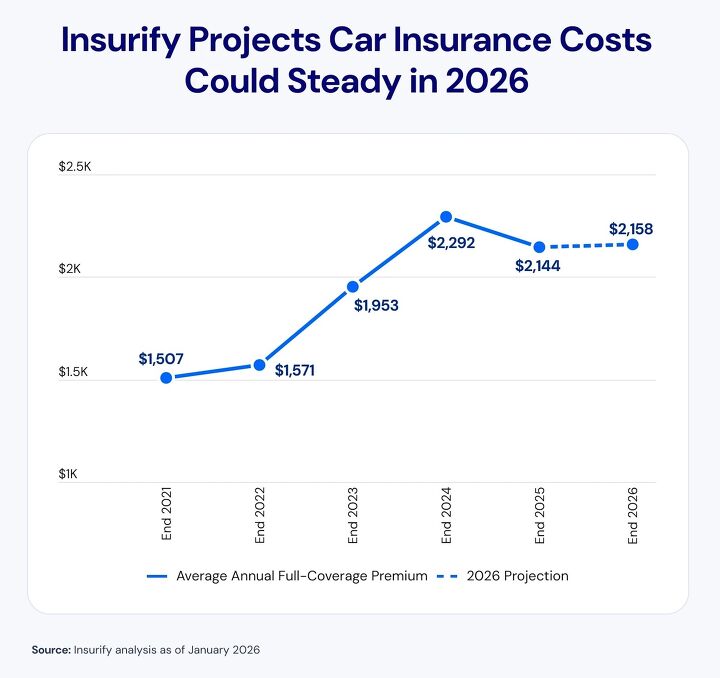
Perhaps the second-highest cost after the payment, insurance has car owners digging into their bank accounts on the regular, and until last year, the annual price for auto insurance has risen, including a massive 14.4 percent jump in 2023, according to the National Association of Insurance Commissioners.
However, a new report from Insurify.com, an insurance website, shows that after a 6 percent dip in 2025, auto insurance prices are expected to remain flat, moving from an average of $2,144 to $2,158 in 2026. It’s a marked change after a 46 percent jump between 2022 and 2024. The premium increased during that time came as part of an effort by companies to protect themselves against a massive increase in risky driving behaviors that escalated during the pandemic.
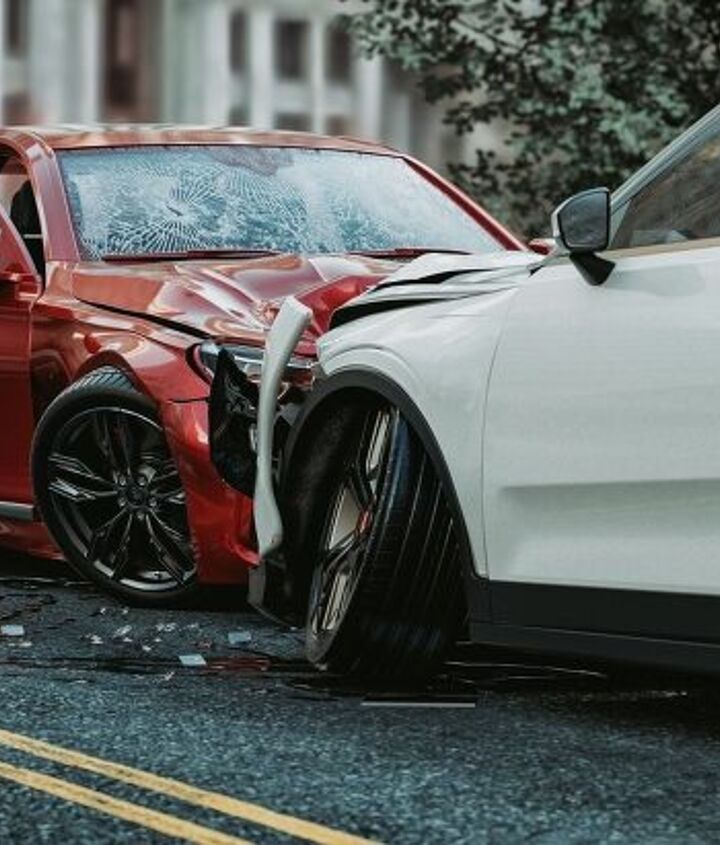
During the second half of 2020 and all of 2021 there were substantially fewer people on the road due to lockdown policies implemented to try to prevent the spread of COVID-19. With more wide-open spaces, the inhibitions of some drivers fell, causing an increase in crashes.
Fast forward to now, and the high premiums have bolstered insurers bottom lines, allowing them to “absorb tariff-driving costs without raising prices. Now many insurers are cutting rates to attract and retain new customers.”
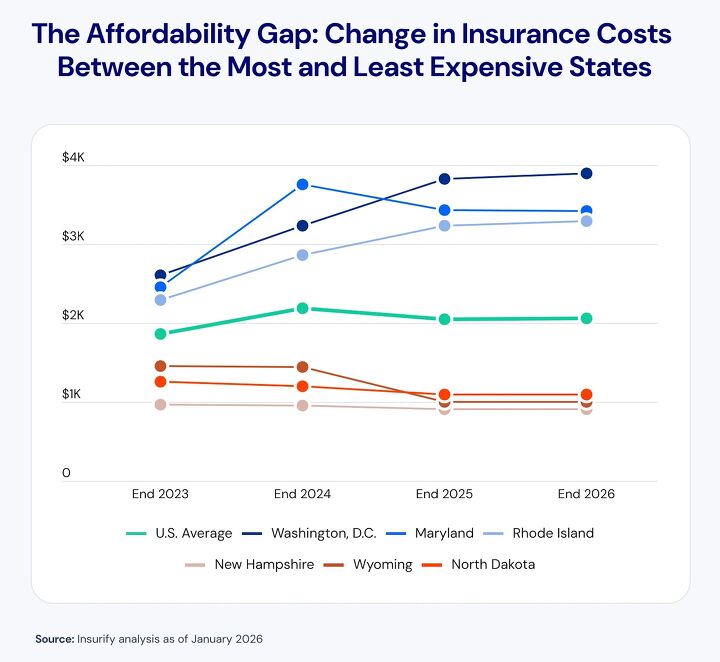
However, not all American drivers are going to see the same benefit as price for car insurance varies wildly from state to state. The upside, according to Insurify, is that you are likely to see some sort of pricing improvement or consistency this year as 39 states posted premium decreases in 2025. Wyoming, Iowa, and Arkansas residents enjoyed the biggest cuts, with prices falling more than 20 percent.
If you live in Washington, D.C., New Jersey, Rhode Island, or Michigan, there is no joy in Mudville today. Premiums in those four spots rose an average of 12 percent last year. Keeping with the averages, those residents paid nearly twice as much ($4,017 vs. $2,144) as the rest of the country in 2025.
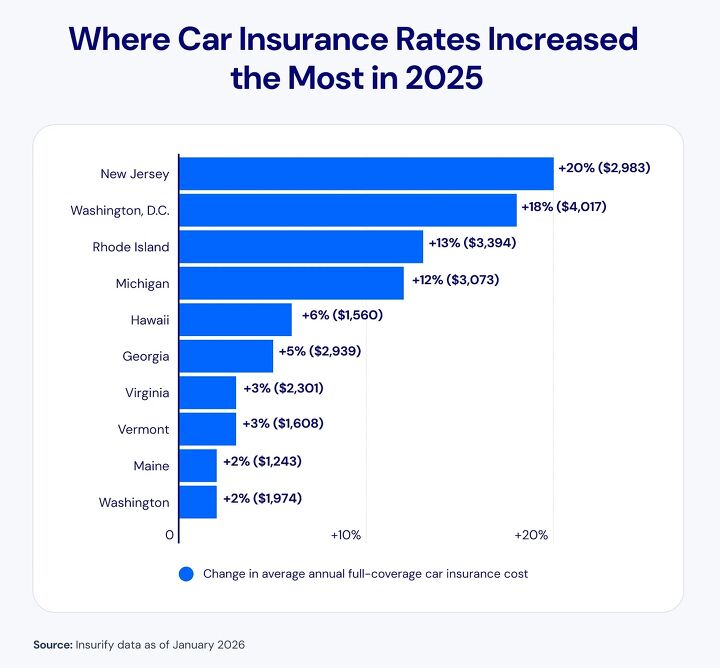
The places with paying the highest average amount in 2026, including any expected increase or decrease include: Washington, D.C. (1.8 percent or $71), Maryland (-0.2 percent or $7 less), Rhode Island (1.7 percent or $56), Michigan (0.2 percent or $6), and New York (0.7 percent or $22). All those states pay more than $3,000 a year annually for auto insurance.
And if you’re looking to cut what you spend on auto insurance each year, look to states with small populations, starting with New Hampshire where the 2026 average is expected to be $957. It’s followed by Wyoming ($1,052), North Dakota ($1,147), Iowa ($1,230), and Idaho ($1,244).
[Images: Shutterstock; Charts: Insurify]
Become a TTAC insider. the latest news, features, TTAC takes, and everything else that gets to the truth about cars first by subscribing to our newsletter.
Michael Strong has spent more than 25 years writing about the automotive industry. A Detroit-area native, he’s written about everything from local car shows to product reviews to financial news. Currently he writes and edits for a variety of national and local publications. He’s also a longtime member of the Automotive Press Association and the International Motor Press Association, and a graduate of Georgia Southern University. Hail Southern! Despite a love for ’70s land yachts and BMWs from the late ’80s and early ’90s, his personal vehicle is neither of those.
More by Michael Strong
Latest Car Reviews
Read moreLatest Product Reviews
Read moreRecent Comments
- Vid169489471 The technology exists today to produce a variable color temperature (kelvin) LED lamp. It can vary from 2700k that soft orange look to 6500k the bright daylight with the bluish tint.Since everything in a late model car is computer controlled, it would be an easy task to write a few lines of code that enables your vehicle to not only dim down from hi to low beam but to shift color temp down to the 2700k range for oncoming traffic, then back up to 5000k once oncoming traffic has passed. For the operator it would be automatic and seamless. For older cars they could be retrofitted with LEDs that are 2700k on low beam and 5000k on hi beam. As far as standards, there could be a lumens max, and a minimum. Several States already have minimum lumen standards going back to the old incandescent bulbs. Why not update these to national standards.
- Jam169859557 More regulation is needed for ALL vehicle lighting systems. [list=1][*]The lighting that is most blinding are the rapidly flashing red, blue and amber lights on emergency vehicles. The lights themselves are blinding, flashing so rapidly that it's impossible for even the sharpest eyes to adjust. What's worse, is the nature of the emergency requires a careful view of the area surrounding the emergency vehicle. There is something going on that needs to be seen. More flashing lights is not the solution.[/*][*]Brighter headlights need to be regulated. The tall riding vehicles do not need headlights positioned so high that they blind drivers in lower riding vehicles. And those heasdlights need to be aimed properly. When I first started driving my 2020 Subaru Outback, many drivers would flash their lights, hoping I would dim my lights. This stopped after I performed am easy adjustment that tilted the beam lower. Late model Subaru headlamps are designed with a sharp cutoff that project less glare above the hood line. When the headlights are properly aimed, other drivers are not blinded by the beam.[/*][*]Customized light assemblies make it more difficult to see the marker lights (tail lamps, turn signals and side marker lamps) that have been tinted. There are many municiple codes that prohibit this tinting, but these laws are seldom enforced.[/*][/list=1]Solutions: Tight controls on emergency vehicle lighting. In trying to make these vehicles more visible, a dangerous side effect is reducing the ability of drivers to see the surrounding perils.Headlight design regulations that reduce the height of the headlight assemblies. Just because a pickup truck has a hood that sits 4 feet abouve the pavement, it does not mean the headlights need to be so high. Owneres should maintain proper adjustments to their vehicle headlights.Establish and enforce regulation requiring a illumination standard be followed.
- Stl170698708 as someone who hates big government, and their interference;but you can add me to the list of people that are blinded by the lights.unfortunately "the poop is out of the horse and no way is it going back in"They have had 5 years to make lights bigger, badder and brighter because in the vehicle work it is go big or go home!Trucks are the worst because so many people use them to express their dominance and that is big, big, big $$ both at the Original Purchase and in the Aftermarket world.If, we are so lucky to get some good government regulation on this it will also take some very good Court enforcement to get the aftermarket people with fines and lawsuits.Much like the EPA did with the Diesel Tuner Industry that felt emission regulations didn't apply to them.This is from someone that owns said pickup truck with the same bright headlights,but i only use the truck when I have too and always turn off the Fog lights when driving in traffic.
- Art65765977 I saw a porsche 911 with the most amazing headlights from behind approaching the Sunshine skyway in Florida. The pattern was 108 degrees across sweeping the road like a broom. My brother and I were amazed. I don't know what it looked like from the front but i am sure it was better than American cars
- Master Baiter This is what happens when you take a chance on a startup auto company. Designing and building cars is hard.
Comments
Join the conversation
I took some of my vehicles off my policy because I was tired of paying for insurance.
I plan to take some of my vehicles off gasoline soon, because I am tired of paying for gasoline.
Alot depends on the type of car. One of the factors for me buying a RAV4 was the lower insurance rate. Yes, it's a granny car, but I live in Louisiana, the litigation capital of the America!!🚗🚗🚗