


The Wave Disc Engine: Spinning Combustion Into the Future
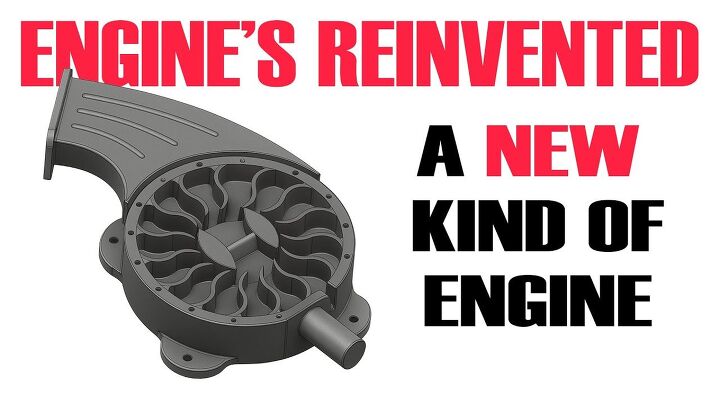
So on this channel we have discussed some weird takes on internal combustion, but the one we will be covering today might just be the weirdest of them all this is the wave disc engine.
And This isn’t just a tweak to pistons or a new trick with valves. This is a complete rethinking of how you can take a lump of hydrocarbon, set it on fire, and turn that into forward motion. Instead of pistons bashing away like angry sewing machines or rotors whizzing about like in a Wankel, the wave disc engine uses shockwaves—actual pressure waves in a spinning disc—to compress and burn fuel. It sounds like something you’d find scribbled on the back of a mental scientists black board, yet the thing not only exists, it’s been built, tested, and it works.
The TTAC Creators Series tells stories and amplifies creators from all corners of the car world, including culture, dealerships, collections, modified builds and more.
A transcript, cleaned up via AI and edited by a staffer, is below.
[Image: YouTube Screenshot]
Become a TTAC insider. Get the latest news, features, TTAC takes, and everything else that gets to the truth about cars first by subscribing to our newsletter.
Transcript:
On this channel, we’ve covered some unusual ideas in internal combustion, but today’s topic may be the most unconventional yet. The wave disc engine isn’t a minor improvement to pistons or a new valve concept. It’s a complete rethinking of how fuel is burned and converted into motion. Instead of pistons moving up and down or a triangular Wankel rotor spinning in a housing, this design uses actual pressure waves inside a spinning disc to compress and burn fuel.
This system has been built, tested, and demonstrated successfully. To understand it, consider how conventional engines work. A piston engine compresses air and fuel by moving pistons inside cylinders. A Wankel engine uses a rotating triangular rotor. The wave disc engine is based on a flat rotating disc with precisely cut channels running outward from the center. As the disc spins, ports open and close in a controlled sequence. Instead of mechanical compression, the engine uses shock waves to compress the air-fuel mixture.
The idea is based on a technology known as a wave rotor, studied for decades as a pressure exchanger for gas turbines. It uses shock waves to perform compression and expansion instead of relying on mechanical components. In a wave disc engine, air enters through an intake port into a rotating channel. As the disc spins, the channel aligns with a combustion chamber, where pressure waves bounce through the passage and compress the mixture in milliseconds. Once compressed, fuel is injected and ignited. Combustion forces exhaust gases out through separate ports, creating a pulse of thrust. With many channels producing pulses hundreds of times per second, the engine delivers continuous power with far fewer moving parts than a traditional engine.
The key challenge is managing the gas dynamics. Timing must be precise. Poor synchronization can cause backflow, misfires, or pressure pulses in the intake. Engineers at Michigan State University, led by Dr. Norbert Müller, spent years refining the geometry of the disc and ports so the pressure waves align correctly. The speed of rotation, shape of the channels, and firing frequency must all match precisely. When optimized, the system achieves extremely high compression ratios without pistons or a crankshaft.
This design is compact and light. A prototype built as a hybrid range-extender reportedly weighed about 20 percent as much as an equivalent piston engine while producing comparable power. It has a small number of moving parts: a rotating disc, a housing, ports, and injectors. That means less maintenance, less lubrication, and reduced frictional losses.
Efficiency is another advantage. Shock-wave compression happens extremely fast, so there is less time for heat to dissipate into the chamber walls. Traditional piston engines lose heat during the slower compression stroke. In contrast, the wave disc performs compression in microseconds, preserving more energy for combustion. Müller’s team estimated thermal efficiency could reach 60 percent, nearly twice that of most piston engines and similar to high-end fuel cells.
Combustion in the wave disc resembles a blend of constant-volume and constant-pressure cycles because compression happens almost instantly. The rapid burn means high power density in a compact space. Since compression is achieved via gas dynamics rather than mechanical force, the engine can operate on many fuels, including gasoline, diesel, ethanol, and hydrogen. Hydrogen is particularly well-suited due to its fast flame speed, which matches the rapid compression process.
Another interesting aspect is the exhaust. Because gases exit in pulses through dedicated channels, some prototypes explored coupling the exhaust to a turbine to recover additional power. In theory, a wave disc engine could produce shaft power while also generating thrust, putting it somewhere between a piston engine and a jet engine.
This is especially appealing as a hybrid range extender. Conventional small engines often run at low, inefficient loads. The wave disc can be designed to run at a constant, highly efficient operating point to generate electricity. This would provide a compact, efficient onboard power source for recharging batteries with significantly lower emissions. Estimates suggested CO2 output could be reduced by up to 90 percent compared to traditional piston engines.
However, major challenges remain. Manufacturing a disc with channels accurate enough for supersonic pressure waves is difficult. Cooling the housing while maintaining tight tolerances is another significant hurdle. Lubrication is also complex without pistons spreading oil around the system. These engineering challenges, combined with limited funding and the industry’s shift toward full electrification, prevented the design from reaching mass production. Research largely stalled more than a decade ago.
The wave disc engine remains a promising but unrealized concept. If perfected, it could offer a combination of low weight, simplicity, high efficiency, and compatibility with cleaner fuels. It had the potential to rewrite expectations for combustion engines with minimal moving parts and exceptional efficiency, but momentum faded before it could reach commercial use.

I am a proud owner of a single turbo 335i and a Ducati 999s. I make a lot of content on both, as well as just sharing my opinion on just about everything car and motorcycle related,
More by Chris VS Cars | TTAC Creator











Comments
Join the conversation
It also appears it will have the same problems as 2-stroke engines. The mixing of intake and exhaust gas together. And mixing lubrication oil with the intake.
Not if you combine it with another sidelined and shelved tech idea that i thought of decades ago that im sure they worked on, magnetic suspension bearings. Rare earth magnets that have poles oppossed in a circular fashion on the sides and outer edge of the disk so that when assembled the disk is suspended between a opposing magnetic sandwich producing a frictionless bearing surface that will further reduce heat and with precision tolerances can still maintain a tight seal but will require the firing order of the veins and balancing to be more than perfect, if done correctly it could make a huge impact on its performance im sure. decades ago a friend had me helping to apply thought to the age old perpetual motion energy idea and that was my thought (well as others if you look at you tube) for an improved bearing surface and also a timed magnetic (or electromagnetic if possible) rotational power source to attempt to provide more power than it consumes, by adjusting magnetic timing and the ability to feather the magnets push/pull causing each magnet to help its neighbor to rotate the disk as a rotor and framework as a stator using windings to generate the theory was once it was started it couldnt be stopped unless a braking mechanism was installed in the outer framework. People have claimed to have built thrm and have videos online but theres no telling if they are real or fake.