

Living In The VW ID. Buzz: Now Halfway Across America
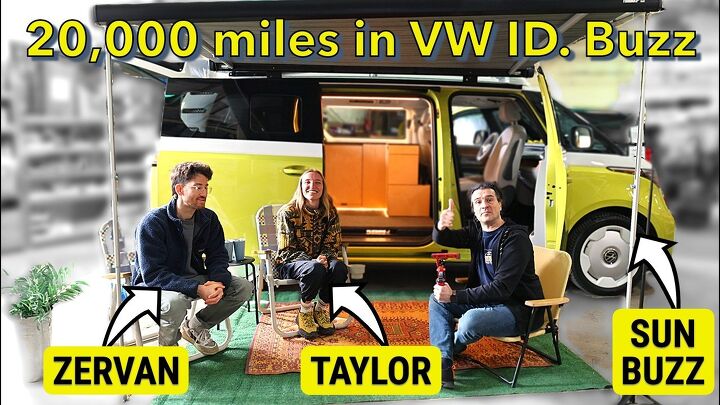
Welcome back to another episode of VW ID Talk! We sit down with Zervan and Taylor, the adventurous duo behind the "Sun Buzz." They are on a mission to travel to the lower 48 states in their VW ID. Buzz, and they are already halfway there.
After 7 months, 25 states, and 20,000 miles, they share why cross-country EV road-tripping is so much easier and more relaxing than you might expect.
We also get an exclusive look at their brand-new, full camper conversion—complete with a pop-top bed, induction stove, running water, and swivel seats that officially turn their Buzz into the ultimate digital nomad tiny home. Plus, they share their top three feature requests for the upcoming 2027 ID. Buzz.
ID.Buzz full camper conversion by @PeaceVans. Filmed in their facility in Seattle.
Check out the VWIDTalk Podcast on YouTube and wherever you get your podcasts ( Apple Podcasts, Spotify, Overdrive and more).
A transcript, cleaned up by AI and edited by a staffer, is below.
The TTAC Creators Series tells stories and amplifies creators from all corners of the car world, including culture, dealerships, collections, modified builds and more.
[Image: YouTube Screenshot]
Become a TTAC insider. Get the latest news, features, TTAC takes, and everything else that gets to the truth about cars first by subscribing to our newsletter.
Transcript:
Host:
Hello and welcome back to the VW ID Talk! This episode is especially exciting—we have three special guests: Zervan, Taylor, and their EV, the ID. Buzz, which they call the “Sun Bus.”
Their vehicle has gone through a rapid transformation, and we’ll show that shortly. They’ve been traveling across the lower 48 states in the ID. Buzz, covering 25 states and 20,000 miles in just seven months.
So—how has the experience been?
Guest:
That’s a great question. Honestly, it’s been super easy. We didn’t really know what to expect going in, especially since we weren’t very familiar with EV infrastructure.
But we haven’t had any major issues. We’ve never run out of charge, and we’ve rarely encountered broken chargers. It’s been a very smooth adventure so far.
We’ve traveled everywhere—from Glacier National Park in rural Montana to parts of North and South Dakota, and even West Virginia. We’ve been really surprised by how easy it is to travel across the U.S. in an EV.
Host:
That’s amazing. Zervan, you mentioned you developed a charging strategy. A lot of people worry about finding places to charge—what’s your approach?
Guest:
Yeah, while fast chargers are great, our favorite option is actually campgrounds.
Most people are used to charging at home, but since we’re always on the road, we use RV hookups. Just like RVs plug into campground الكهرباء, we plug in the Buzz the same way.
We usually charge overnight—sometimes it takes only about six hours to fully charge. It’s basically like charging at home while you sleep.
Host:
That’s a great tip. Were there any range concerns? And what would you recommend to others planning long EV road trips?
Guest:
We think range is a bit overrated.
Of course, very low range wouldn’t work for road trips, but the ID. Buzz gets around 180–200 miles on the highway, which is totally fine for us.
We typically drive for about 2 to 2.5 hours, then stop to charge for 20 minutes—which lines up perfectly with taking a break, getting food, or using the restroom.
It actually makes road trips more relaxing. We love the rhythm of driving and charging.
For example, during our seven-month trip, we usually drove about five hours a day. That meant one fast charge, then arriving at a destination where we’d stay for a couple of days and explore.
But once, we drove from the East Coast to the West Coast in just three days—about 10 hours per day. That was honestly one of the worst experiences because we couldn’t enjoy the journey.
If your goal is just to get from point A to point B as fast as possible, that’s not enjoyable. The journey is the goal. There’s so much to see across the U.S.—why rush?
Host:
Absolutely. And with travel assist, the driving experience is even easier, right?
Guest:
Yes! You can set the speed, keep the car in the lane, and just relax. Combined with the spacious interior and huge windshield, it feels almost like driving a bus—in a good way.
It’s incredibly comfortable for long distances.
Camper Conversion
Host:
Let’s take a look inside. You’ve done a full camper conversion, including a pop-top?
Guest:
Yes—and it’s a game changer. We’re planning to live in it full-time.
One of the biggest changes is that we can now stand inside. That alone makes a huge difference.
We also have:
A pop-top bed
A full kitchen with an induction stove
A refrigerator (we used to rely on a cooler)
A sink with running water
Host:
That’s incredible. And the seating converts as well?
Guest:
Yes, everything is modular. The seating converts into a bed, and there’s a table so one person can work while the other relaxes.
Before, we just had an air mattress. Now we have a proper bed and couch—it completely changes how we travel.
Host:
Do you plan to sleep upstairs or downstairs?
Guest:
It depends. When we’re stealth camping in cities, we’ll likely keep the pop-top closed. But at campgrounds, we’ll open it and sleep upstairs.
It’s cooler, has better airflow, and gives more space.
Host:
And the awning?
Guest:
That adds a lot of living space. We can set up chairs outside and create a comfortable outdoor area. Since we’ll be living in the van full-time, it’s a huge upgrade.
Host:
It’s basically a tiny home on wheels.
Guest:
Exactly! Compared to our first setup—a small kitchen box and mattress—this feels like luxury.
Features & Improvements
Host:
If you could suggest improvements for the 2027 ID. Buzz, what would they be?
Guest:
Number one: a proper camp mode.
Right now, you can sort of hack it, but it’s not efficient. A dedicated mode that manages heating and cooling overnight while conserving battery would be a huge improvement.
Second: more range. While we’re fine with the current range, many people want 400–500 miles like newer EVs.
Third: software improvements. The current system works, but it could be more advanced and user-friendly.
Host:
What about fun features?
Guest:
We love the seasonal themes—like Christmas or summer animations—and little Easter eggs, like tracking how far you’ve driven compared to landmarks like the Nile River.
More features like that would be great, along with more functional infotainment options.
What’s Next?
Host:
What’s next for your journey?
Guest:
Right now, we’re in Seattle. Next, we’ll drive down to California to pick up our belongings.
Then we’ll head through:
The Southwest
The South
Florida
Up the East Coast to Maine
We still have 23 states left, so we’ll be covering a lot of ground. Maybe even Alaska after finishing the lower 48.
Host:
That’s amazing. Thanks so much for joining us—we wish you many happy EV adventures!
Guest:
Thank you!
Host:
And thank you for watching—don’t forget to subscribe!

Driven by ID owners, the VWIDTalk Podcast is operated by VW ID owners for VW ID owners, sharing best practices, tips, tricks, and mods in engaging, multi-participant discussions on everything to do with Volkswagen's lineup of electric vehicles. Dive deep, stay positive, and most importantly, enjoy the ride. Hosts: VWIDTalk.com moderators and ID.4 owners Jan Kalis and Wes Garrison
More by VWIDTalk Podcast, TTAC Creator









Comments
Join the conversation
"We love the rhythm of driving and charging."
And for the low percent of drivers who this works for, that's fine, but charging to 80% with a minivan, driving 180 miles tops and stopping again to charge to 80% is muy loco for most of us for road trips.
An electrifying adventure.
Will VW resume production of the ID Buzz?