

Abandoned History: Daewoo Motors, GM's Passport to International Sales (Part IV)

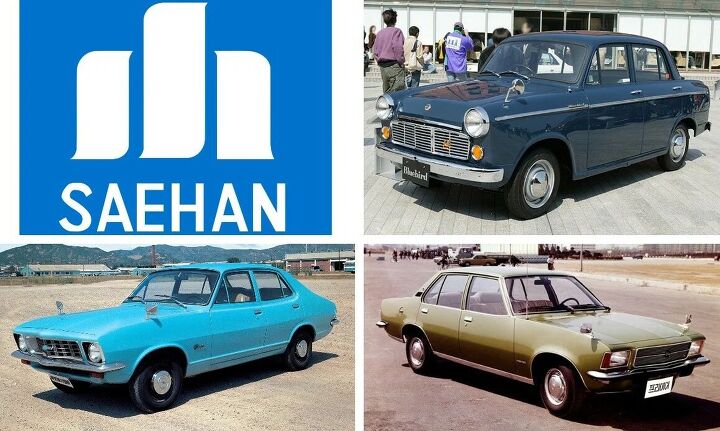
We return to Abandoned History’s coverage of the twists and turns of the Daewoo story, at a time when the company’s predecessor, Shinjin, was no more. After an early Seventies joint venture with General Motors saw the company renamed to General Motors Korea, Shinjin bowed out of the deal after just five years. In 1976 Shinjin’s ownership in the business was sold to a state-owned Korean bank, and General Motors Korea was renamed to Saehan Motor Company. But that didn’t mean GM was out of the picture - far from it.
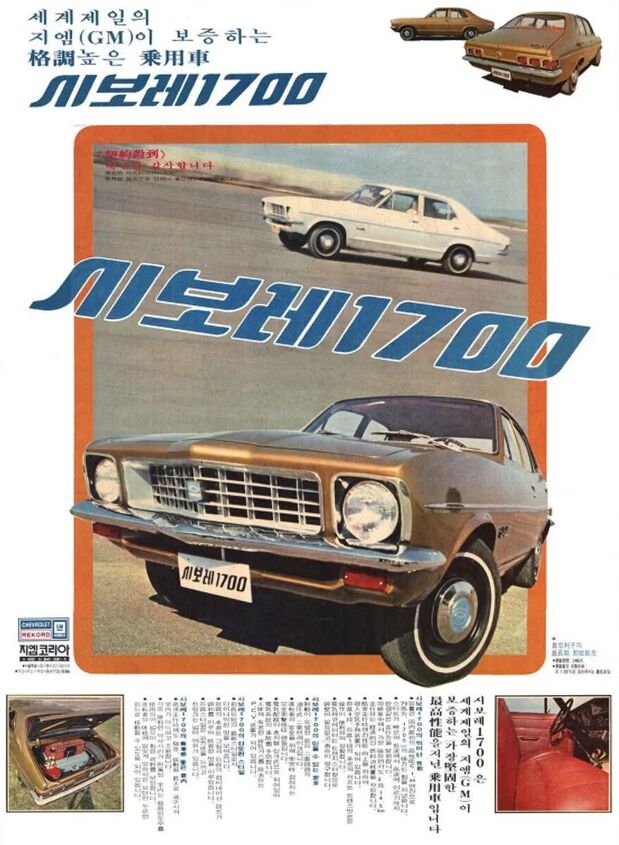
As we learned previously, the cars GM Korea sold were GM’s various international wares from Europe and Australia, lightly rebadged for Korean market usage. The cars were not suitable for Korean consumers and sold poorly. Behind the scenes, GM didn’t exactly mesh well with Shinjin management.
In fact, it was General Motors who asked the Korean government to step in and arrange for a new business partner in the joint venture. Contact was made through the U.S. embassy in Seoul. Shinjin was not well off financially anyway, and the Korean government was always happy to interfere in private business. The new arrangement with a national bank would surely be more hands-off and ease the management conflict GM experienced with Shinjin.
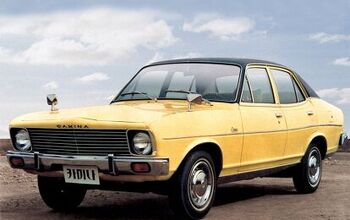
With their new level of control over the day-to-day operations, GM decided to improve its situation in Korea by changing fairly slowly. Continued from the GMK days was the Camina, or as Australians knew it, the Holden Torana. Originally called the Chevrolet 1700 under GMK distribution, it was lightly revised and received a smaller engine in 1976 when it was rebranded to Camina.
Immediately after the name change, the Camina became a Saehan Camina. Its smaller 1.5-liter engine was less thirsty than the Chevrolet 1700, but the car was otherwise the same. It’s indicated the 1700 nobody wanted remained on sale alongside the Camina for its final three years on the market. It turned out nobody wanted the Camina either, and only 992 examples were sold in total between GMK and Saehan.
Saehan took the opportunity to step further away from the 1700’s failure by rebranding the wagon variant as the Saehan Caravan. Presumably, the larger engine was more appealing to the more upmarket family wagon segment of the market: Saehan managed to sell 966 Caravans in about three years.
The 1700 and Camina continued on sale through 1978 and fared poorly against the more Korean-focused competition from the domestic Hyundai and Kia. The Caravan persisted until early 1979, at which point GM decided it was time for a replacement of all three models. Overall, there was not much of a draw for the Korean consumer to purchase a domestically-made car that was a leftover from what GM offered in other countries.
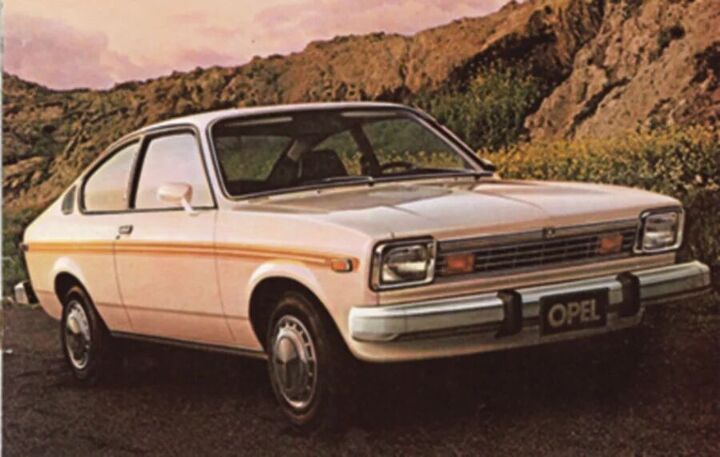
Saehan tried again in 1977 with its first new product since GMK’s launch in 1972. Called the Saehan Gemini, it was a light rework of the European market take on the Isuzu Gemini that debuted in 1974. The Gemini was an interesting product worthy of its own Rare Rides Icons coverage. Rear-drive and subcompact, the Gemini was based on the GM T-body platform. The T was GM’s first attempt at a unibody subcompact to be sold in most world markets, and you’d know it as the platform underneath the Chevette.
After its first couple years, the Gemini stood as the only affordable passenger car offered by Saehan. It was built in two-door coupe and four-door sedan formats and was powered by a gasoline 1.5-liter inline four good for 73 horsepower. Crucially, the Gemini’s engine was not built domestically but was imported from Europe. That meant one of its key components was built with foreign labor and subject to taxation, which made the Gemini expensive versus its competition.
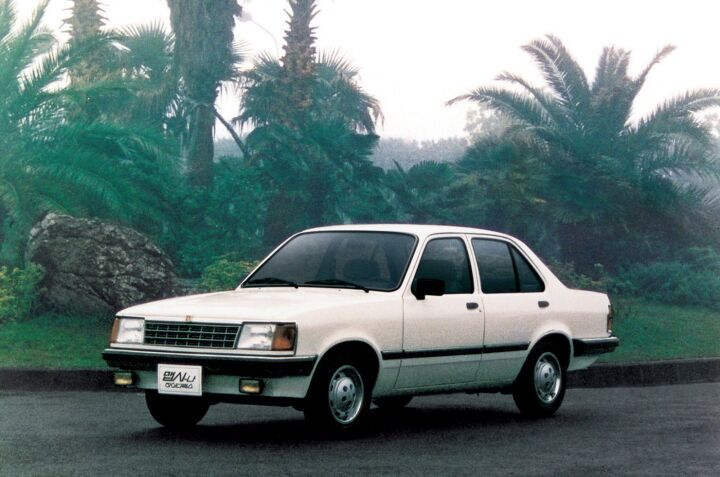
Rather than use Isuzu styling, GM sold Koreans a trim rework of the Opel Kadett C. Said Kadett C was also rebadged for the UK market as the Vauxhall Chevette. For Saehan purposes, the Gemini was a more successful product and became the first of GM’s Korean wares that were exported to other markets (places where GM didn’t already sell a version of the T). For export use, the Gemini was badged as a Bird, for whatever reason.
Even though it was expensive, the Gemini had a claim to fame in the Korean market: It was the only compact car available with an automatic transmission. The Gemini was very successful in the Korean market for a couple of years but fell from popularity as Hyundai’s first mass-produced car stormed the market. It was of course the Giugiaro-designed and Mitsubishi-powered Pony. But the Gemini was not down for long, as we’ll learn in our next installment.
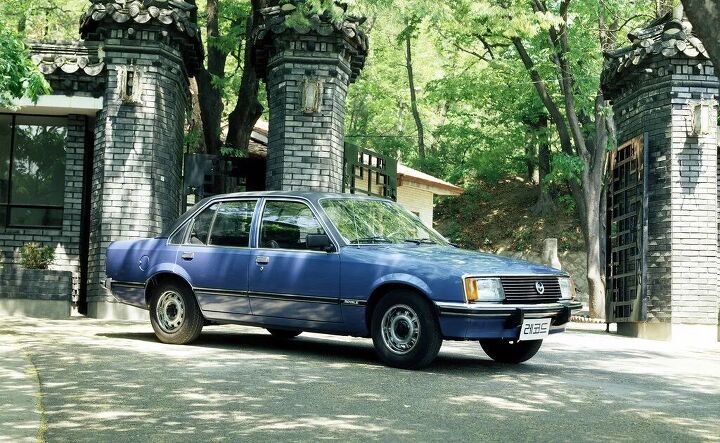
At the high end of the market was the old GMK Rekord, and its high-trim sibling the Rekord Royale. Both cars were based on the European Opel Rekord D, which GMK introduced to Korea in 1972 as the 1900. In 1975 GMK started to import the more upscale Commodore B as well and called it the Rekord Royale. Though it was the same car underneath, the Royale had nicer trim and was slightly longer at the front.
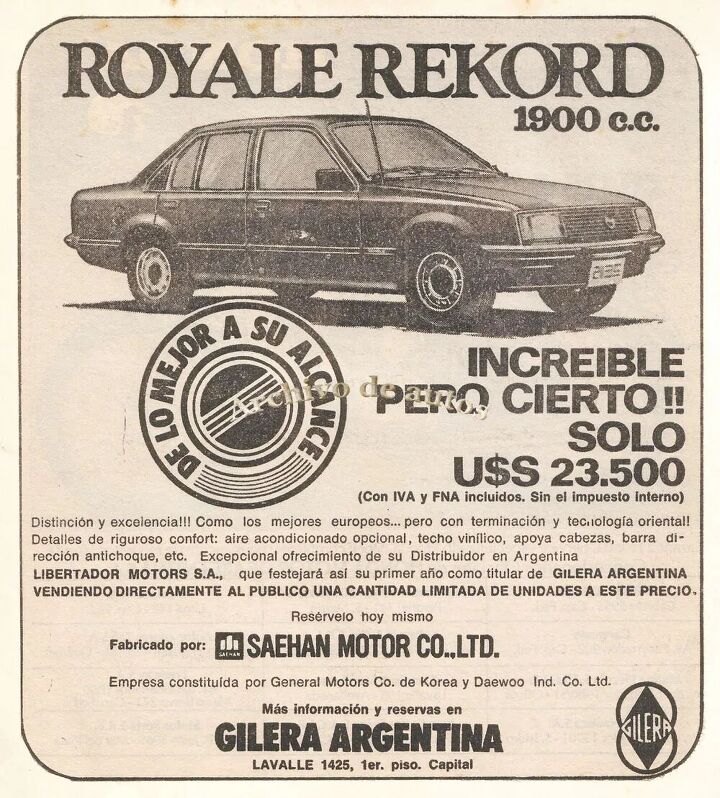
Both names changed in 1976 when they were newly marketed as Saehan vehicles. However, the simple two-model executive car lineup was short-lived. The underlying Rekord D concluded its international production in 1977, after a successful run of over a million cars. Naturally, Rekord D was replaced by Rekord E. In Korea, the Saehan Rekord remained in its old format part way through 1978.
At that point, the new Rekord E arrived, wearing the expected grille and badge swap. However, the lineup was revised, as the E was marketed as the Saehan Rekord, and Saehan Royale. In export markets, the old Rekord Royale combination name was still used.
The company attempted to differentiate the base model from the upscale version, but in reality, the only differences were some trim. Additionally, the Royale had the more formal front clip from the Opel Senator A. There was a new line of Royale trims circa 1980, as the Royale matured into the Royale Series. That meant there was an additional badge on the back of a customer’s Royale Diesel, Royale Salon, or Royale Automatic. Rekords and Royales were also delivered with foreign engines, built in Germany by Opel. But that was less of a pricing issue at the higher end of the market.
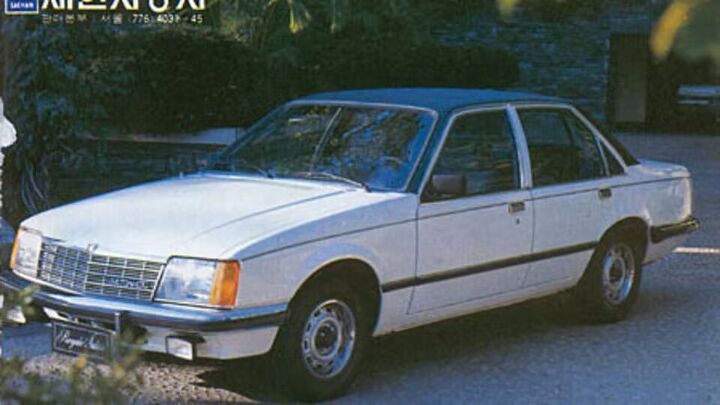
Engines were of 1.5-, 1.9-, or 2.0-liter displacements, with unimpressive horsepower figures of 60, 85, and 102, respectively. The smallest engine was a notable one, as it was used for Korean export only: Opel had not used that 1.5 in a new car since the 1970 Rekord C. Despite German engines, the Rekord and Royale used body panels from the Australian-built Holden versions of the Opels.
With the Rekord/Royale as an established luxury car in South Korea and the Gemini serving the lower-middle consumer, it seemed Saehan was finally getting established as a bit player in the market. However, things were not settled for more than a few months.
While the Gemini and Rekord models were brand new at Saehan, there were changes occurring at Saehan HQ. Namely, a conglomerate called Daewoo had its eye on breaking into the automotive sector. We’ll pick it up there next time.
[Images: Saehan, Opel]
Become a TTAC insider. Get the latest news, features, TTAC takes, and everything else that gets to the truth about cars first by subscribing to our newsletter.
Interested in lots of cars and their various historical contexts. Started writing articles for TTAC in late 2016, when my first posts were QOTDs. From there I started a few new series like Rare Rides, Buy/Drive/Burn, Abandoned History, and most recently Rare Rides Icons. Operating from a home base in Cincinnati, Ohio, a relative auto journalist dead zone. Many of my articles are prompted by something I'll see on social media that sparks my interest and causes me to research. Finding articles and information from the early days of the internet and beyond that covers the little details lost to time: trim packages, color and wheel choices, interior fabrics. Beyond those, I'm fascinated by automotive industry experiments, both failures and successes. Lately I've taken an interest in AI, and generating "what if" type images for car models long dead. Reincarnating a modern Toyota Paseo, Lincoln Mark IX, or Isuzu Trooper through a text prompt is fun. Fun to post them on Twitter too, and watch people overreact. To that end, the social media I use most is Twitter, @CoreyLewis86. I also contribute pieces for Forbes Wheels and Forbes Home.
More by Corey Lewis










Comments
Join the conversation
Nice overhangs.
I have gradually come to appreciate the global ubiquity of the T-platform.