

Junkyard Find: 1981 Buick LeSabre Estate Wagon
The last time we saw a Detroit station wagon in this series was nearly a year ago, when we admired a Chevy Vega Kammback. How about properly imposing American wagons with rear-wheel-drive and V8 engines? Would you believe our most recent one was an LTD Country Squire in 2016?

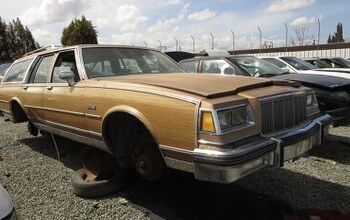
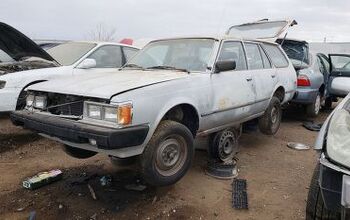
Since we need to correct that wagon deficit in dramatic fashion, here's a discarded example of one of the most prestigious Detroit station wagons available in the United States during the Late Malaise Era: a 1981 Buick LeSabre Estate.

The MSRP on this car started at $9,926, which comes to about $35,845 in 2024 dollars. The only new American-made station wagon that cost more as a 1981 model (not counting coachbuilt stuff or whatever edge-case wagon-ish machinery you're already getting angry about) was the even bigger Buick Electra Estate Wagon and its $12,092 price tag ($43,667 after inflation). If you wanted your neighbors to envy the cost of your Michigan-grade wagon in 1981, Buick was your best bet!

Not the Ford LTD Country Squire ($8,774) nor its Mercury Marquis Colony Park sibling ($9,434). Not the Oldsmobile Custom Cruiser ($9,028) nor Pontiac Bonneville Safari ($9,687) and of course not the Chevrolet Caprice Classic wagon ($8,362). Chrysler and American Motors were no longer players in the big wagon game by 1981, though there were diminished-expectations LeBaron and Concord wagons in showrooms that year.

If you were an import-loving type of questionable loyalties a short year after the U.S. Olympic Hockey Team had defeated the evil Russian Bear, a new Mercedes-Benz 300 TD wagon listed at $31,373, Volvo priced its top 240 wagon at $15,325 and Toyota was asking $11,249 for a Cressida wagon that year.

It was 105°F at the Sacramento-area car graveyard in which I found this car, so I didn't shoot as many photos as I'd have liked of this car's 160°F interior. I'd already shot cars at two nearly-as-hot Nevada locations earlier that day.

Just look at that big comfy bench seat, with the classy faux stitching on its genuine vinyl upholstery.

These wagons were hard to beat for long-road-trip comfort with the whole family. The interior in this one is in great shape.

The fake wood on the dash is reasonably convincing for the era.

I couldn't get the hood latch open (a very common problem with GM cars of this era), but the build tag tells us that the original engine was the base Oldsmobile 307-cubic-inch V8 with four-barrel computer Quadrajet carburetor. Assembly took place at Fairfax Assembly in Kansas, where B-25s were built during World War II.

It's possible that this car only traversed 22,442 miles during its life, but my guess is that it's a well-cared-for 122,442-mile car.

There was no need for me to pull this beautiful dash clock for my hoard collection, because I already own one.

You'd think a car this costly would have had air conditioning and a radio as base equipment, but such was not the case with the 1981 LeSabre Estate. The A/C cost $625 and the AM/FM stereo was $178 ($2,257 and $643 in today's money). For a mere $432 ($1,560 now), you could listen to cassette tapes in your new LeSabre Estate (for the optional AM/FM/cassette/CB combination, you had to start with the Electra Estate).
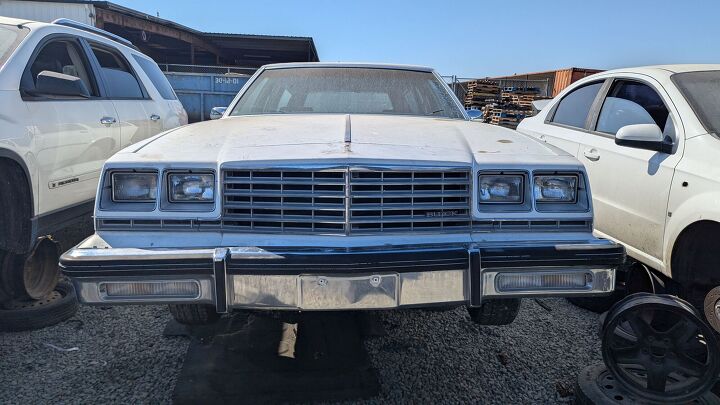
The final year for the LeSabre wagon was 1985, though its Chevy Caprice Classic sibling remained in production all the way through 1990. The Buick Roadmaster Estate revived the big Buick wagon for 1991 through 1996, and that was the final chapter for U.S.-market Buick station wagons of any sort.

1981 Buick LeSabre Estate Wagon in California wrecking yard.

1981 Buick LeSabre Estate Wagon in California wrecking yard.

1981 Buick LeSabre Estate Wagon in California wrecking yard.

1981 Buick LeSabre Estate Wagon in California wrecking yard.

1981 Buick LeSabre Estate Wagon in California wrecking yard.

1981 Buick LeSabre Estate Wagon in California wrecking yard.

1981 Buick LeSabre Estate Wagon in California wrecking yard.

1981 Buick LeSabre Estate Wagon in California wrecking yard.
This generation (1977-1985) of GM B-Body was smaller than its predecessor, but sales were good.
[Images: The Author]
Become a TTAC insider. Get the latest news, features, TTAC takes, and everything else that gets to the truth about cars first by subscribing to our newsletter.

Murilee Martin is the pen name of Phil Greden, a writer who has lived in Minnesota, California, Georgia and (now) Colorado. He has toiled at copywriting, technical writing, junkmail writing, fiction writing and now automotive writing. He has owned many terrible vehicles and some good ones. He spends a great deal of time in self-service junkyards. These days, he writes for publications including Autoweek, Hagerty and The Truth About Cars.
More by Murilee Martin







Comments
Join the conversation
My father-in-law had a series of these back in the 70's and 80's. They were really good at rusting.
My dad had a '79 Custom Cruiser not too far off from this.
The full size crossover equivalent of these now is probably 25% more expensive in real dollars but has more content