

Rare Rides: The Wallyscar Brand, From Tunisia With Pride

Today’s topic is an automaker you’ve likely never heard of. It’s a small company that was founded not that long ago, offers vehicles in very limited markets, and produces around 600 vehicles per year. Its product is based upon old ideas from other manufacturers, all done up in fiberglass until very recently. Let’s enter the wonderful world of Wallyscar.
Your author was alerted to this little-known brand on Twitter. I’d posted a picture of the Kia Pride van, looking lovely in blue with its whitewall tires. A well-informed Twitter person let me know the Fiesta/Pride lived on in a new identity as the Wallyscar 619! I had to edit the pending Festiva post for accuracy, as I’d previously claimed its production came to an end in 2020. Then I set about some additional research into the 619 and Wallyscar.
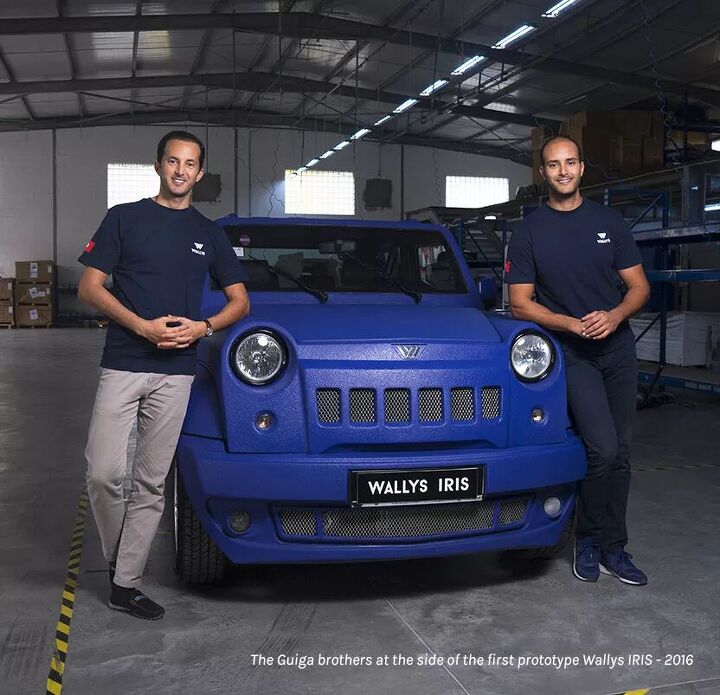
Ideas for the company that would become Wallyscar (Wallys for short) blended together in 2005. A random meeting occurred on the islands of Wallis and Futuna, between Zied Guiga, his brother Omar, and a man named René Boesch. Boesch used to build Jeeps in some capacity, but the Internet seems unclear on what it was. The three joined forces and founded Wallyscar in 2006. Its headquarters are in the city of Ben Arous, in northeastern Tunisia.
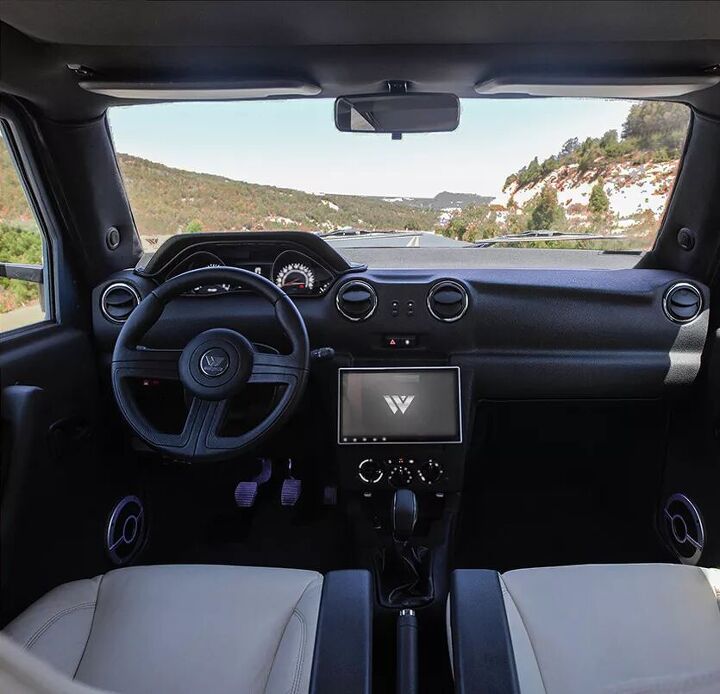
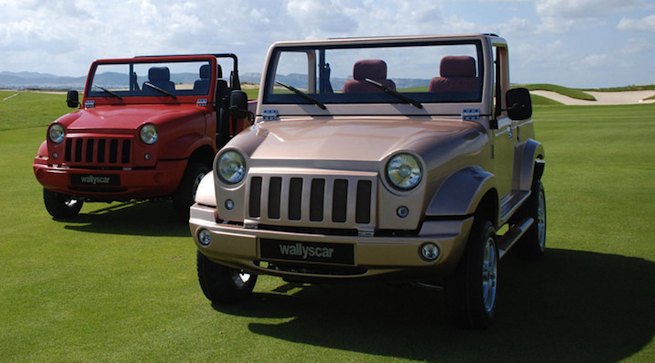
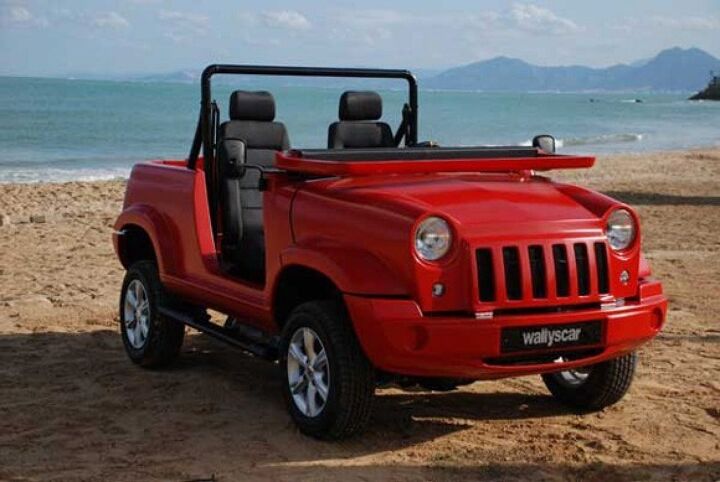
The new company’s first vehicle was the IZIS, which debuted at the Paris Motor Show in 2008. It was a small off-road Jeep-type vehicle with two doors, that looked a lot like an old Jeep Liberty at the front. However, a lawyer might disagree with said assertion, because the IZIS had six slats in the grille, whereas Jeep had seven. Similarly, the name Wallys drew no inspiration from Willys Jeep. So there.
Wallyscar follows four main ideals behind its vehicles: Small exterior dimensions, economy and robustness, retro-modern styling, and great reliability. For its debut product, the IZIS used a fiberglass body designed by Tunisian design firm HH design.
Wallyscar partnered generally with PSA, German electrical system supplier VDO, and tech/component testing firm UTAC for a complete set of components. Thus, the tiny Jeep-like IZIS was considered a knockdown kit (CKD) vehicle. It was available with or without doors, and the roof was also optional. The engine and interior were sourced from the manufacturers listed above. In particular, the engine came directly from Peugeot: IZIS was powered by a 1.4-liter PSA engine, good for 74 horsepower. Because of the kit nature of the IZIS there were about 100 different colors available, as well as a range of interior trim, power features, and even different steering wheels.
IZIS went on sale in the limited markets of Tunisia, Morocco, France, and Panama. Wallyscar insisted on compliance with European levels of safety and claims today that all its models are built to the highest safety standard. To that end, the IZIS received a two-star NCAP rating (out of five).
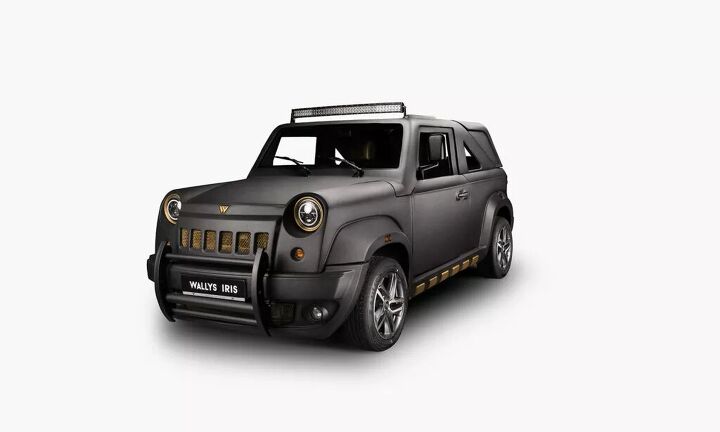
https://www.wallyscar.com/wp-content/uploads/2020/09/Withoutlogo1-2-1_preview.mp4Production of the IRIS started in March 2017 with a price of 35,900 dinars, or $11,782 USD. Wallys maintains the IRIS is carefully hand-assembled and gives the customer many choices in paint colors and interior components. Devoted to local production, 57 percent of parts used in Wallys cars are made locally in Tunisia.
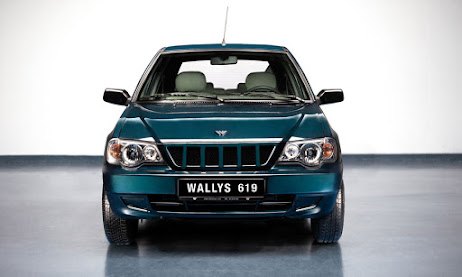
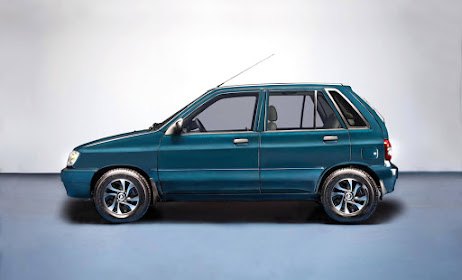
The Wallys lineup expanded in April of 2021 when the company started production of a new five-door hatchback. Well, new isn’t the right word generally, more new to them. When Iranian manufacturer SAIPA finished building its various hatch, wagon, and truck versions of the Kia Pride, it sold the tooling onto a new home: Wallys. Wallys began construction of its first metal-bodied car shortly thereafter, as the 619. The car was announced on their Facebook page but curiously did not make it onto the Wallys official site.
The absence of publicity may be because the 619 is not of Wallys’ own design, or perhaps because it is undoubtedly sourced (at least for now) from parts that are not locally assembled. There are a couple of publicity photos from Wallys as seen here. The Pride bones underneath the more modern front and rear fascia are obvious.
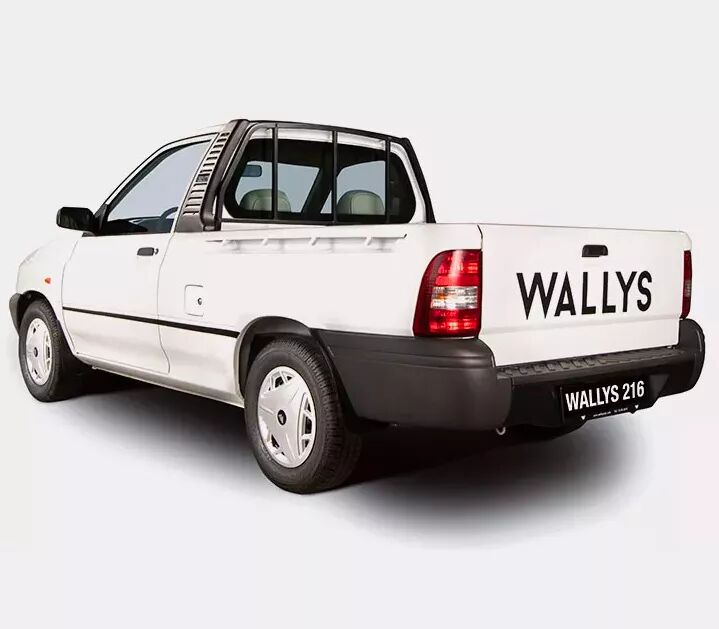
https://www.wallyscar.com/wp-content/uploads/2022/03/OPT-website-bg-14s-2-1.mp4Also obvious is the basis of the other vehicle Wallys began producing last year. Called the 216, the company’s new and economical pickup truck is none other than the discontinued SAIPA 151. The 151 was SAIPA’s eventual translation of the Pride five-door into a pickup. The 216 is also available with a sort of extended bed cap, as a panel truck.
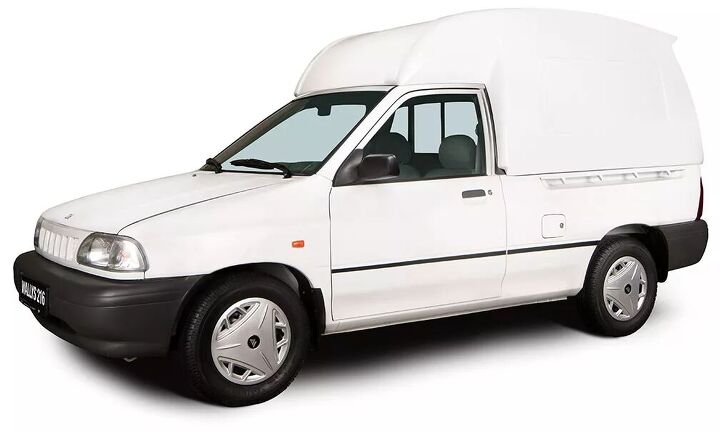
Wallys offers the same 1.3-liter PSA engine it has always used in all its three models, as well as dual airbags. The pickup is currently listed on a pre-order basis for a base price of 29,900 dinar, or just $9,812 USD.
With one of its own creations on sale and two versions of the Festiva/Pride, we’ll see just how long Wallys can keep on building a little Mazda hatchback from 1986.
[Images: Wallyscar]
Interested in lots of cars and their various historical contexts. Started writing articles for TTAC in late 2016, when my first posts were QOTDs. From there I started a few new series like Rare Rides, Buy/Drive/Burn, Abandoned History, and most recently Rare Rides Icons. Operating from a home base in Cincinnati, Ohio, a relative auto journalist dead zone. Many of my articles are prompted by something I'll see on social media that sparks my interest and causes me to research. Finding articles and information from the early days of the internet and beyond that covers the little details lost to time: trim packages, color and wheel choices, interior fabrics. Beyond those, I'm fascinated by automotive industry experiments, both failures and successes. Lately I've taken an interest in AI, and generating "what if" type images for car models long dead. Reincarnating a modern Toyota Paseo, Lincoln Mark IX, or Isuzu Trooper through a text prompt is fun. Fun to post them on Twitter too, and watch people overreact. To that end, the social media I use most is Twitter, @CoreyLewis86. I also contribute pieces for Forbes Wheels and Forbes Home.
More by Corey Lewis








Comments
Join the conversation
New and used car prices keep staying high like this, you can bet, assuming these can meet federal standards, that brands/cars like this will be making their way across the ocean. I'm still trying to figure out why my eyes are having a tough time with the interior picture - grossly undersized steering wheel or really high instrument panel? And every low-cost car company must use those same part number circular air vents and covers. Buy 'em cheap by the gross!
Interesting. Never heard of this one, and it looks competent compared to the average British kit car of yore, usually the brainchild of some complete wally. So they'd never sell it in Blighty simply because of the name. If you are a wally, well, you're a complete twit. The Brits have so many great names to insult other people with:git, wanker, tosser, wally, slapper and several dozen more. It's like Nova in Spanish meaning it's not going and thus a fine name for a car, ahem, There are several other cases of unintended consequences in translation, like the Phukme truck from North Korea.