
Rare Rides Icons: The History of Kia's Larger and Full-size Sedans (Part I)

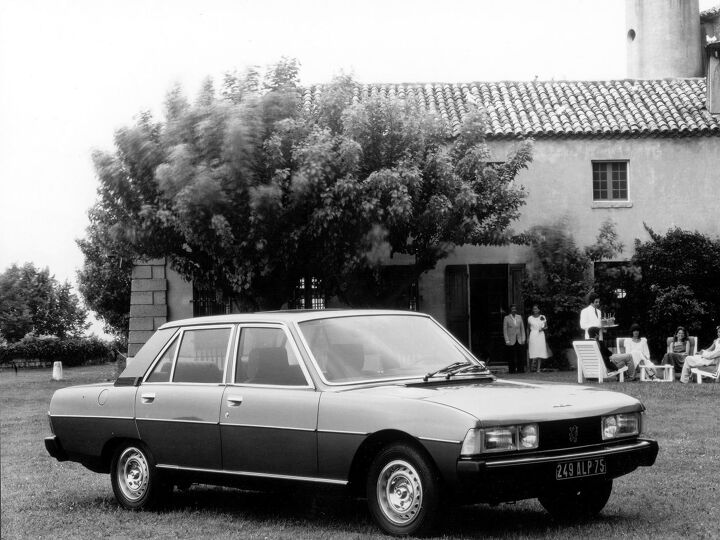
I got to thinking about one particular big old Kia from the late Nineties the other day, and upon searching it on The Internet, I realized the Korean manufacturer had a much longer history with large cars than I’d thought previously. Given most of them were (or are) off-limits to the North American market, it might be time for a history lesson. We begin today with Kia’s first large car. It’s one you’ve probably heard of, because it was a Peugeot.
Before we get all French, a quick rundown of Kia’s history is in order. Founded in June of 1944, Kyungsung Precision Industry started as a manufacturer of bicycle components and steel tubing. It remained in parts supplier mode through the Forties and didn’t produce anything with wheels until 1951. It was then that Kia put all the parts it manufactured together and created the first Korean-made bicycle, the Samchully.
The company’s full name was difficult to paint onto a bicycle and hard to remember, so the company rebranded itself to Kia Industries in 1952. Seeing success with their bicycle, the firm expanded to motorcycles in 1957. Its first powered vehicles were small motorcycles licensed from Honda, but once the company got a taste of internal combustion it was off and running.
Kia’s first four-wheeled vehicles were licensed trucks from Mazda. That relationship started in 1962, and the two companies remained cozy for quite some time. More on that later.
Circa 1970 Kia got into the Italian car game as well and produced a licensed version of the Fiat 124. One of any number of licensed variants of that particular Fiat, it lasted in Korean production through 1975. That was a year after Fiat canceled 124 production.
In the early Seventies, Kia needed a place to build all the Mazdas, so the company constructed its first automotive plant in 1973. Originally called the Sohari Plant, the factory is now called Autoland Gwangmyeong. Placed outside Seoul, today the busy factory builds the Kia Carnival, Rio, Stinger, Stonic, K9, and K900.
The factory was notable at the time as the producer of Korea’s first internal combustion engine. A year after it opened, Kia produced the first car to wear its branding and called it the Brisa. It was another Mazda underneath (a Familia), lightly reworked by Kia.
Though the company had production of its own car, Kia wanted to fill out its lineup a bit. And like it had in 1970, Kia turned to Europe to license a couple of cars. The midsize it selected was the Fiat 132 (1972-1981) which Kia built and sold at its dealerships from 1979 to 1981. That same year, it also started building the largest sedan from Peugeot.
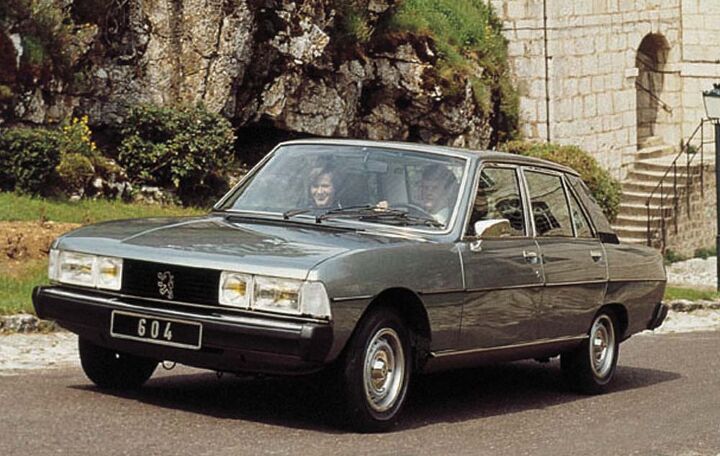
It was of course the 604. The first true executive car to come from Peugeot since the heydays of the Thirties, the boxy and Pininfarina-designed sedan entered French production in 1975 after a debut at the Geneva Motor Show earlier in the year. The new and luxurious 604 was based on the practical 504, shared its doors and part of its floor pan, and was built using the same general ideas as its smaller sibling. It was available only as a sedan, as was suitable for the executive car buyer.
The 604 was solid and stout in the (at the time) Peugeot tradition. Rear-wheel drive, engines were six-cylinder if filled with gasoline, and inline-four if diesel. Unfortunately, both gasoline engines were of the PRV engine family, in displacements of 2.7 and 2.8 liters. Diesel mills were Peugeot-Citroen units from their XD engine range, in 2.3- and 2.5-liter displacements. Both had a turbocharger.
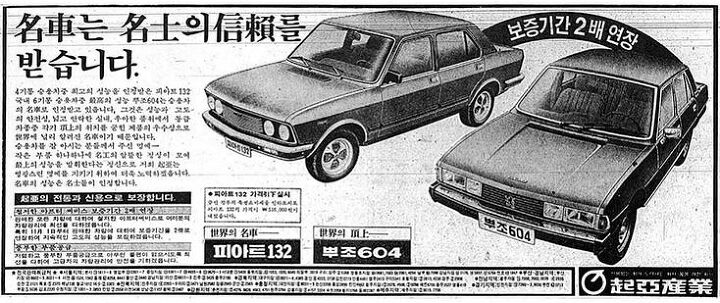
Though it was on sale through 1985, the 604 was considered a big failure. It was reliable enough, drove nicely, was spacious and comfortable, and was ignored for worse executive contemporaries like the Rover SD1. After its 10-year run, Peugeot moved just 153,252 examples. In contrast, PSA’s other new executive car, the Citroën CX, sold in much greater numbers: almost 1.2 million.
But Kia needed a large car for its lineup and turned to Peugeot for the first and only time in the company’s history. In 1979, the 604 joined the Fiat 132 at the Sohari Plant. On license, Kia imported knockdown kits (CKDs) and assembled the 604 with care. While the number of Fiat 132s assembled is counted at 4,759, the number of 604s built is not known. The 604 would’ve been a very rare and expensive car at the time, when most South Koreans did not own cars. It might’ve been difficult to get serviced when the PRV V6 went sour, too.
The 132 and 604 existed in Kia’s lineup for just three years, as production halted in 1981. The reason was a very specific one: Army general turned dictator Chun Doo-hwan (1931-2021) increased his power after becoming the company’s de facto ruler late in 1979. Chun orchestrated a military coup in May 1980 and then pursued many awful dictatorial actions. Among them was a forced consolidation of Korea’s burgeoning automotive industry. The commandment handed to Kia was that it could build only light trucks and vans. Said instruction lasted through 1986, and during that time the company’s only vehicle was the Bongo in its various guises.
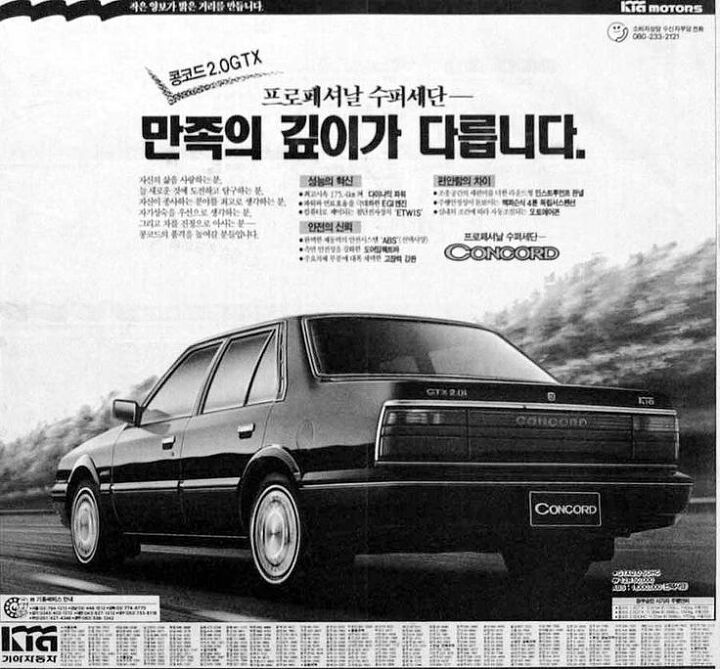
As democracy returned to South Korea during 1987, Kia cozied up to a friend of Mazda: Ford. It was then the production of the Pride began, which you’d know as the Mazda 121 or perhaps the Ford Festiva. The 121’s extensive history is worth a full Rare Rides Icons entry. Then Kia entered the midsize class in 1987 with the Concord, before it ever offered a compact car.
The Concord was a GC generation Mazda Capella underneath, which you’d call the 626. Said Mazda was also sold as the Ford Telstar in some markets. Mazda sold its GC platform off to Kia after the successful mid-sizer finished its 1982-1987 run. All examples of the Concord used inline-four Mazda engines, built in Korea. The first Concords shipped with only one engine, a 2.0-liter carbureted mill good for 99 horsepower.
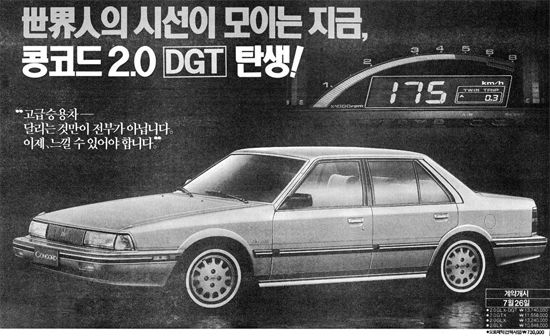
Concord was considered an upscale car and looked a bit different from the Mazda upon which it was based. Though the body shape was the same, Kia added their own front and rear clips. The main competition for the Concord was its domestic arch-rival: The rear-drive Hyundai Sonata.
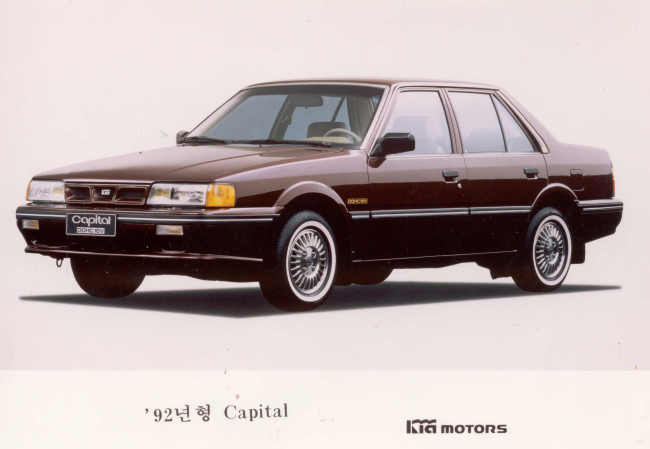
To cater to the lower end of the midsize market, the Capital was introduced in 1989. Based on the Concord but with cheaper looking trim and smaller engines, the Capital used 1.5-liter power with 80 horses at introduction. Both cars were refreshed in 1991 for the ’92 model year, and became the “New Concord” and “New Capital.”
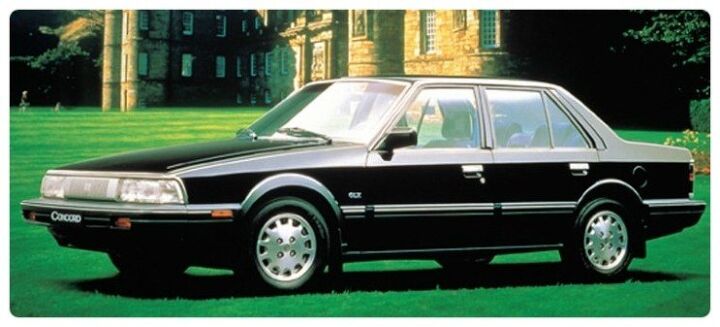
The Concord and Capital lived a very long time on their early Eighties platform at Kia. Capital continued on through 1996 and was replaced by the first Sephia, on sale since 1992. The more expensive Concord was replaced by the Credos, the first midsize Kia designed on its own (again based on a Mazda 626).
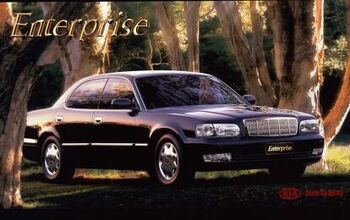
Kia proved to itself that it could sell an upscale car to the home market with the Concord, and at the same time it debuted the New Concord it expanded to its first full-size luxury car. You can probably guess what it was based upon. Next time we’ll talk Potentia.
[Images: Peugeot, Kia]
Interested in lots of cars and their various historical contexts. Started writing articles for TTAC in late 2016, when my first posts were QOTDs. From there I started a few new series like Rare Rides, Buy/Drive/Burn, Abandoned History, and most recently Rare Rides Icons. Operating from a home base in Cincinnati, Ohio, a relative auto journalist dead zone. Many of my articles are prompted by something I'll see on social media that sparks my interest and causes me to research. Finding articles and information from the early days of the internet and beyond that covers the little details lost to time: trim packages, color and wheel choices, interior fabrics. Beyond those, I'm fascinated by automotive industry experiments, both failures and successes. Lately I've taken an interest in AI, and generating "what if" type images for car models long dead. Reincarnating a modern Toyota Paseo, Lincoln Mark IX, or Isuzu Trooper through a text prompt is fun. Fun to post them on Twitter too, and watch people overreact. To that end, the social media I use most is Twitter, @CoreyLewis86. I also contribute pieces for Forbes Wheels and Forbes Home.
More by Corey Lewis







Comments
Join the conversation
I wonder if the early Kias also had problems with excessive oil consumption, spontaneous fires, seizing engines, detaching seat belts and inflated MPG ratings?
You forgot about the Mercury Sable sold by Kia dealerships in South Korea. This is the link for the South Korean advertisement for the Mercury Sable https://m.blog.naver.com/bf101/221138376304