
Abandoned History: Dodge's Dead Import Trucks (Part II)

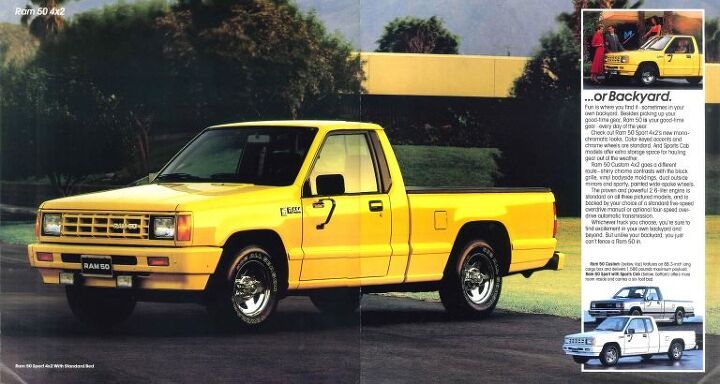
Dodge’s import truck story began in 1979, when the Mitsubishi Forte (or L200) arrived on North American shores, rebadged as the Dodge D-50 and Plymouth Arrow. A captive import like the Colt, the durable Dodge D-50 (later Ram 50) proved itself a solid entrant into the compact pickup truck market. What proved unpopular was the Plymouth Arrow, which did not make it past its initial 1979-1982 outing. The Ram 50 was refreshed in 1982 but was certainly due for replacement in 1987 when the second generation arrived.
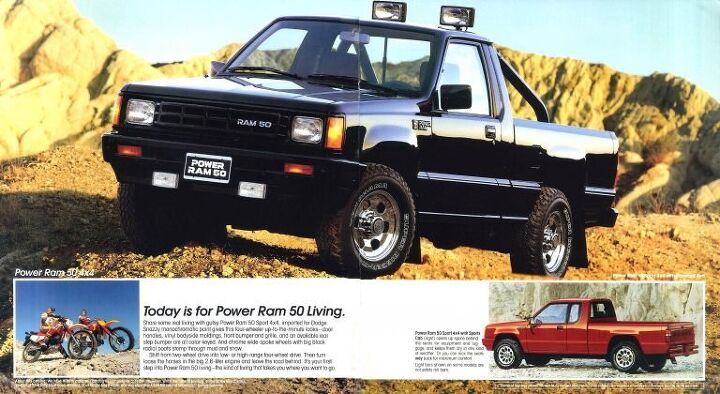
Most of the world received the second-gen Mitsubishi compact truck in 1986, but it took an additional year to be converted to a Dodge. Mitsubishi found a successful formula with its first Forte (or L200) and honed it in the second generation. Sticking to the same basic principles as before, the truck adopted the K platform nomenclature it would keep permanently. Its various guises were coded as K00, K10, K20 and K30 (today it’s KJ and KL.)
Interestingly, the new second-gen truck wasn’t available in its home market for some time. The Forte branding was quickly forgotten, to be used decades later by Kia. Additional identities included Colt in South Africa, Cyclone in Thailand, and Strada in South America and other markets. Though the first generation saw production in three countries, the second was even more international: The trucks were produced in factories across five nations. Japanese production was supplemented by Thailand, Portugal, the Philippines, and Brazil. The truck returned as an offering in Japan in 1991, where it wore the Strada name used elsewhere. The Strada trademark is now a property of Fiat.
As with its debut generation, there were six different engines used in the Triton dependent upon the market. The smallest power arrived via a 2.0-liter G63B inline-four that was used in the Colt Vista when it debuted in North America in 1983. Next up was the 2.4-liter 4G64, which eventually found its way to the Eclipse in 1996. Top-spec inline-four power was courtesy of a carryover, the 2.6-liter 4G54, an engine available to Mitsubishi and Chrysler customers in the US from 1982 through about 1989.
For the first time, the Triton received optional V6 power. It was the 3.0-liter 6G72 that’s been mentioned in more Rare Rides articles than one can count. Its first availability was in 1988 generally, but not until 1990 for the Ram 50. Its final usage was last year as the curtain closed on the Pajero. Worth noting, the V6 was available only on four-wheel-drive models. The V6 was likely a concession to the American market, which always wanted more cylinders in its small trucks (and vans) than elsewhere.
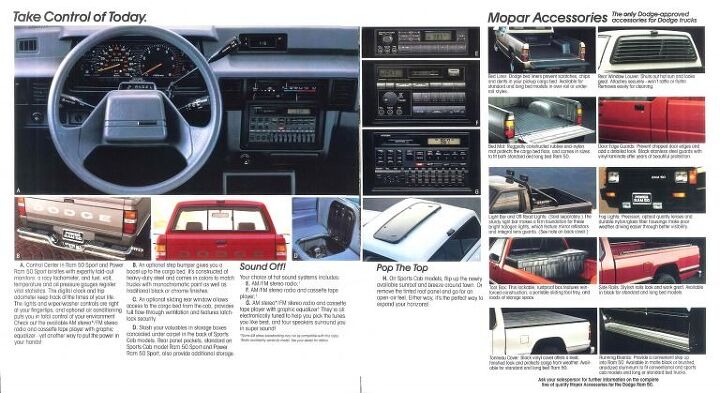
Mitsubishi began adding comfort and luxury options to its truck in this generation, which meant Chrysler didn’t have to work so hard on its own to increase margins. Around the world, markets began to expect more from small pickups. Early in its life, the Triton was largely an exercise of utility, but that changed over the years as the truck grew more option-laden and comfortable, and gained the six-cylinder engine. Speaking of which, the V6 was not well-liked internationally. It was much less efficient than the diesel engine option and produced less power.
The engine lineup was filled out by those aforementioned diesels, both were 2.5-liters this time and were available with or without a turbocharger. The truck’s second-generation had two different transmissions, a five-speed manual or a four-speed automatic. And since an auto came from the factory, it meant Chrysler didn’t have to implant a TorqueFlite into its imports.
Mitsubishi consolidated its wheelbases in the second generation Triton, down to two: The smallest was for short bed models at 105.5 inches, while the other option had a 116.1-inch wheelbase. The longer chassis was for two-door, long-bed models, and the newly available extended cab and four-door.
Overall length grew in the Triton’s second generation, with the expansion of bed length and cab combinations. The standard cab short bed was 177.2 inches long, and the extended cab short bed versions were in the middle at 188.2 inches. The extended cab with the long bed was 193.7 inches overall. Other dimensions stayed about the same as they were before, with four-wheel drive models always slightly wider and taller than their two-wheel-drive counterparts.
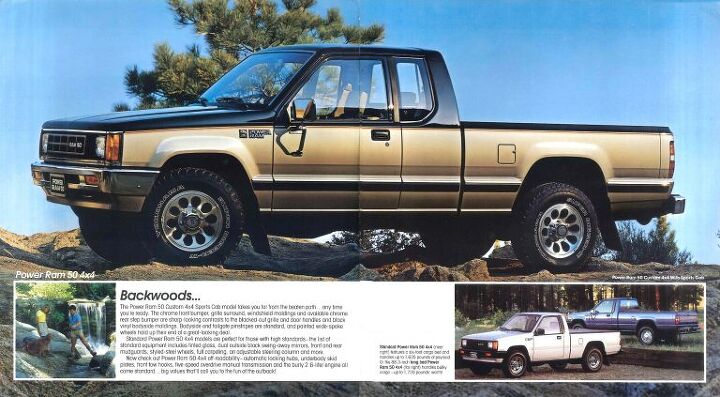
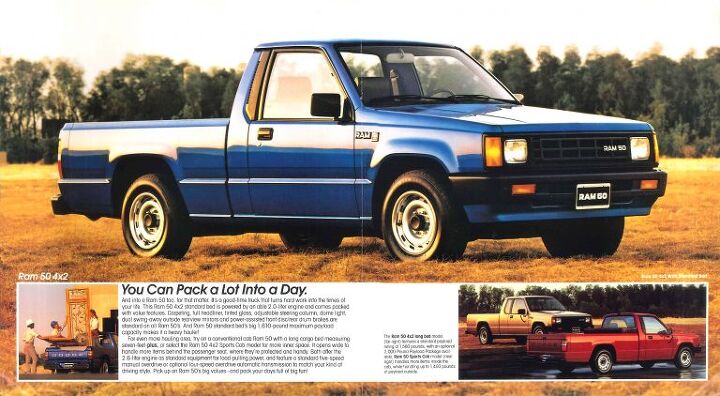
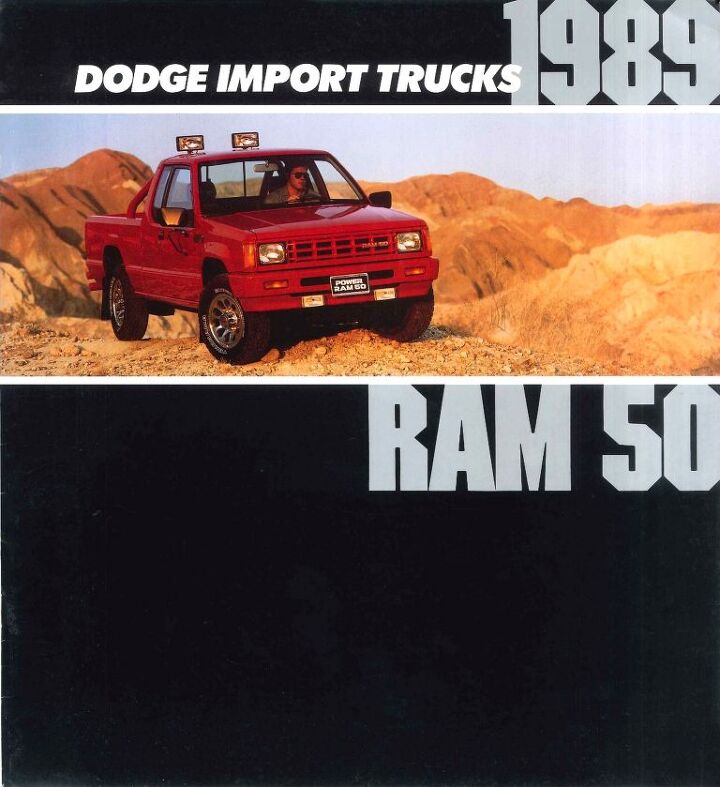
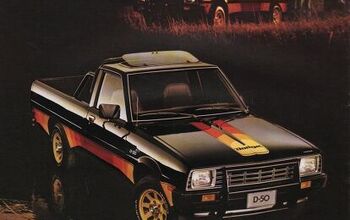
As far as looks, the new Ram 50 was not all that removed from the old one. There were square headlamps like before, but now there were only two of them. The front fascia was a bit more modern via an egg-crate grille, which replaced the horizontal slats grille on the outgoing model. The bumper stuck out further from the body and was finished most often in black. Higher trims of the old Ram 50 used a chrome bumper with black corner caps, but second-gen versions implemented a body-colored bumper instead. New styling happened via turn indicators next to the headlamps, which wrapped around the front corners slightly.
The square, unadorned body was much the same as it was before, with a basic character line that ran along the entire side. The doors were the same shape as before, as was the roofline. At the rear, the bumper was almost identical to the old model. Tailgates that read “DODGE RAM” on the first generation now said “DODGE.” Tail lamps were the same basic rectangular shape as before, but the red/amber/white color arrangement was rearranged, to amber/white/red. Exciting stuff.
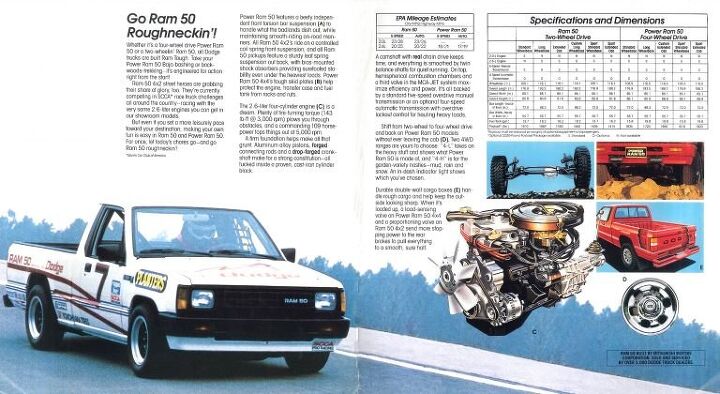
The four-door Triton did not make its way to North America as a Dodge; options were limited to the regular cab with short and long beds or the extended cab with short or long bed. Chrysler went a bit wild with the trim options on the Ram 50, and by 1989 there were 11 different distinct flavors. Worth noting, the Power Ram badging was still in use for four-wheel-drive variants. Let’s talk trims, I know you want to!
The base two-wheel-drive version was the same price in short or long bed guise, at $8,600 ($20,417 adj.) There was a base extended cab too, only in two-wheel drive at $8,960 ($21,271 adj.). A plain-Jane base four-wheel drive with short or long bed filled out the lower rung of the lineup, at $10,765 ($25,557 adj.) and $11,324 ($26,884 adj.), respectively.
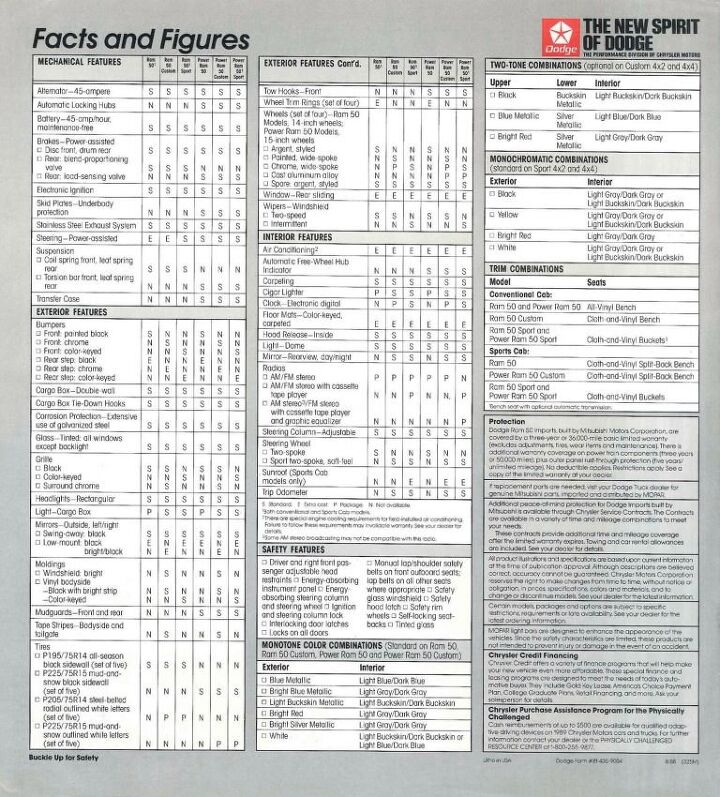
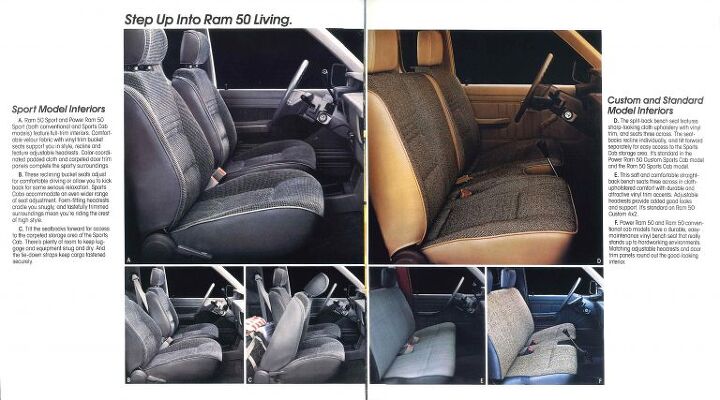
A Custom badge was applied to a lower-mid level long bed truck, in two-wheel drive for $9,049 ($21,483 adj.) or four-wheel for $11,900 ($28,251 adj.). Visual changes like chrome wheels and body-colored bumpers appeared at the Sport trim, which was offered in short bed and two-wheel drive for $9,776 ($23,209 adj.), as well as a two-wheel-drive extended cab long bed at $10,687 ($25,372 adj.). Sport continued with a short bed four-wheel-drive version for $12,449 ($29,555 adj.). And finally, the top-tier was a Sport extended cab long bed with four-wheel drive: $13,369 ($31,739 adj.).
When the new Ram 50 went on sale, it was powered via the 2.0-liter or 2.6-liter inline fours. The base engine had a carburetor and was good for 92 horses, while the larger 2.6 managed 109 hp. The 2.0 was dropped in short order, and the base engine became the aforementioned 2.4-liter (116 hp) in 1991. Power Rams gained the 3.0 V6 (143 hp) that year as their only engine.
Changes over the years were limited mostly to trims. The Mitsubishi Mighty Max sibling to the Ram 50 was updated for 1993, but the Ram experienced little to no visual changes. It continued on sale as a complement to the Dodge Dakota, Chrysler’s midsize truck that went on sale the same year as the new Ram 50.
Ram 50 was pulled from the North American market after 1994, when it seems Dodge was no longer interested in selling an imported truck under its name. If one references the marketing materials over the years, the Ram 50 was continually pushed to a smaller portion of the brochure, and not featured on the front pages alongside Ram full-sizers and Dakota. The last year for the Mighty Max was 1996, which was also the final year for the second-gen Triton.
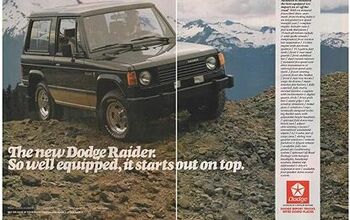
But the Ram 50 wasn’t the only new Mitsubishi doing double time as a Dodge in 1987. Aside from the Colts, there was an exciting new SUV in the lineup! It was called the Raider, a Montero by any other name. Raider’s up in Part III.
[Images: Dodge]
Interested in lots of cars and their various historical contexts. Started writing articles for TTAC in late 2016, when my first posts were QOTDs. From there I started a few new series like Rare Rides, Buy/Drive/Burn, Abandoned History, and most recently Rare Rides Icons. Operating from a home base in Cincinnati, Ohio, a relative auto journalist dead zone. Many of my articles are prompted by something I'll see on social media that sparks my interest and causes me to research. Finding articles and information from the early days of the internet and beyond that covers the little details lost to time: trim packages, color and wheel choices, interior fabrics. Beyond those, I'm fascinated by automotive industry experiments, both failures and successes. Lately I've taken an interest in AI, and generating "what if" type images for car models long dead. Reincarnating a modern Toyota Paseo, Lincoln Mark IX, or Isuzu Trooper through a text prompt is fun. Fun to post them on Twitter too, and watch people overreact. To that end, the social media I use most is Twitter, @CoreyLewis86. I also contribute pieces for Forbes Wheels and Forbes Home.
More by Corey Lewis







Comments
Join the conversation
Side Note: Not an import, but yesterday I saw a CHERRY Dodge Little Red Truck. Were those circa '74-ish. One of my best friend's Dad had one. He never let us borrow it. :-)
My stepfather bought a new Ram 50 in 1987. Base model, 2.0L, manual trans, manual steering, no A/C. Oddly though it had tilt steering. He bought it to commute in and tow my parents little 16ft Bayliner. I bought it from him in the mid 90's for $700 with 190k on it. I delivered pizza in it while I had a part time job at Dominos for 5 years then used it for commuting. It had 309,000 miles on it when I donated it to charity around 2008. I still miss that little truck.