
Abandoned History: The Cadillac Cimarron, a Good Mercedes-Benz Competitor


Sometimes car companies get a bit carried away with a new idea that, for a myriad of reasons, doesn’t translate so well in its execution. Toyota (and other Japanese companies) did exactly this when they invested in the very unsuccessful line of WiLL cars and other consumer products in the early 2000s.
Today we look at a 1980s domestic example of an idea that fell flat. It was the time Cadillac thought applying lipstick to a Cavalier-shaped pig would make the BMW and Mercedes-Benz 190E customer come a’callin. It’s time for Cimarron, a J-body joint.
Cadillac, America’s Standard of the World brand, typically sold enormous and expensive cars that were at one point built to a high quality standard. And that was well and good. But by the early Seventies, two major points became clear to General Motors: Cadillac’s quality image was fading, and there was indeed a market for a slightly smaller luxury car. Smaller as in mid-size.
Thus, in 1976 GM took a risk and fancied up the rear-drive and mid-size X-body from the Nova into the much different (not really) K-body Seville. Sold as “internationally-sized,” whatever the hell that meant, the Seville was svelte, lighter than a normal Cadillac. And it was a sales success. But it didn’t change the North American Euro-luxury leaning buyer’s blue-haired image of Cadillac. “We must do more, aim lower,” said someone at Cadillac.
And aim lower they did, as in 1980 the brass at GM signed off on the smallest Cadillac ever, a compact to be based on the new J-body platform currently in development. This new car was a result of some marketing research on Cadillac buyers. The results informed GM’s management that Cadillac customers were not moving from European brands over to Seville because it was incredibly desirable. Rather, it showed Seville customers were typically loyal domestic brand buyers who wanted a smaller sedan. The “European matching” with Seville hadn’t worked.
In response, this all-new Cadillac offering would compete more directly with the compact (and premium) European sports sedans offered by Germany, in particular the 3-Series and Mercedes 190E. Smaller, more upscale, more front-drive – just like a BMW, huh? Dealers were in favor of a smaller car but didn’t know what they’d be getting.
Work began in 1980, two years before the debut of the J-body in North America. That wasn’t much (enough) time for the slow-moving behemoth that was General Motors, and the Cimarron had one of the shortest development times GM ever attempted. The Cadillac to end all Cavaliers was supposed to debut circa 1985, give GM time to work out the product kinks of a new platform (good idea, says me). But management was eager and pushed the timeline up to a model-year ’82 release with the rest of the J-body cars.
The rushed plan didn’t go down well with GM president Pete Estes, (in charge 1974 to 1981). Originally an engineer at Oldsmobile and the man who came up with the name for the Camaro, Estes saw the high-quality vinyl being draped over the Cavalier and protested.
“You don’t have time to turn the J-car into a Cadillac,” he said. Crickets from Cadillac management.
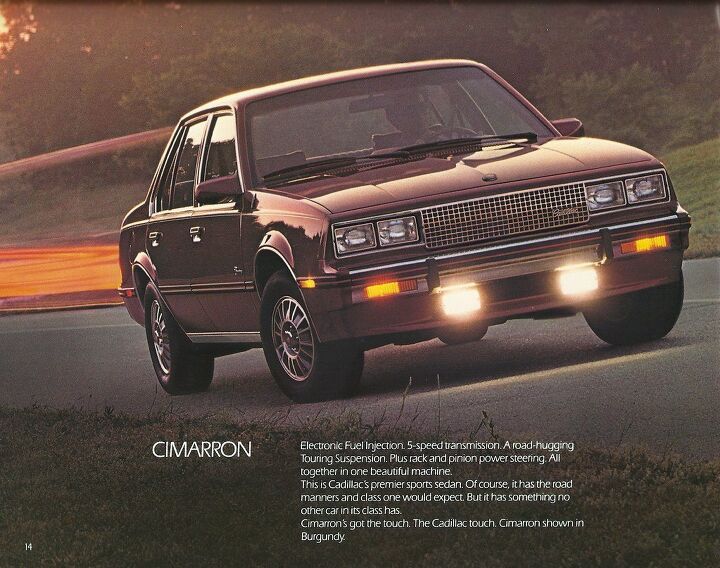
Cadillac hyped the new Cimarron in brochures, using bold adjectives like adventure, fortitude, and pioneering. GM first considered calling it the Envoy, Cascade, or Series 62, but instead went with Cimarron by Cadillac. They were proud enough of their creation that at launch the Cadillac name was absent from the car. This was immediately corrected when the Cadillac script appeared on the trunk in 1983, and the car was simply called Cadillac Cimarron.
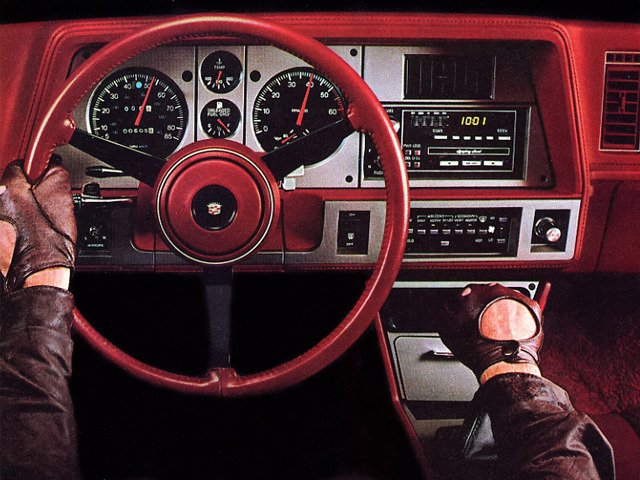
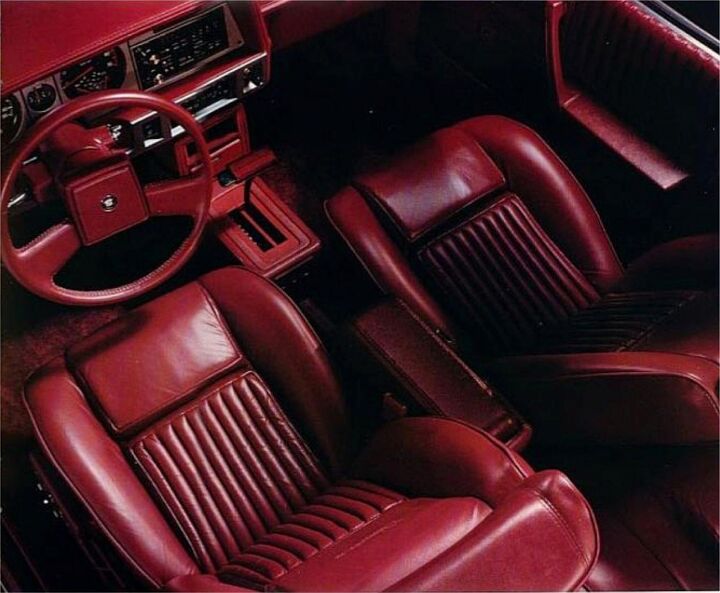
More appropriate would’ve been Cimarron by Cavalier, as what debuted was a badge-engineering job unlike anything GM had tried prior. At the front and rear were slightly more formal-looking clips than a Cavalier, while every exterior shape between the two was the same. There was some additional trim and chrome outside, and an optional vinyl roof not found on Cavalier. Inside, the Cimarron steering wheel had three spokes instead of two. The center console was slightly a different shape, and the cassette stereo was up higher. While Cavalier sometimes had digital gauges, initial Cimarrons featured analog ones which were cased in silvery plastic “simulated aluminum” instead of gray. Digital gauges became an option later. Bucket seats were standard on the Cadillac and were covered in low-grade leather. A seldom selected “Ripple Cloth” option appeared later, with cloth seating surfaces and vinyl-covered bolsters. Seats were heavily ribbed and matched the color-keyed vinyl door panel trim.
And that was it. No wood, no luxuriously powerful engine, no special features, no cupholders. All Cimarrons were sedans (though a convertible wouldn’t have gone amiss here) and were powered by the same 1.8-, 2.0-, or 2.8-liter engines as the Cavalier. Transmissions were the same too, with a three-speed automatic or four- or five-speed manual, though most were ordered with the automatic. The 2.8 V6 became optional in 1985 on the luxurious Cimarron but became standard in 1987.
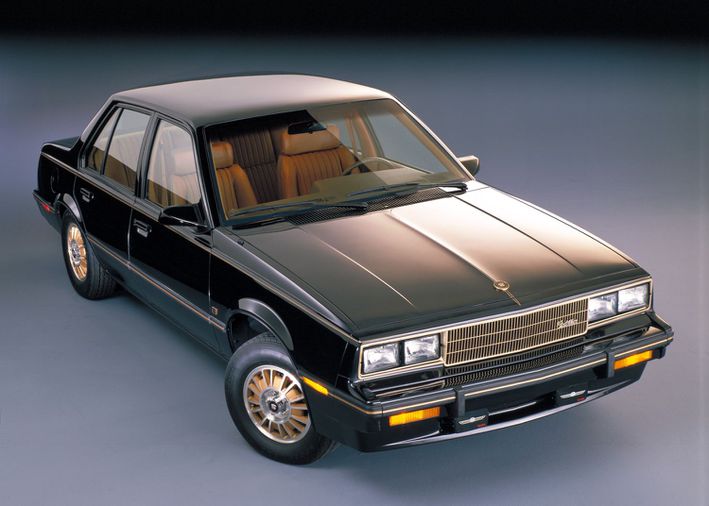
Along the way there was but one notable trim package, the D’Oro introduced in 1984. Directly translated from Italian and Spanish into “golden,” D’Oro was designed for customers who enjoyed gold trim, badges, wheels, grille, bumper strips, and tape stripes. D’Oro was emblazoned via a plaque on the flimsy glovebox lid alongside Cimarron, and there was additional color-matched lower body cladding not found on standard Cimarron. In ’84 the package was available only with black exterior and tan leather, but in ’85 the trim expanded to white and red exterior paint. D’Oro continued in availability through 1986.
GM persisted with slight fiddling with front and rear trim to make it look a bit different from its Cavalier sibling. Wrap-around taillamps appeared in ’86, alongside much better-looking composite headlamps to replace the sealed beam Cavalier units. The Cimarron was largely laughed out of the room by the automotive press, and rightly so.
However, though its 132,499 sales were not as impressive as expected, many Cimarron buyers were new to the Cadillac brand and younger than the typical customer. Cadillac brass considered a new generation of Cimarron past 1988, but instead sealed its fate and sent those development funds to update the Eldorado and Seville for ’88 and the front-drive Fleetwood and Deville for ’89. A good call. Cimarron was one of the last first-gen J-body cars on sale, as for ’88 the Cavalier and company entered their second generation.
Cimarron eventually made its way to Worst Car Ever lists here and there. It’s largely considered the worst example of badge engineering in modern history, as it represented a cynical take on a Cavalier at nearly double the price. Thus far, Cadillac has remembered the Cimarron’s Abandoned History lesson and has not repeated the mistake.
[Images: Cadillac]
Interested in lots of cars and their various historical contexts. Started writing articles for TTAC in late 2016, when my first posts were QOTDs. From there I started a few new series like Rare Rides, Buy/Drive/Burn, Abandoned History, and most recently Rare Rides Icons. Operating from a home base in Cincinnati, Ohio, a relative auto journalist dead zone. Many of my articles are prompted by something I'll see on social media that sparks my interest and causes me to research. Finding articles and information from the early days of the internet and beyond that covers the little details lost to time: trim packages, color and wheel choices, interior fabrics. Beyond those, I'm fascinated by automotive industry experiments, both failures and successes. Lately I've taken an interest in AI, and generating "what if" type images for car models long dead. Reincarnating a modern Toyota Paseo, Lincoln Mark IX, or Isuzu Trooper through a text prompt is fun. Fun to post them on Twitter too, and watch people overreact. To that end, the social media I use most is Twitter, @CoreyLewis86. I also contribute pieces for Forbes Wheels and Forbes Home.
More by Corey Lewis








Comments
Join the conversation
@el scotto--Excellent summation of what is wrong with the Detroit based auto manufacturers and the same thing applies to much of the US based manufacturers. The executives are too far removed from the actual product and the experiences most consumers have with those products. The problem is also the bean counters who cost cut the product so much that there are more problems and the product itself becomes less desirable. Cimarron is an excellent example of what was and is wrong with Detroit.
TTAC the website that ensures the Cimarron lives on.