

Abandoned History: Project Genesis, Toyota Cars for Young People

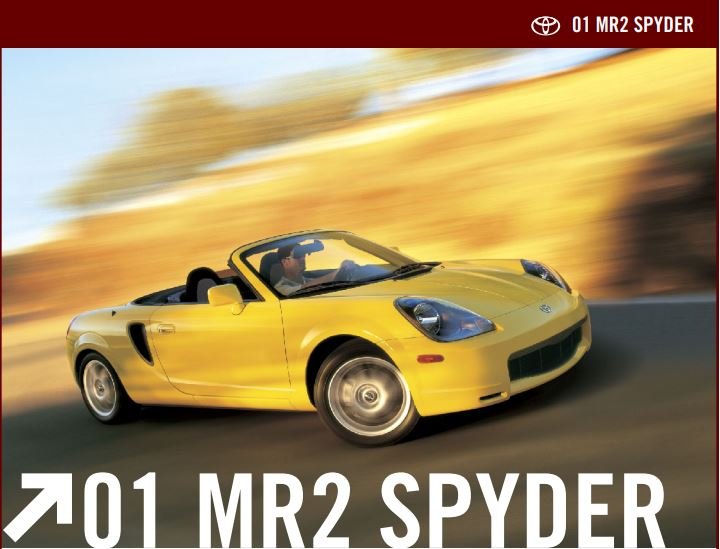
Toyota was very focused on youthful consumer appeal at the turn of the millennium. Around the same time the WiLL sub-brand launched in the Japanese home market with its multitude of different products, a similar project was just getting underway at Toyota Motor Sales USA.
It was called Project Genesis, and like WiLL, it didn’t go well.
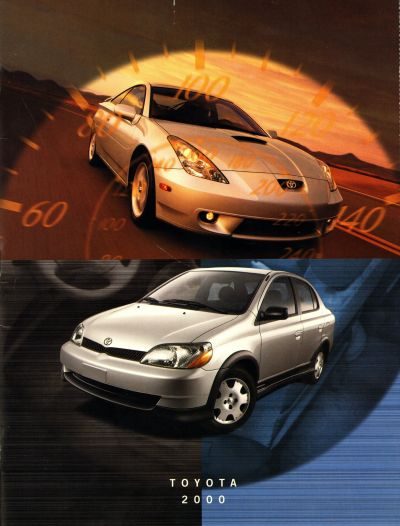
Project Genesis was a task force established by two of the top brass at Toyota USA in 1999. President Yoshimi Inaba and company COO James Press had a great idea for three exciting new cars about to arrive at North American Toyota dealers.
The cars in question were the seventh generation Celica, the third-gen MR2, and the new ECHO. All three cars entered production late in 1999 for the 2000 model year, and while customers were already familiar with the sporty Celica and MR2, the ECHO was a 2000 replacement for the dearly departed Tercel. Tercel ran through the ’98 model year if you can believe it.
Toyota USA knew these new cars appealed to their youngest customers, and the plan for them was simple: Market all three as their own sub-brand within Toyota dealers in the US. The plan extended to the Japanese dealership network as well, which is a more complicated setup than is used in North America.
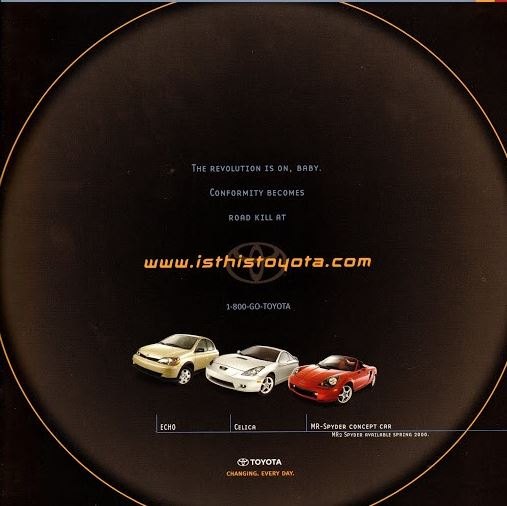
Celica, MR2, and ECHO (Platz in Japan) were to be bundled together in print advertisements and use a different marketing strategy than the rest of the Toyota lineup. Affordability, fuel economy, and being so cool with techno music were all features of the ad campaigns, as seen here. For whatever reason, no one has memorialized a 2000s US market MR2 ad on YouTube.
Did the advertising work? Did younger buyers flock to the three new Toyotas with their targeted commercials and sub-brand print materials? No, not really. The most successful product of the group with younger consumers was the Celica. It was more well-rounded than the too costly, too small MR2, and the too economical and goofy-looking ECHO. Much like other economy cars that were supposed to be “fun” and “cool,” older people bought the ECHO (usually in silver or beige) and then drove it very slowly around town.
Interested in lots of cars and their various historical contexts. Started writing articles for TTAC in late 2016, when my first posts were QOTDs. From there I started a few new series like Rare Rides, Buy/Drive/Burn, Abandoned History, and most recently Rare Rides Icons. Operating from a home base in Cincinnati, Ohio, a relative auto journalist dead zone. Many of my articles are prompted by something I'll see on social media that sparks my interest and causes me to research. Finding articles and information from the early days of the internet and beyond that covers the little details lost to time: trim packages, color and wheel choices, interior fabrics. Beyond those, I'm fascinated by automotive industry experiments, both failures and successes. Lately I've taken an interest in AI, and generating "what if" type images for car models long dead. Reincarnating a modern Toyota Paseo, Lincoln Mark IX, or Isuzu Trooper through a text prompt is fun. Fun to post them on Twitter too, and watch people overreact. To that end, the social media I use most is Twitter, @CoreyLewis86. I also contribute pieces for Forbes Wheels and Forbes Home.
More by Corey Lewis









Comments
Join the conversation
I was in high school in 1999-2000 and remember this campaign vividly, even the "is this toyota" web address. It was all over the car mags at the time. I find it interesting that Toyota was worried about its image with youth as long ago as the late '90s. Not an invalid concern I suppose. I personally thought all 3 Genesis vehicles had sub-par interiors. Which for Toyota in the '90s was a disappointment because people were used to the fat interiors of the 1994 Camry and LS400. These Genesis vehicles came out just as Toyota was starting to cheap out interiors, and it really showed in all 3. Not impressive, even to a high schooler. I remember a girl at my high school from a die-hard family Toyota got the first Echo I ever saw. Tall, tippy, dorky, and cheap silly interior. Celica was the vehicle with the most promise; checked one out at a dealer and was not impressed by the all-hard plastic interior and rock-hard center armrest. I had a 1999 Cougar at the time, and the Celica interior quality was truly no better. And I thought the Cougar wore the wedge styling better. I also vividly remember the intro of Scion and what a potentially big deal it was at the time. The initial Scion vehicles seemed more in-line with a true youth brand, but they screwed it by "normalizing" the second-gen Scion vehicles (ESPECIALLY xB). Reminds me of when GM "normalized" Saturn. Same effect: brand death.
My daughter had an Echo, with a 5-speed. "Economical and goofy-looking" fairly characterizes the car; I'd add "tippy" if driven with any vigor. The gearshift felt like you were stirring a bucket of TinkerToys™, the car lacked a temp gauge, and "tinny" captures the noise level. But it was easy to work on, the seats were O.K., even on long drives, and the A/C worked pretty well. Honestly, the car was a "cockroach," and I mean that as a compliment: ugly, un-loved, and almost un-killable. We would still have it, but it was crushed by an over-eager pickup.