
2022 Jeep Grand Wagoneer First Drive - In the Mix

When the invite hit to drive the 2022 Jeep Wagoneer and Grand Wagoneer hit my inbox, I found myself a tad surprised by the location – New York City.
Or, to be precise, the roads outside the city in the Hudson Valley and Westchester County. We’d merely be laying our heads in Manhattan, with the real action taking place in the suburbs. With brief forays into strange lands named New Jersey and Connecticut.
There’s a reason why so many first drives are held in California – good roads and good weather. It’s the same reason why drives don’t take place as often in places like New York, Chicago, or even Detroit. The roads aren’t as fun to drive and are often in bad shape, and the weather is less predictable. Events that involve the (mostly) controlled environment of a track are an exception, of course.
On the other hand, sometimes a place is picked because it fits the marketing, or the PR folks think the car will look good in the photos we snap, or the chief spinmeister just really likes a certain hotel/restaurant/golf course nearby.
That said, sometimes I wonder if the vehicle just isn’t very good when the drive-event takes place on roads that are mostly freeway or rural roads with few tricky turns.
That was my fear with the Grand Wagoneer. Especially since Jeep loves to take us off-road, and Westchester County isn’t exactly Moab. But about an hour into the drive, it hit me – Jeep didn’t have us there to hide the Wagoneer’s flaws. I mean, who cares how fast it can run the Snake in Malibu, anyway? It’s a large three-row SUV, for chrissake. No, the company had us driving around moneyed old-school suburbs because the Grand Wagoneer is meant to fit right in with the Lincoln Navigators and Cadillac Escalades that well-heeled executive types are used to buying.
Which it does reasonably well enough.
(Full Disclosure: Jeep flew me to New York City, put me up in two very nice hotels, and offered meals. The company also offered a hat, which I didn’t take.)
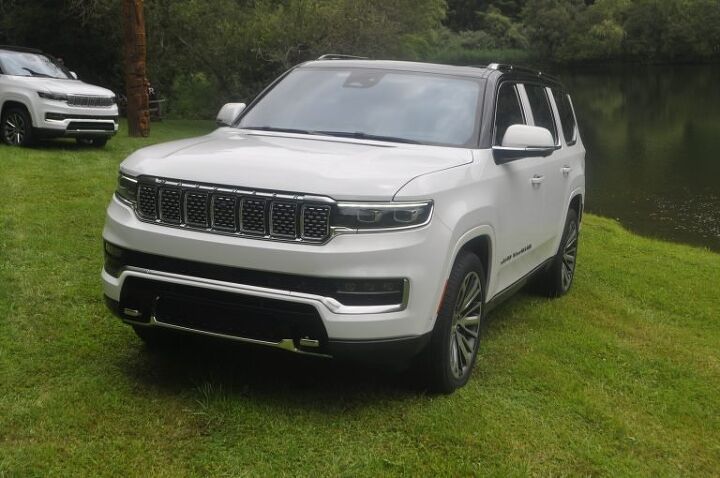
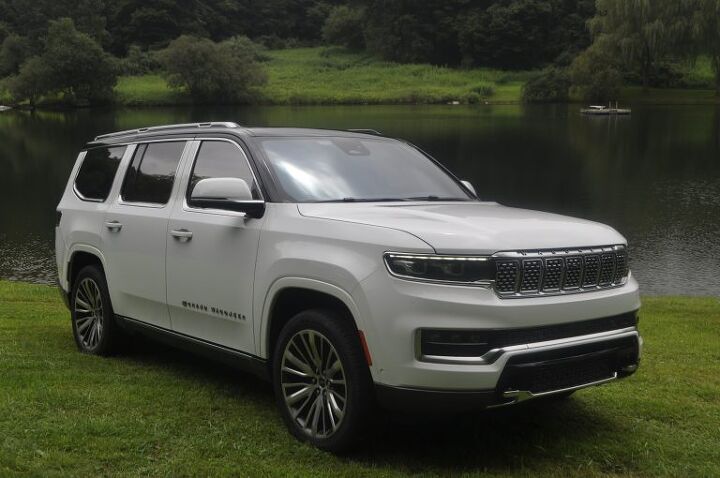
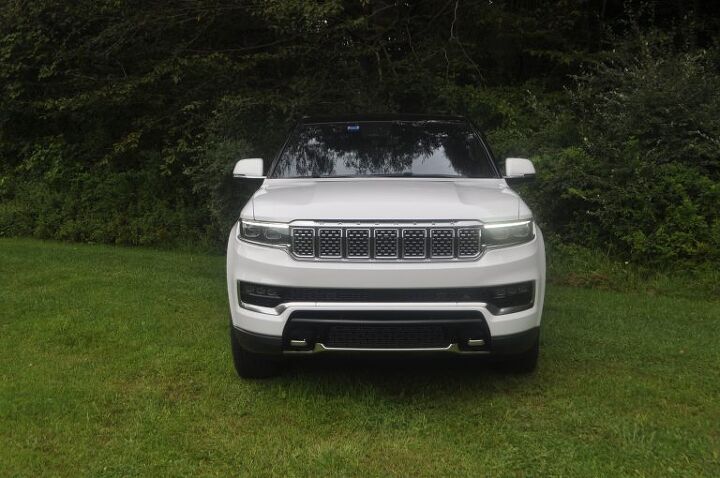
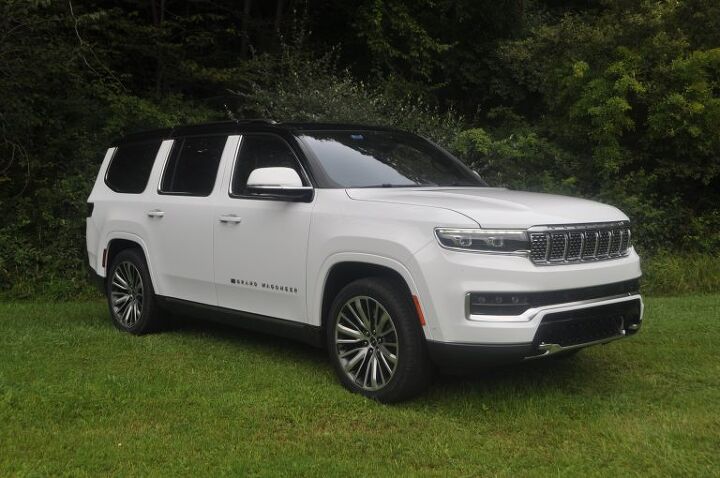
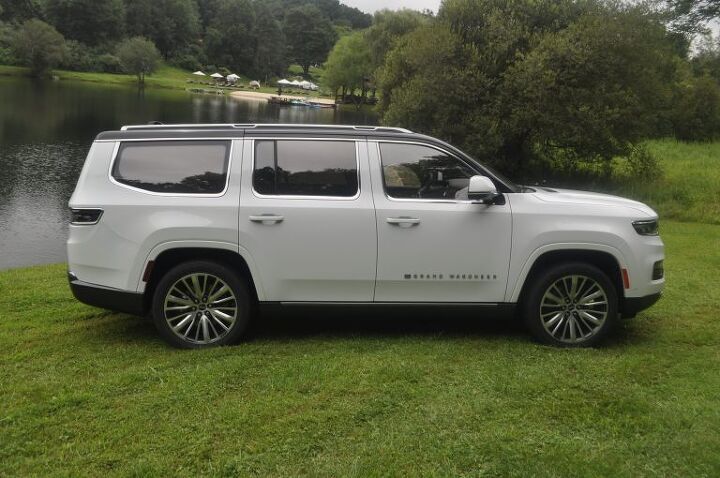
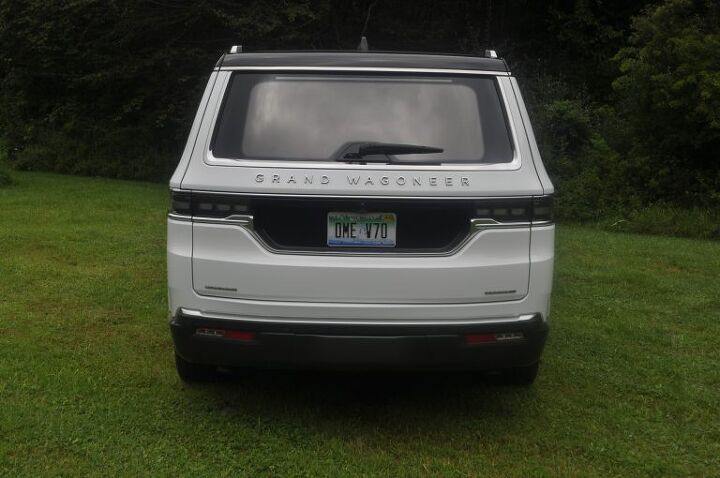
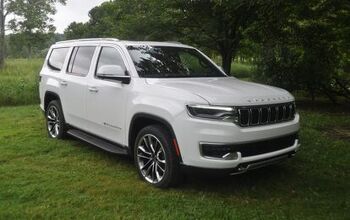
The exterior styling is certainly polarizing – a few of the wags around here have been merciless in their criticism. I don’t find it quite as offensive to the eyes as they do, and I think it looks better up close than in photos, but I do agree that it is far from sexy. It’s not going to turn heads like the Caddy does or even provide bland handsomeness like some Lincolns (think Aviator) do. But it blends just fine, to my eye.
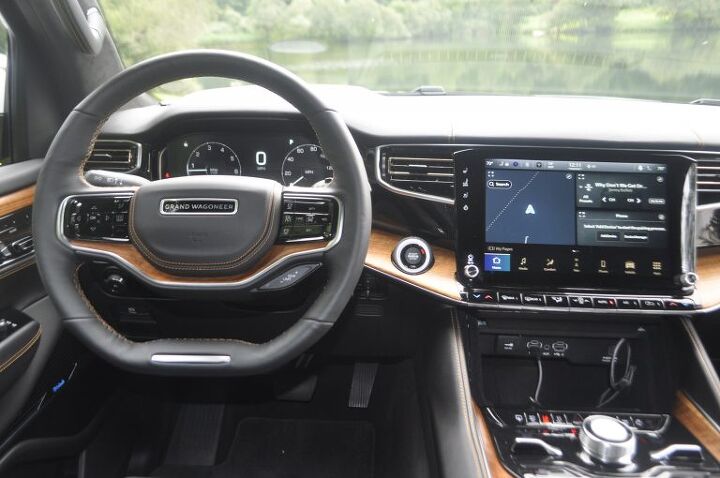
The cabin is a better story, though some materials felt downmarket in a six-figure SUV. I liked that Jeep is offering interior color choices other than black and also dug the fact that Jeep has gone all-in on screens on this thing. In many circumstances, I’d find a screen-heavy interior to be cheesy and off-putting, but it works here, in part because the screens are easy to read and use, and in part because the available passenger-side screen is not in the driver’s eye-line.
That passenger-side screen can be used for navigation, viewing the exterior cameras, or entertainment. Including, yes, television via Fire TV. All told, up to 75 inches of total screen display area is available. Second-row passengers get a 10.25-inch center-row screen and seat-mounted screens are available.
It doesn’t hurt that the newest version of Uconnect is well done. The system continues to be among the best of the infotainment options out there, and the Uconnect 5 upgrades look sharp and work well.
Big body-on-frame SUVs tend to have big motors, and the Grand Wagoneer, which rides on what Jeep calls an all-new architecture, is no exception. Standard is a 6.4-liter V8 making 471 horsepower and 455 lb-ft of torque and pairing with an eight-speed automatic transmission. All Grand Wagoneers are four-wheel drive.
Once I got settled in and adjusted the customizable digital gauge cluster to my liking, I turned the shift knob/dial to Drive and motored north from NYC, riding in quiet comfort.
Wind noise was mostly muted, and the V8 was largely silent unless I needed to dig deep to pass. The Grand Wagoneer was more well-behaved on the freeway than the Grand Cherokee L I drove earlier this year, with a lot less wander. The ride was compliant without ever dropping into the territory of soft – no float, no wallow. Broken pavement mostly didn’t upset the chassis, though some of the roughest of the rough stuff eventually filtered up to my backside.
Thank the standard Quadra-Lift air suspension for that – it uses air springs at each wheel and also has rear load-leveling. Drivers can adjust the height manually, too.
There is a Sport mode, along with the requisite off-road modes (rock, snow, sand/mud) that are part of the Quadra-Drive II 4WD system that comes standard on the Grand Wagoneer and includes a two-speed transfer case and an electronically-controlled limited-slip rear differential and hill-descent control. Sport mode livened up the handling a little, making the few curves I encountered slightly more fun to navigate, but you never forget how large this beast is, or how its mission is to haul people and cargo and not carve corners. Even if it is more capable at that last task than I expected it to be.
The weight is noticeable when the V8 is employed for passing – it’s stout and up to the task, but it’s obvious it has a lot of curb weight to move around. Six-thousand four-hundred and twenty pounds of curb weight, to be exact.
It’s not a Jeep event without off-roading, and I got the chance to put the regular Wagoneer through its paces on a light off-road course that included some rock crawling. Not the Grand, though. I was told the Grand Wagoneer was, in theory, capable of tackling the course – it does have skid plates – but the retractable running boards might suffer some damage.
Vehicles like this are meant to eat highway miles in comfort, and the Grand Wagoneer did that just fine. Between the comfortable yet not soft ride and the fairly quiet cabin, I felt pretty coddled on the highway. My nitpicks were few – as noted above, some materials felt a bit downmarket and some touchpoints used plastics that were a bit too hard for this price point. I occasionally fumbled the HVAC controls – toggling the switches up wasn’t intuitive at first, though I got used to it.
I had little trouble accessing the third row, and I had room once situated back there. At six-one and rocking a dad bod, that’s no small deal. The third row will work for most adults, and not just for short trips.
If you’re wondering where the exterior wood paneling is, Jeep told a colleague that the designers felt it too retro for the Grand Wagoneer, which they’re trying to paint as a modern alternative to the iron already on sale in this class.
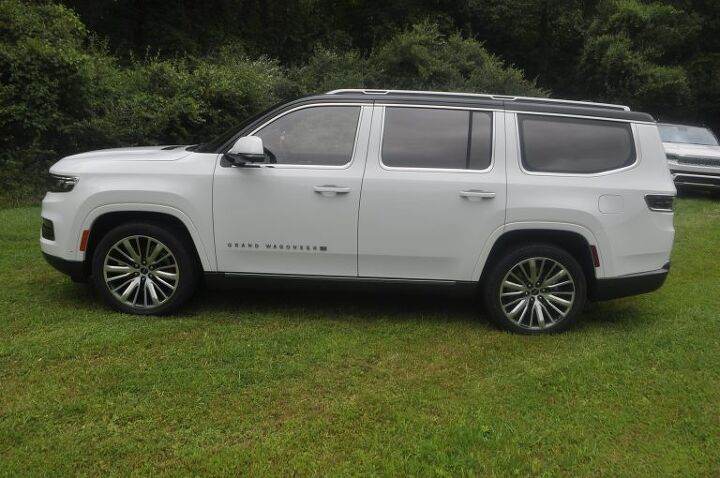
With a six-figure asking price, maybe it’s good to avoid the wood. The Grand Wagoneer starts at $86,995 and comes in four trims: Series I, Series II, Obsidian, and Series III. The loaded Series III I tested started at $103,995 and came with a head-up display, traffic-sign recognition, digital rear-view mirror, 360-degree camera, active driving-assist system, full-speed forward-collision warning plus, blind-spot and rear cross-path detection, night vision with pedestrian and animal detection, a 12.0-inch infotainment screen, Apple CarPlay, Android Auto, navigation, satellite radio, in-car Wi-Fi, rear-seat monitoring camera, wood interior accents, rear center console, heated second-row seats, cooled rear seats, four-zone climate control, second-row captain’s chairs with power tilt and slide, reclining and split-folding third-row seat, panoramic sunroof, a power liftgate, and 22-inch wheels.
The only option was a $995 trailer tow package. On that note, a Grand Wagoneer equipped as mine was can tow 9,850 pounds.
Fuel economy is a predictably dismal 13 mpg city/18 mpg highway/15 mpg combined.
With the towing package and a full two grand (!) for destination, my tester cost $106,990.
That’s a lot of money for a lot of Jeep. I haven’t driven the Escalade or Navigator recently, so I can’t say exactly how well the Grand Wagoneer stacks up, but I can say it seems like it will fit right in among the well-heeled masses occupying the higher-priced ZIP codes surrounding whichever city you care to name.
It’s been a long time since Jeep offered a large three-row SUV of this type. The Grand Wagoneers of old are classics now. This new one doesn’t seem destined to be a future collectible, but that’s probably OK with Jeep. The new Grand Wagoneer will fit in just fine in the private-school pickup line.
It’s not without flaws. The styling is going to put some folks off. All those screens might be pricey to replace should things break beyond the warranty period. The fuel economy is going to punish people’s wallets, and the hefty curb weight impacts acceleration a bit.
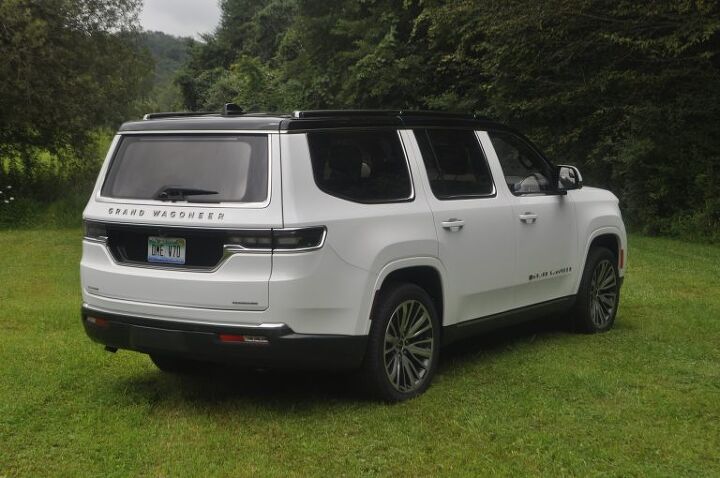
Yet the Grand Wagoneer will happily eat miles while keeping the driver (and more than a few passengers) coddled in complete comfort.
The fashionistas will shop elsewhere. The rest of the wealthy world now has one more SUV on the shopping list – one that’s good enough to stay on said list. Maybe the Wagoneer isn’t an immediate class champion, but it’s in contention, and being in the mix out of the gate might just be good enough.
[Images © 2021 Tim Healey/TTAC]
Tim Healey grew up around the auto-parts business and has always had a love for cars — his parents joke his first word was “‘Vette”. Despite this, he wanted to pursue a career in sports writing but he ended up falling semi-accidentally into the automotive-journalism industry, first at Consumer Guide Automotive and later at Web2Carz.com. He also worked as an industry analyst at Mintel Group and freelanced for About.com, CarFax, Vehix.com, High Gear Media, Torque News, FutureCar.com, Cars.com, among others, and of course Vertical Scope sites such as AutoGuide.com, Off-Road.com, and HybridCars.com. He’s an urbanite and as such, doesn’t need a daily driver, but if he had one, it would be compact, sporty, and have a manual transmission.
More by Tim Healey









Comments
Join the conversation
I don't care for the looks, but I don't think the Caddy is better.
I am largely indifferent to all types of SUVs and crossovers. But I feel like I need to specifically give the design team kudos for delivering a vehicle with an upright rear profile instead of a faux-coupe fastback thing that needlessly takes away from cargo space.