
Jaguar Land Rover Wants to Build Cars in the U.S., but Only If Americans Buy More

Matt Posky
by Matt Posky

Jaguar Land Rover says it’s totally stoked at the idea of establishing a production facility in the United States, but claims Americans will probably need to buy a few more cars before that vision can become a reality. This might not be a problem, as U.S. buyers have been all about JLR lately. Group sales were the best in over fifteen years in 2016 and last year saw the company achieve a record high of 114,333 deliveries.

While the majority of those sales come from Land Rover, Jaguar has also seen impressive growth over the last three years. More North American sales are definitely coming, especially with Rover already looking to have one of its best years on record in just the first three months of 2018. So why won’t the manufacture pull the trigger and start laying the groundwork on a new factory?

According to CEO Ralf Speth, Jaguar Land Rover doesn’t see itself as a large enough automaker to make big moves without some very careful planning. In a recent interview with Wards Auto, Speth said he still feels JLR is a “very small company.”

“We need a certain volume of vehicles to be sold in the U.S. to make the overall production in the U.S. viable,” he said.

When pressed about Volvo’s decision to set up an assembly plant in South Carolina, despite delivering just 81,504 vehicles in the U.S. last year, the CEO didn’t see the equivalency. “Everybody’s business case is different and everybody starts maybe in a different way,” he said. “I don’t want to discuss the advantages or disadvantages of Volvo. We really need to find our own way.”

We don’t think it’s an unfair comparison. Both companies have similarly sized parent companies (Tata for JLR, Geely for Volvo) and sell to roughly the same consumer base. It’s not a perfect comparison, but we can’t think of many better.

Jaguar Land Rover’s way forward doesn’t just involved improving sales. Speth says a dominant model will need to emerge on the U.S. market before the company can build a factory there. While the F-Pace is the clear standout for Jaguar, practically everything in Land Rover’s lineup moves between 10,000 and 20,000 annual units in the United States.

“We have 15 or 16 nameplates … if you divide every and each number by this 15 or 16 then you will recognize the remaining number per nameplate is not big enough,” Speth explained. “So can you maybe encourage [sales and marketing and dealers] to sell a little bit more from at least one or two nameplates?”

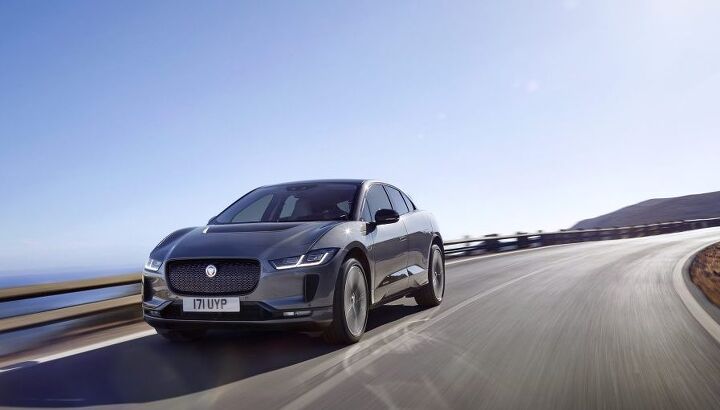
The company is already making commitments to America, however. In addition to its new new U.S. headquarters in Mahwah, NJ, Jaguar will supply 20,000 examples of its I-Pace battery-electric CUV to Waymo for use in its autonomous fleet. Those cars won’t be coming until 2020, so the brand could have set up shop in North America, given that the U.S. is one of its target markets. But Magna Steyr, which was tapped to manufacturer the vehicle for JLR, understandably decided to build it in Graz, Austria, next to the E-Pace.

However, that facility is already stretched pretty thin; it recently began construction auxiliary factory in Slovenia to help with production. If I-Pace demand exceeds expectations in North America, and JLR can pin down another volume model, perhaps the U.S. will get that factory after all.
[Images: JLR]

Matt Posky
Matt Posky

Consumer advocate tracking industry trends and regulations. Before joining TTAC, Matt spent a decade working for marketing and research firms based in NYC. Clients included several of the world’s largest automakers, global tire brands, and aftermarket part suppliers. Dissatisfied, he pivoted to writing about cars. Since then, he has become an ardent supporter of the right-to-repair movement, been interviewed about the automotive sector by national broadcasts, participated in a few amateur rallying events, and driven more rental cars than anyone ever should. Handy with a wrench, Matt grew up surrounded by Detroit auto workers and learned to drive by twelve. A contrarian, Matt claims to prefer understeer and motorcycles.

More by Matt Posky

Comments
Join the conversation
3 of 4 comments
  • Vulpine Vulpine on Apr 06, 2018

    Make what Americans want and more people will buy them. But from what we've seen so far, their reliability will have to move significantly higher on the chart.

  • SuperCarEnthusiast SuperCarEnthusiast on Apr 08, 2018

    For me to buy another Jag or even a RR, the vehicles would have to approach the reliability of a Toyota/Lexus model.

    • Tstag Tstag on Apr 09, 2018

      It’s funny for me to ever consider a Lexus product it would have to have the sophistication and looks of a JLR product.... I don’t really give a stuff about reliability as all cars are fairly reliable these days and the key issues with a car are normally resolved in the warranty period. That said for JLR I sell more cars in the USA they should make reliability a higher priority and they should focus on getting the Defender and Defender pickup to market faster.

  • Amwhalbi My 1972 Mercury Capri was my first stick shift car. God, I miss that thing. It was a blast to drive.
  • Vid169489471 The technology exists today to produce a variable color temperature (kelvin) LED lamp. It can vary from 2700k that soft orange look to 6500k the bright daylight with the bluish tint.Since everything in a late model car is computer controlled, it would be an easy task to write a few lines of code that enables your vehicle to not only dim down from hi to low beam but to shift color temp down to the 2700k range for oncoming traffic, then back up to 5000k once oncoming traffic has passed. For the operator it would be automatic and seamless. For older cars they could be retrofitted with LEDs that are 2700k on low beam and 5000k on hi beam. As far as standards, there could be a lumens max, and a minimum. Several States already have minimum lumen standards going back to the old incandescent bulbs. Why not update these to national standards.
  • Jam169859557 More regulation is needed for ALL vehicle lighting systems. [list=1][*]The lighting that is most blinding are the rapidly flashing red, blue and amber lights on emergency vehicles. The lights themselves are blinding, flashing so rapidly that it's impossible for even the sharpest eyes to adjust. What's worse, is the nature of the emergency requires a careful view of the area surrounding the emergency vehicle. There is something going on that needs to be seen. More flashing lights is not the solution.[/*][*]Brighter headlights need to be regulated. The tall riding vehicles do not need headlights positioned so high that they blind drivers in lower riding vehicles. And those heasdlights need to be aimed properly. When I first started driving my 2020 Subaru Outback, many drivers would flash their lights, hoping I would dim my lights. This stopped after I performed am easy adjustment that tilted the beam lower. Late model Subaru headlamps are designed with a sharp cutoff that project less glare above the hood line. When the headlights are properly aimed, other drivers are not blinded by the beam.[/*][*]Customized light assemblies make it more difficult to see the marker lights (tail lamps, turn signals and side marker lamps) that have been tinted. There are many municiple codes that prohibit this tinting, but these laws are seldom enforced.[/*][/list=1]Solutions: Tight controls on emergency vehicle lighting. In trying to make these vehicles more visible, a dangerous side effect is reducing the ability of drivers to see the surrounding perils.Headlight design regulations that reduce the height of the headlight assemblies. Just because a pickup truck has a hood that sits 4 feet abouve the pavement, it does not mean the headlights need to be so high. Owneres should maintain proper adjustments to their vehicle headlights.Establish and enforce regulation requiring a illumination standard be followed.
  • Stl170698708 as someone who hates big government, and their interference;but you can add me to the list of people that are blinded by the lights.unfortunately "the poop is out of the horse and no way is it going back in"They have had 5 years to make lights bigger, badder and brighter because in the vehicle work it is go big or go home!Trucks are the worst because so many people use them to express their dominance and that is big, big, big $$ both at the Original Purchase and in the Aftermarket world.If, we are so lucky to get some good government regulation on this it will also take some very good Court enforcement to get the aftermarket people with fines and lawsuits.Much like the EPA did with the Diesel Tuner Industry that felt emission regulations didn't apply to them.This is from someone that owns said pickup truck with the same bright headlights,but i only use the truck when I have too and always turn off the Fog lights when driving in traffic.
  • Art65765977 I saw a porsche 911 with the most amazing headlights from behind approaching the Sunshine skyway in Florida. The pattern was 108 degrees across sweeping the road like a broom. My brother and I were amazed. I don't know what it looked like from the front but i am sure it was better than American cars
Next