What's Standing Between You and a Future Citron or Peugeot? Possibly, a Tariff
Steph Willems
by Steph Willems

The threat of new import tariffs has PSA Group worried about its plan to return to the United States. Following President Trump’s proposal to levy a 25-percent tax on steel imports and a 10-percent tariff on inbound aluminum, Europe balked at the suggestion, leading to further threats of a car tariff.

Right now, the U.S. levies a 2.5-percent tax on imported European vehicles, far less than Europe’s 10-percent tariff on vehicle travelling eastward across the Atlantic. There’s a 25-percent U.S. tariff on European vans and trucks, too, which explains why crates of Mercedes-Benz van components sail into the port of Charleston, South Carolina at regular intervals.

According to Trump, any European retaliation against the proposed metal tariffs — which seem all the more likely given yesterday’s resignation of the president’s pro-free trade economic advisor, Gary Cohn — would see the U.S. ratchet up its car tariff. If the scenario comes to pass, your dreams of one day buying a new French car in America could easily be dashed.

Speaking to Automotive News at the Geneva Motor Show, PSA Group CEO Carlos Tavares said he’s watching the situation closely. A new vehicle tariff could make the automaker reconsider its 10-year U.S. re-entry plan.

“If the overall framework of tariffs change, it may have an impact on our strategy,” Tavares said Tuesday. “That’s clear, because if we don’t have a profitable business plan, then we don’t go.”

Under the existing plan, the maker of Citroën, Peugeot, and DS vehicles wants to gradually ease back into a market it vacated in 1991, first with ride-sharing programs and other mobility efforts, and later with its own vehicles. A full return would occur by 2026. PSA already has a staffed North American headquarters in Atlanta guiding the initiative.

“The tariffs, if they were to exist, would have an impact on the way we go to market, because we have a very staged and step-by-step approach,” Tavares said. “That means that at the beginning we would source the cars from outside the U.S., given the very limited volumes. If this was to change we would have to reassess our strategy.”

While German automakers like BMW, Mercedes-Benz, and Volkswagen already have a strong U.S. manufacturing presence, Trump’s threats aren’t being taken lightly. German automakers imported half a million vehicles to the U.S. last year. According to Germany’s Center for Automotive Research, boosted European car tariffs could cut the automakers’ profits by 10 percent.

“Roughly speaking, German carmakers achieve between 10 and 13 percent of their profits in the US,” Metzler bank analyst Jürgen Pieper told Deutsche Welle. “Should a 10 percent duty be imposed, that would perhaps reduce profits in the US by a third.”

As for PSA, Tavares isn’t freaking out just yet. Taking an optimistic tone, the executive said, “Of course, we prefer global trade and we prefer open markets. That’s much better for everybody at the end of the day. I feel that good sense will prevail.”

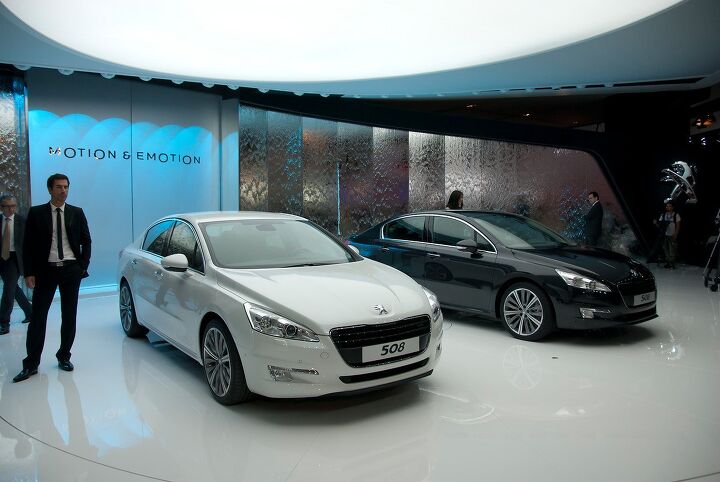
[Image: PSA Group]

Steph Willems
Steph Willems

More by Steph Willems

Comments
Join the conversation
3 of 122 comments
  • Voyager Voyager on Mar 09, 2018

    The EU is more serious about reducing emissions and fossil energy dependency overall. So, no wonder big V8-powered cars are taxed accordingly. What does need to change, is what TTAC mentions: the U.S. lighter tariffs in general on import cars; make that on par with what the EU is charging.

  • TruthSeeker TruthSeeker on Mar 09, 2018

    I just heard today that Canada and Mexico are to be exempt from tariffs on steel and aluminum... wonder what that will stir up in the EU?

    • Admin Admin on Mar 09, 2018

      It will certainly prove to be interesting.

  • Amwhalbi My 1972 Mercury Capri was my first stick shift car. God, I miss that thing. It was a blast to drive.
  • Vid169489471 The technology exists today to produce a variable color temperature (kelvin) LED lamp. It can vary from 2700k that soft orange look to 6500k the bright daylight with the bluish tint.Since everything in a late model car is computer controlled, it would be an easy task to write a few lines of code that enables your vehicle to not only dim down from hi to low beam but to shift color temp down to the 2700k range for oncoming traffic, then back up to 5000k once oncoming traffic has passed. For the operator it would be automatic and seamless. For older cars they could be retrofitted with LEDs that are 2700k on low beam and 5000k on hi beam. As far as standards, there could be a lumens max, and a minimum. Several States already have minimum lumen standards going back to the old incandescent bulbs. Why not update these to national standards.
  • Jam169859557 More regulation is needed for ALL vehicle lighting systems. [list=1][*]The lighting that is most blinding are the rapidly flashing red, blue and amber lights on emergency vehicles. The lights themselves are blinding, flashing so rapidly that it's impossible for even the sharpest eyes to adjust. What's worse, is the nature of the emergency requires a careful view of the area surrounding the emergency vehicle. There is something going on that needs to be seen. More flashing lights is not the solution.[/*][*]Brighter headlights need to be regulated. The tall riding vehicles do not need headlights positioned so high that they blind drivers in lower riding vehicles. And those heasdlights need to be aimed properly. When I first started driving my 2020 Subaru Outback, many drivers would flash their lights, hoping I would dim my lights. This stopped after I performed am easy adjustment that tilted the beam lower. Late model Subaru headlamps are designed with a sharp cutoff that project less glare above the hood line. When the headlights are properly aimed, other drivers are not blinded by the beam.[/*][*]Customized light assemblies make it more difficult to see the marker lights (tail lamps, turn signals and side marker lamps) that have been tinted. There are many municiple codes that prohibit this tinting, but these laws are seldom enforced.[/*][/list=1]Solutions: Tight controls on emergency vehicle lighting. In trying to make these vehicles more visible, a dangerous side effect is reducing the ability of drivers to see the surrounding perils.Headlight design regulations that reduce the height of the headlight assemblies. Just because a pickup truck has a hood that sits 4 feet abouve the pavement, it does not mean the headlights need to be so high. Owneres should maintain proper adjustments to their vehicle headlights.Establish and enforce regulation requiring a illumination standard be followed.
  • Stl170698708 as someone who hates big government, and their interference;but you can add me to the list of people that are blinded by the lights.unfortunately "the poop is out of the horse and no way is it going back in"They have had 5 years to make lights bigger, badder and brighter because in the vehicle work it is go big or go home!Trucks are the worst because so many people use them to express their dominance and that is big, big, big $$ both at the Original Purchase and in the Aftermarket world.If, we are so lucky to get some good government regulation on this it will also take some very good Court enforcement to get the aftermarket people with fines and lawsuits.Much like the EPA did with the Diesel Tuner Industry that felt emission regulations didn't apply to them.This is from someone that owns said pickup truck with the same bright headlights,but i only use the truck when I have too and always turn off the Fog lights when driving in traffic.
  • Art65765977 I saw a porsche 911 with the most amazing headlights from behind approaching the Sunshine skyway in Florida. The pattern was 108 degrees across sweeping the road like a broom. My brother and I were amazed. I don't know what it looked like from the front but i am sure it was better than American cars
Next