


QOTD: What's the Most Unreliable Car You've Ever Owned?

Ah, a lack of reliability. No, we’re not talking about your friends or employees, but cars. Whether it’s a reliable Toyota or something German, if you’ve been driving for any extended period over a number of different vehicles, you’ve likely got a story about unreliability.
Today you get a chance to let it all out — tell us the tale of the most unreliable vehicle you’ve ever owned. We’ve got the tissues handy.
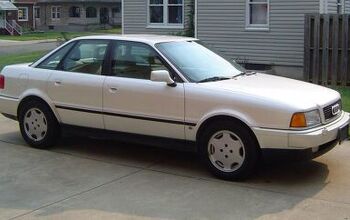
My tale of unreliability comes from a car I’ve mentioned before on these hallowed pages. Though I suspect I’m not unique in experiencing a first car which was unreliable, perhaps mine had different problems than yours (unless yours was also an Audi 5000 — I know you’re out there). My minimum wage job as a cashier at Kroger netted me the light blue rectangle from 1987 which graced my parent’s driveway and the street in front of their house in 2002. The very special 5000 was bestowed with excellent rustproofing, dark blue velour seats, and a myriad of issues.
Straight away after purchase my dad and I discovered a coolant leak due to a bad water pump. The prior owner (original owner, mind you) surely knew about it, and in a case of BHPH-at-home, failed to disclose. The replacement was not an especially fun job, but my dad was able to fix it and keep me out of an expensive repair shop. While we’re on the subject of things that were actually fixed, a few months down the road there was a slight problem with the radiator. The inlet of the radiator (plastic) suddenly disintegrated, leaving me with a smelly and hot ride home from school one early summer day. It was all one piece, so a new radiator was required. I think it was something over $600 for a replacement. That was about 125 hours of cashiering.
Somewhere between the water pump and the radiator blowout, one of the trigger door handles gave out. The 5000’s unique trigger handles were made of (many) relatively fragile parts inside, parts which wore out. Removing the inside of the door was no quick job, though at least a used replacement handle only ran $50 or so. Such a unique crunching sound those door triggers made as they broke! Bonus: Watch out for icy weather, where water gets in the trigger components, freezes, and can lead to failure.
The rest of the issues were never fixed, but instead received a “bang on it or jiggle wires” treatment. Door locks were vacuum actuated by a pump in the trunk, which would sometimes run and other times not. Often, the doors would lock and unlock one at a time — usually when you were away from the car overnight. Best not to leave any valuables in ye olde 5000. The GM-sourced climate control was not the pinnacle of reliability, and would sometimes cease to operate. A kick to the underside of the dash, or a reach for some loose wires to jiggle would often wake it back up from its slumber.
My particular 5000 did not enjoy the cold weather at all, really. In addition to the door handle problems caused by cold and freezing, the rear brakes would often stick on at the first stop of the morning on the way to school. It made for quite a nice smoke trail behind me as I arrived for class. The throttle (or something) got a bit sticky in similar weather, and there were a few instances of unintended acceleration when switching from park to drive, with erratic idling conditions. Just a lurch forward of a couple feet, then it would usually settle down. The ’93 Audi 90S which replaced it two years afterward was considerably better in all respects.
In fact, every other car I’ve had was more reliable than that Audi 5000, considering I had it for two years and maybe 4,000 miles. What’s your worst tale of automotive unreliability?
[Image: Murilee Martin / The Truth About Cars]
Interested in lots of cars and their various historical contexts. Started writing articles for TTAC in late 2016, when my first posts were QOTDs. From there I started a few new series like Rare Rides, Buy/Drive/Burn, Abandoned History, and most recently Rare Rides Icons. Operating from a home base in Cincinnati, Ohio, a relative auto journalist dead zone. Many of my articles are prompted by something I'll see on social media that sparks my interest and causes me to research. Finding articles and information from the early days of the internet and beyond that covers the little details lost to time: trim packages, color and wheel choices, interior fabrics. Beyond those, I'm fascinated by automotive industry experiments, both failures and successes. Lately I've taken an interest in AI, and generating "what if" type images for car models long dead. Reincarnating a modern Toyota Paseo, Lincoln Mark IX, or Isuzu Trooper through a text prompt is fun. Fun to post them on Twitter too, and watch people overreact. To that end, the social media I use most is Twitter, @CoreyLewis86. I also contribute pieces for Forbes Wheels and Forbes Home.
More by Corey Lewis















Comments
Join the conversation
2002 Jetta GL. Purchased new in December 2001. April of 2002 could barely get up to 2000RPM in any gear. Engine and transmission replaced under warranty by dealer after flying in a tech from VW North American HQ to see how/why it happened. The explanation given: shrug. 2006 Range Rover Autobiography. Suspension x3, and every other problem associated with Land Rover. Never even made it to 90k miles.
Late to reply here. '73 Austin Marina Purchased new, stopped at the mall to get groceries on the way home from the dealer, it wouldn't go into Reverse. Pretty much went downhill from there.