
Mazda Reveals a Treasure Trove of MX-5 Miata Design History, Shows How We Got the Fourth-gen ND Miata

The end result is tasty. Maybe the narrow headlamps are sliced too thinly; the hood cut line that intersects with the housing too obvious. Perhaps the rear end could use a bit more breadth. The wheels still appear a bit small from some angles.
But the fourth-generation Mazda MX-5 Miata — known in Mazda circles as the ND, succeeding the NA, NB, and NC — is generally regarded as an eye-catching, modern, successful evolution of the venerable Mazda sports car.
How did Mazda arrive at the end result? What led Mazda to settle on the final production version? Which styling direction was rejected?
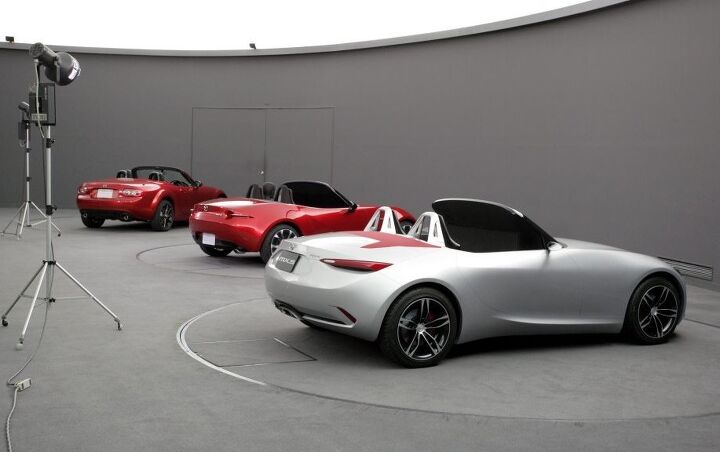
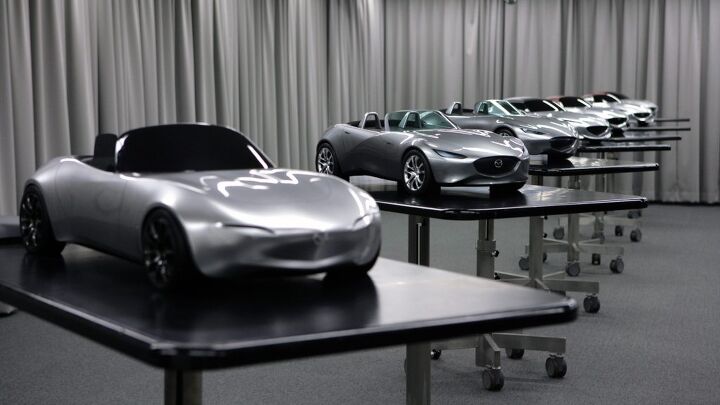
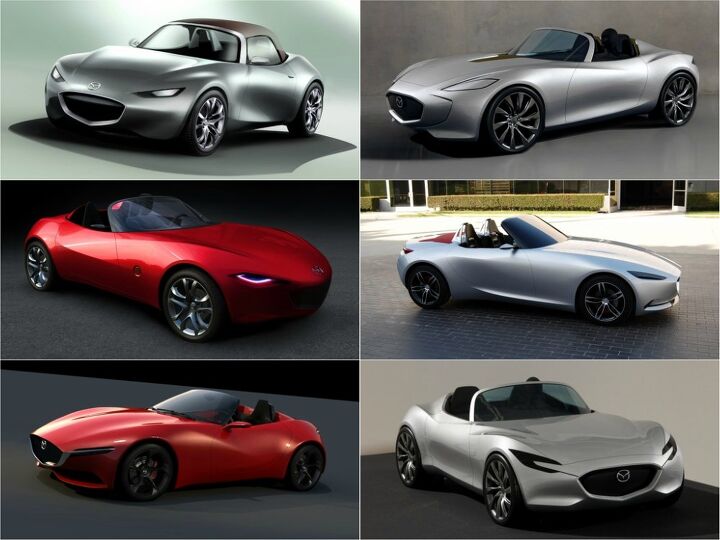
In a fit of transparency, Mazda’s PR department has released the entire background of the process, including 140 photos detailing the evolution of what would become the fourth-generation Mazda MX-5.
A new MX-5 is a big deal, not just because it serves as a global status symbol for the Mazda brand, not just because it’s an enthusiast-oriented car often covered by enthusiast press. The dawn of a new MX-5 is a big deal because it’s such a rare occurrence.
Nearly a decade passed by between the production start of the third-gen Miata and the ND Miata’s unveiling in September 2014. That’s a lot of time to think about what the next Miata is going to look like.
Mazda was strict with its internal objectives. “The car had to be lighter, smaller, more efficient and with a design that shared little between it and other Mazda vehicles,” Mazda says. Led by Ikuo Maeda, Mazda began working on the appearance of the fourth-gen Miata in 2011, with designers in Europe, the U.S., and Japan.
Although Mazda wanted the new Miata to return to its roots, it couldn’t just be a car that appealed to fans of the 1990 Miata. Newly licensed drivers of today weren’t born until 2001, more than a decade after the first Miata arrived in America.
Mazda says its designers’ goals required them to style a car that was “simple and distinct” yet also “emotional and expressive” — conflicting expectations that inevitably slowed the process. Mazda’s Japanese designers ended up styling a car that Mazda’s American designers found in February 2012 to be too similar to the original NA Miata. Mazda’s Japanese designers, on the other hand, felt the Americans’ Miata “didn’t capture raw emotional excitement.”
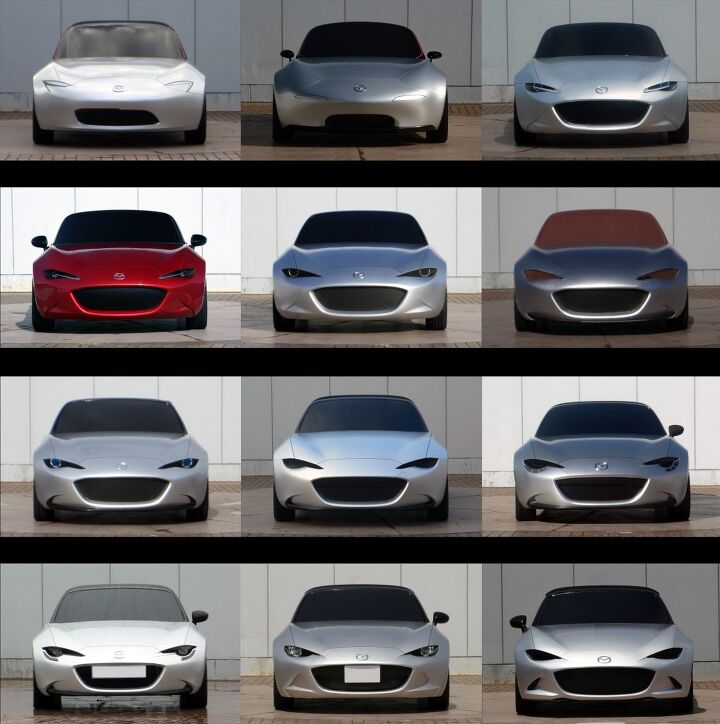
One theory didn’t win out over the other, as the designers began to adopt the Japanese theme while integrating U.S. and European detailing for a car that would appear “uniquely Japanese” but still “globally relevant.” The final proposals were revealed inside Mazda in October 2012.
But that was just the body, so Mazda then went to work on the ND’s face. The pop-up headlights made possible a low-slung front fascia in the first Miata that Mazda felt had been lost in successive generations. With no chance of bringing pop-ups back, Mazda still wanted to bring the front end appearance closer to the ground. Mazda’s European designers’ approach was vital in this regard. Adopting LEDs made possible a lower hood line, as well.
By the end of 2013, Mazda was tinkering with the final version in anticipation of 2014’s September reveal.
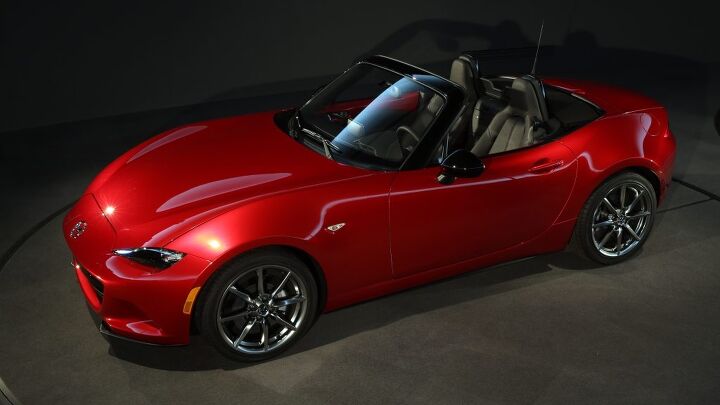
Besides conflicting internal voices, conflicting priorities stand in the way of an automaker producing any sports car designer’s ideal design. The production BMW Z4, for instance, won’t offer some of the more extravagant detailing and surfacing of the roadster concept unveiled last week. Yet while we’d all, in our own subjective way, choose elements of the latest MX-5 to change, the new MX-5 does appeaer to be every inch a Miata and yet strikingly different from the NC Miata that lingered from 2006 until 2015.
Surely on that point we can all agree that Mazda did what Mazda intended to do.
[Images: Mazda]
Timothy Cain is a contributing analyst at The Truth About Cars and Autofocus.ca and the founder and former editor of GoodCarBadCar.net. Follow on Twitter @timcaincars.
More by Timothy Cain
Latest Car Reviews
Read moreLatest Product Reviews
Read moreRecent Comments
- Amwhalbi My 1972 Mercury Capri was my first stick shift car. God, I miss that thing. It was a blast to drive.
- Vid169489471 The technology exists today to produce a variable color temperature (kelvin) LED lamp. It can vary from 2700k that soft orange look to 6500k the bright daylight with the bluish tint.Since everything in a late model car is computer controlled, it would be an easy task to write a few lines of code that enables your vehicle to not only dim down from hi to low beam but to shift color temp down to the 2700k range for oncoming traffic, then back up to 5000k once oncoming traffic has passed. For the operator it would be automatic and seamless. For older cars they could be retrofitted with LEDs that are 2700k on low beam and 5000k on hi beam. As far as standards, there could be a lumens max, and a minimum. Several States already have minimum lumen standards going back to the old incandescent bulbs. Why not update these to national standards.
- Jam169859557 More regulation is needed for ALL vehicle lighting systems. [list=1][*]The lighting that is most blinding are the rapidly flashing red, blue and amber lights on emergency vehicles. The lights themselves are blinding, flashing so rapidly that it's impossible for even the sharpest eyes to adjust. What's worse, is the nature of the emergency requires a careful view of the area surrounding the emergency vehicle. There is something going on that needs to be seen. More flashing lights is not the solution.[/*][*]Brighter headlights need to be regulated. The tall riding vehicles do not need headlights positioned so high that they blind drivers in lower riding vehicles. And those heasdlights need to be aimed properly. When I first started driving my 2020 Subaru Outback, many drivers would flash their lights, hoping I would dim my lights. This stopped after I performed am easy adjustment that tilted the beam lower. Late model Subaru headlamps are designed with a sharp cutoff that project less glare above the hood line. When the headlights are properly aimed, other drivers are not blinded by the beam.[/*][*]Customized light assemblies make it more difficult to see the marker lights (tail lamps, turn signals and side marker lamps) that have been tinted. There are many municiple codes that prohibit this tinting, but these laws are seldom enforced.[/*][/list=1]Solutions: Tight controls on emergency vehicle lighting. In trying to make these vehicles more visible, a dangerous side effect is reducing the ability of drivers to see the surrounding perils.Headlight design regulations that reduce the height of the headlight assemblies. Just because a pickup truck has a hood that sits 4 feet abouve the pavement, it does not mean the headlights need to be so high. Owneres should maintain proper adjustments to their vehicle headlights.Establish and enforce regulation requiring a illumination standard be followed.
- Stl170698708 as someone who hates big government, and their interference;but you can add me to the list of people that are blinded by the lights.unfortunately "the poop is out of the horse and no way is it going back in"They have had 5 years to make lights bigger, badder and brighter because in the vehicle work it is go big or go home!Trucks are the worst because so many people use them to express their dominance and that is big, big, big $$ both at the Original Purchase and in the Aftermarket world.If, we are so lucky to get some good government regulation on this it will also take some very good Court enforcement to get the aftermarket people with fines and lawsuits.Much like the EPA did with the Diesel Tuner Industry that felt emission regulations didn't apply to them.This is from someone that owns said pickup truck with the same bright headlights,but i only use the truck when I have too and always turn off the Fog lights when driving in traffic.
- Art65765977 I saw a porsche 911 with the most amazing headlights from behind approaching the Sunshine skyway in Florida. The pattern was 108 degrees across sweeping the road like a broom. My brother and I were amazed. I don't know what it looked like from the front but i am sure it was better than American cars
Comments
Join the conversation
I love the Bugs Bunny Tokio Jokio look of the bottom pics.
Is there a link anywhere showing all 140 concepts?