
QOTD: What's the Most You Will Pay to Have Autonomous Decency?
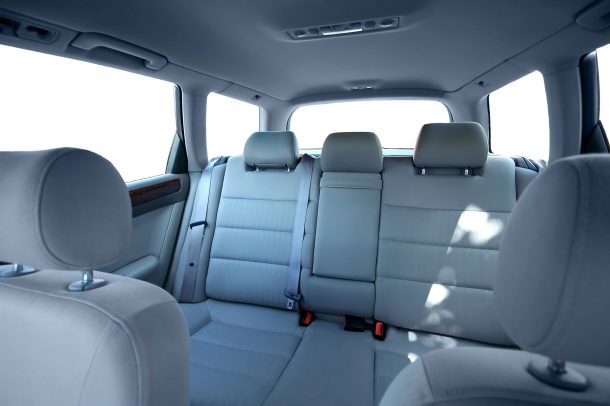
Yesterday, we talked about how self-driving cabs would quickly become absolutely filthy, the same way that most of mass transit is absolutely filthy. I’m not sure if that’s always the case, to be honest.
Which got me thinking about autonomous vehicles — is there a way I could ruthlessly limit the customer base of any given vehicle to those whose thoughts on personal hygiene, food disposal, and bodily fluids mirrored mine? There are surely people who are fussier than I am, as well, and perhaps they don’t want me in their vehicles.
I also suspect that the cost of using an autonomous service will have to slip below $499/month for people to well and truly consider it. Maybe it can be a little more expensive in Manhattan or Chicago but very few people in the Brave New World really have much more than five Benjis a month to spend on transportation. So let’s say that the base price for autonomy is $499/month. How much more would you pay for your tier? And what do you expect from that tier?
As for me, I’d pay $200/month more to have an outrageously exclusive set of parameters placed on my customer group. I’m thinking I want age restrictions for sure. Young people are messy and as Perry Farrell once sang, the elderlies are like children. I don’t want aromatic food in my vehicle. I don’t want the residuals of cologne or perfume in my vehicle. I want it to meet the standards currently set by my Accord — imperfect, but not more than ten minutes of cleaning away from being ready to sell.
How about you?
[Image: Blaz Kure/ Bigstock]
More by Jack Baruth
Latest Car Reviews
Read moreLatest Product Reviews
Read moreRecent Comments
- Amwhalbi My 1972 Mercury Capri was my first stick shift car. God, I miss that thing. It was a blast to drive.
- Vid169489471 The technology exists today to produce a variable color temperature (kelvin) LED lamp. It can vary from 2700k that soft orange look to 6500k the bright daylight with the bluish tint.Since everything in a late model car is computer controlled, it would be an easy task to write a few lines of code that enables your vehicle to not only dim down from hi to low beam but to shift color temp down to the 2700k range for oncoming traffic, then back up to 5000k once oncoming traffic has passed. For the operator it would be automatic and seamless. For older cars they could be retrofitted with LEDs that are 2700k on low beam and 5000k on hi beam. As far as standards, there could be a lumens max, and a minimum. Several States already have minimum lumen standards going back to the old incandescent bulbs. Why not update these to national standards.
- Jam169859557 More regulation is needed for ALL vehicle lighting systems. [list=1][*]The lighting that is most blinding are the rapidly flashing red, blue and amber lights on emergency vehicles. The lights themselves are blinding, flashing so rapidly that it's impossible for even the sharpest eyes to adjust. What's worse, is the nature of the emergency requires a careful view of the area surrounding the emergency vehicle. There is something going on that needs to be seen. More flashing lights is not the solution.[/*][*]Brighter headlights need to be regulated. The tall riding vehicles do not need headlights positioned so high that they blind drivers in lower riding vehicles. And those heasdlights need to be aimed properly. When I first started driving my 2020 Subaru Outback, many drivers would flash their lights, hoping I would dim my lights. This stopped after I performed am easy adjustment that tilted the beam lower. Late model Subaru headlamps are designed with a sharp cutoff that project less glare above the hood line. When the headlights are properly aimed, other drivers are not blinded by the beam.[/*][*]Customized light assemblies make it more difficult to see the marker lights (tail lamps, turn signals and side marker lamps) that have been tinted. There are many municiple codes that prohibit this tinting, but these laws are seldom enforced.[/*][/list=1]Solutions: Tight controls on emergency vehicle lighting. In trying to make these vehicles more visible, a dangerous side effect is reducing the ability of drivers to see the surrounding perils.Headlight design regulations that reduce the height of the headlight assemblies. Just because a pickup truck has a hood that sits 4 feet abouve the pavement, it does not mean the headlights need to be so high. Owneres should maintain proper adjustments to their vehicle headlights.Establish and enforce regulation requiring a illumination standard be followed.
- Stl170698708 as someone who hates big government, and their interference;but you can add me to the list of people that are blinded by the lights.unfortunately "the poop is out of the horse and no way is it going back in"They have had 5 years to make lights bigger, badder and brighter because in the vehicle work it is go big or go home!Trucks are the worst because so many people use them to express their dominance and that is big, big, big $$ both at the Original Purchase and in the Aftermarket world.If, we are so lucky to get some good government regulation on this it will also take some very good Court enforcement to get the aftermarket people with fines and lawsuits.Much like the EPA did with the Diesel Tuner Industry that felt emission regulations didn't apply to them.This is from someone that owns said pickup truck with the same bright headlights,but i only use the truck when I have too and always turn off the Fog lights when driving in traffic.
- Art65765977 I saw a porsche 911 with the most amazing headlights from behind approaching the Sunshine skyway in Florida. The pattern was 108 degrees across sweeping the road like a broom. My brother and I were amazed. I don't know what it looked like from the front but i am sure it was better than American cars
Comments
Join the conversation
You are assuming that vehicle sharing will replace ownership. I suspect most people who can afford the cost of ownership will still prefer it over tolerating the messes that other users leave behind. For me, how well the vehicle functions in autonomous mode will be the critical factor. If I'm going to the grocery store, I will want to get into it inside my garage, announce my destination, and enjoy the ride until it has parked itself in a slot near the store's front door. In situations where there is no parking nearby, I would expect it to drop me off at the front door and then find a parking place where it would await my summons. Until autonomous vehicles can function at that level, I fail to see their usefulness.
Hard to say because this consumer behavior is on the backlash/outrage spectrum. It's like gasoline prices. They rise and nobody really cares, then one day, society draws a line in the sand and rage spreads throughout the population, and people start buying economy cars and hybrids en masse. It's not really possible to gauge your rage before hand so I'm not sure what would trigger my desire to spend more money. I don't fly first class, though I jammed in coach seats like a sardine for 3-4 hours. I can say confidently that personal space will not affect my decision. I'm pretty sure puke would set me off, and I'd probably be willing to drop another $150-$200 in order to escape the weekend puke brigade. Maybe autonomous vehicles could have age restrictions like rent cars. Everyone under 25 get the city bus plastic seat treatment.